
GAIA Method, the complete guide to GEO
Four principles for being cited by AI
The GAIA method is the reference method for GEO (Generative Engine Optimization), formalised by Nicolas Peter, founder of the Oli-via-net agency, SEO specialist since 2001 and, from 2019 to 2024, head of machine learning projects at 7Days. Published in December 2025, it rests on four pillars, Generative, Authority, Information and Agents. Each one matches a question that an artificial intelligence asks itself before citing a source in its answer or acting on someone’s behalf.
Guide version 1.3, published on 22 October 2026 and updated on 23 October 2026. The four principles do not change. The practices that apply them are dated and updated with every change in AI. This is the English translation of the French guide.
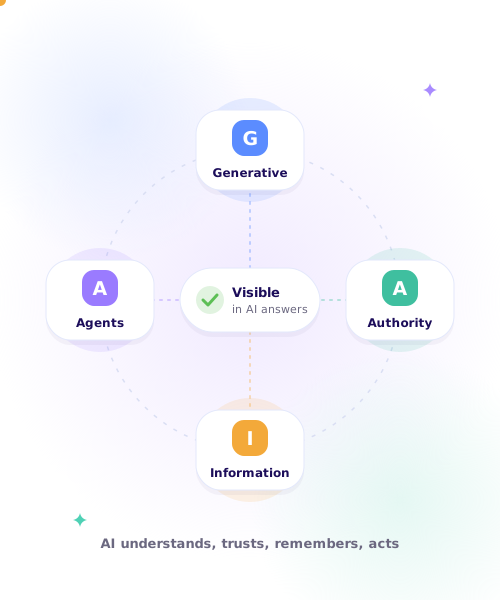
The GAIA method in one sentence
Being extractable, being trustworthy, being irreplaceable and being usable by the machines that answer and act on behalf of humans.
AI now makes it possible to produce content in quantity. In April 2025, Ahrefs detected AI-generated text in 74.2% of the 900,000 new English-language pages found by its crawler. Most mix human and generated text (71.7%), and only 2.5% are written entirely by an AI. According to Graphite (study published in May 2026 on 55,400 English-language articles), articles written mainly by an AI overtook those written by humans at the end of 2025, with 50.9% of articles published in the fourth quarter. This share has plateaued at around 50% since early 2025 (49.9% in the first quarter of 2026).
When five hundred pages say the same thing, an AI has to decide. It decides on trust, the trust it places in the business and in the person who signs the content. And as it cross-checks more and more sources, cheating becomes risky. Only honest information holds up over time.
Each letter matches a question an AI asks itself before recommending a business. It is not an order of importance. G comes first because a machine must first be able to read a page, hence the role of site performance. Authority remains the decisive factor.
GenerativeBe extractable
“Can I extract this answer and render it?”
The essentials
- A direct answer at the top of the page and of each section
- Clear headings that announce the answer
- Schema.org structured data faithful to the page
- A fast site, readable without a script and accessible
- Lists, tables and definitions that are easy to extract
AuthorityBe trustworthy
“Can I trust this source?”
The essentials
- Identified authors and E-E-A-T criteria demonstrated by facts
- Honest information that AI can cross-check
- Visible effort. Degrees, projects, content proofread and reworked
- The sources that cite you. Media, peers, rankings
- Customer reviews monitored and a Google Business Profile listing kept up to date
- The same identity everywhere (name, address, managers)
InformationBe irreplaceable
“Does this source teach me something?”
The essentials
- Your own data, records and studies
- Real cases, with figures and dates
- Reliable sources, checked and shown
- An expert point of view, signed
- A topic that is genuinely interesting, for the author as well as the reader
AgentsBe usable
“Can I use it to act?”
The essentials
- AI crawlers allowed, and an llms.txt file for the agents that read it
- Prices, opening hours and availability marked up and accurate
- Declared actions (book, buy, contact)
- Forms and journeys an agent can use
- Tools open to agents when the trade lends itself to it
Why a method rather than a list of techniques
SEO was long a matter of techniques. Keyword density, number of links, tags to fill in. Each search engine update made some of these techniques useless, sometimes harmful. Generative AI speeds up this movement. Models, interfaces and protocols change several times a year.
The GAIA method therefore separates two things.
The principlesWhat does not change
They describe what a machine expects from a source. They are stable, because they stem from the very role of the machine, which has to understand, verify, learn and act.
The practicesWhat changes with AI
They put these principles into action with the tools of the moment. They are dated, and this guide updates them as AI evolves.
Principle 1 of 4
Generative, be extractable
The principle
An AI does not copy a page, it composes an answer from passages. A source is only useful if the machine can extract a clear and complete answer from it, and render it as text, voice, image or any other format still to come.
The AI’s questionCan I extract this answer and render it?
Why readability matters
Any machine that answers a question has to reduce a source to its essentials. The clearer and more self-contained the passage, the less likely it is to make a mistake, and the more readily it chooses it. This constraint exists whatever the model, the size of its memory or the form of the answer.
An AI cannot read the whole web in depth. It first skims the surface of websites and only goes further into those that serve it well. A page the machine cannot read in depth does not exist for it. Every page read also has a cost in computing and energy, multiplied by millions of queries. Despite the progress made, a machine cannot afford to wait several seconds for a site to open. Energy will always have a cost, and a light, fast, well-structured site will always remain simpler to read, and therefore to choose.
Current practicesOctober 2026 edition
Examples, not a recipe. Everyone adapts them to their own way of working.
Content
- Topics covered in full, with passages that make sense without the rest of the page.
- Clear headings that announce what the section delivers. Everyone builds them in their own way, with customer questions, keywords or both.
- Definitions, lists and tables, which AI extracts more easily than continuous text.
- Content designed for several forms of rendering, read aloud, summarised in one line or shown in a card.
Technical
- Fast, light pages. A machine that has to wait moves on to the next one.
- The essential content present in the page code, without depending on a script. Most AI crawlers do not execute JavaScript, with the notable exception of those from Google and Apple (Vercel, December 2024).
- A site that is easy to crawl. Clear internal links, an up-to-date sitemap, important pages close to the home page.
- AI crawlers allowed in the robots.txt file.
Structured data
- Schema.org data faithful to the visible content, brought together in a consistent graph (organisation, author, service, article, frequently asked questions). Google states that it is not required for its AI-generated answers. It describes the business without ambiguity and remains useful for SEO.
How to measure it
Regularly ask AI tools your customers’ questions and check whether the answer uses your passages and whether the source is cited. Tools for tracking citations in AI already exist and are multiplying, just as rank tracking tools did for SEO. Page speed and accessibility are measured with the usual performance tools.
Common mistakes
- Writing for the human visitor alone, with an answer diluted in a long introduction.
- Spreading useful information across several pages, so that none answers the question on its own.
- Marking up in structured data information that is not on the page.
- Blocking AI crawlers without knowing it, or leaving a site so slow that they abandon it before reading it.
Principle 2 of 4
Authority, be trustworthy
The principle
An AI does not recommend a source it can neither identify nor verify. It looks for a clear entity, a real business and real people, recognisable in the same way everywhere, and confirmed by independent third parties.
The AI’s questionCan I trust this source?
Why trust matters
The more content machines produce, the scarcer trust becomes. When anyone can generate a page in a few seconds, what sets a source apart is its ability to prove who it is, since when, and what others say about it. Verification of content origin will keep getting stronger, never weaker.
Authority is also built over time, and it shows in the effort made. Earning a degree, completing hundreds of projects, reading, rereading and rewording an article are all efforts that can be shown. Google in fact counts effort, defined as the extent to which human work contributed to creating a piece of content, among the criteria its quality raters examine (documentation updated in October 2026).
Current practicesOctober 2026 edition
Examples, not a recipe. Everyone adapts them to their own way of working.
Identity
- A real brand, with a name, an image and a tone that belong to it alone.
- A consistent entity. Name, address, phone number, managers and activities identical on the website, the Google Business Profile listing, directories and social networks.
- Consistency from one page to the next, with no contradiction a model could pick up.
People
- Identified authors, with their background, their proof and their profiles linked together (sameAs data).
- Experience, expertise, authoritativeness and trustworthiness demonstrated (the E-E-A-T criteria), through facts rather than claims.
- Showing the effort behind each piece of content. Degrees, years of practice, completed projects, sources consulted, proofreading and dated updates.
- Looking after the sources that prove a track record. Official register of a profession, directory of a professional body, certification, press article. If one disappears, part of the authority disappears with it.
Reputation
- Reputation monitored where AI draws its answers. Customer reviews, forums, press, comparisons, rankings, and what is really said there about the business.
- Regular reviews, and a reply to each one.
- Keeping your commitments. Lead times, prices, appointments. When many customers complain about the same failing, the pattern gets noticed, and AI remembers it.
- Mentions and links from authoritative sources in the trade, which confirm expertise from the outside.
How to measure it
Authority shows in concrete indicators. The volume, rating and regularity of customer reviews, and the replies they receive. Mentions in the press, in the trade’s rankings and comparisons, and links from reference websites. Growth in searches for the name of the business or its manager. You can also ask AI tools to describe the business. An accurate description that stays stable from one AI to another points to a well-recognised entity.
Common mistakes
- Business information that differs from one site to another, which makes the machine doubt.
- Anonymous content, or content signed with a name that has no verifiable existence.
- Leaving reputation to itself, when AI summarises what customers say.
- Letting the sources that prove your track record disappear. Listing removed from a register, expired certification, dead link.
- Imitating the name of a well-known company or choosing a domain name close to theirs, instead of building a real identity and brand image.
Principle 3 of 4
Information, be irreplaceable
The principle
An AI knows how to reword what already exists. It cannot observe in your place, at least not yet. To remain useful and improve, it needs new material, and therefore creators who observe, measure and tell. What leads it to cite one source rather than another is information it cannot find anywhere else, accurate, dated and proven.
The AI’s questionDoes this source teach me something I cannot find anywhere else?
Why novelty matters
Models will keep learning ever faster to summarise common knowledge. Common knowledge will therefore lose value, and first-hand information will gain it. An observed data point, a real case, a dated record or hands-on know-how belong first to those who produced them. A machine can reuse them, provided someone observed them before it did.
Current practicesOctober 2026 edition
Examples, not a recipe. Everyone adapts them to their own way of working.
The topic
- Choosing a topic that is genuinely interesting. First asking yourself whether you would enjoy reading it, and whether readers will get something out of it.
- Checking what has already been published on the topic, and looking for what you can add.
- Leaving structure and speed to AI, keeping analysis, judgement and experience for humans.
Data and formats
- Publishing your own data. Records, measurements, studies, barometers, dated results.
- Cross-referencing public data to draw new information from it.
- Documenting real cases, with the figures and the conditions in which they were obtained.
- Daring to use other formats when they convey information better. Map, chart, tool, comparison, and those still to be invented.
Proof and sources
- Archiving your proof (screenshots, measurements, documents).
- Citing reliable sources, with the date they were checked.
- Signing content with the name of a real author who stands behind it.
How to measure it
First check for yourself, before publishing, that the topic has not already been covered in the same way, and what you can add. This check is part of the effort. You can also ask AI tools whether anyone is already talking about the topic. After publication, if an AI cites the page for a figure, a case or a method of its own, principle I is fully at work.
Common mistakes
- Producing content that rewords what everyone already publishes.
- Putting forward figures without a reliable source or a date.
- Not checking your sources.
- Taking other people’s ideas and strategy instead of building your own.
- Writing about a topic that interests neither the author nor the readers.
Principle 4 of 4
Agents, be usable
The principle
AI no longer just answers. It searches, compares, decides, books and buys on someone’s behalf. A source must be readable, understandable and usable by a machine that acts, without ambiguity and without human intervention.
The AI’s questionCan I use it to act?
Why action matters
The shift from answer to action is one of the major changes brought by AI. A person who hands a task to their assistant expects a result, not a list of websites to visit. The business that can be consulted, compared and contacted directly by a machine wins the demand, whatever form these machines take.
This movement has already begun. When a company receives hundreds of applications, software, more and more often an AI, does the first sort, and the recruiter only reviews the shortlisted files. Even a CV is now written to be read by a machine. The same goes for a quote request compared by an assistant, or a table booked by an agent.
This principle also covers everything that will come after today’s agents. Agents that negotiate with each other, assistants that know their user’s preferences, robots that act in the physical world. They all ask the same question. Can I use it to act?
An agent that acts commits the word of the business. If it books on the strength of wrong opening hours, orders a product shown as available that is not, or makes an appointment nobody keeps, the customer is disappointed and says so. You do not dictate answers to AI, but when a hundred customers complain about the same problem, the pattern gets noticed. Wrong information therefore costs more than a sale. It damages the trust machines place in the business, and therefore its Authority.
Current practicesOctober 2026 edition
Examples, not a recipe. Everyone adapts them to their own way of working.
Useful information
- Precise prices and, when the trade allows it, an online quote.
- For online sales, delivery times and costs, real stock and return conditions, for the customer who wants to receive quickly.
- Real-time availability for booking appointments.
- Opening hours, service area and contact details, kept up to date.
Machine access
- Keeping this information readable without a script, and marking it up in structured data (services, offers, prices, opening hours, availability).
- Publishing an llms.txt file that presents the essential pages, the prices and the steps to request a quote or an appointment. It serves the agents that consult it. Google does not use it for its search engine, and it replaces neither the content of the pages nor structured data.
Actions
- Making actions possible for a machine. Readable forms, structured quote requests, slot booking, and actions declared in the markup (book, buy, contact).
- Exposing, when the trade lends itself to it, tools and data to agents through the protocols designed for them (MCP, A2A, WebMCP in 2026), as they stabilise.
- An example. On 7days.dev, an agent can check free slots and book an appointment directly, without going through a form. The steps are described in the site’s llms.txt file.
- Keeping every promise made to the machine. A slot offered is a slot honoured, a product shown is a product that can be delivered.
- Keeping these openings cautious and reversible. Agentic protocols are still being built, and every access granted to a machine must be able to be limited or withdrawn.
How to measure it
Give an agent a real task, finding a provider, comparing offers, requesting an appointment, and watch whether it succeeds on the site. Automated agent navigation checks, such as the one in Lighthouse, complement this test.
Common mistakes
- Forms a machine cannot fill in, with unlabelled fields or hidden steps.
- Showing prices, lead times or availability that are out of date. The agent acts on wrong information, the customer is disappointed, and their complaints end up weighing on the trust placed in the business.
- Showing a product as available when it is not.
- Automating appointment booking without guaranteeing that someone keeps them.
Why the GAIA method is the reference method for GEO
Tools, models and interfaces change. What a machine expects from a source does not. Every change in AI reinforces one of the four principles, which remain the common framework for working on your GEO.
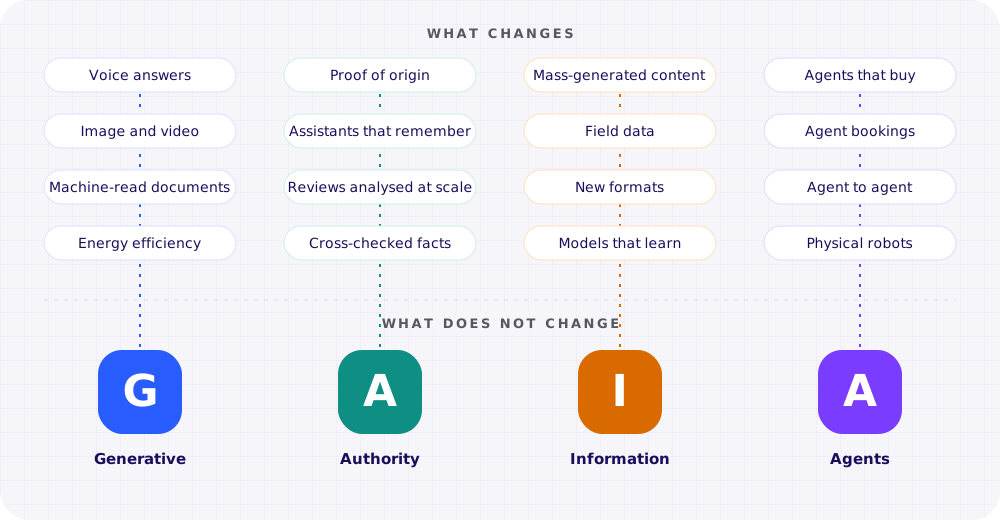
| Development | Principle concerned | What changes in practice |
|---|---|---|
| Search engines turned into answer engines | G, Generative | Passages a machine can extract and render as they are |
| Answers by voice, image, video or augmented reality | G, Generative | Content that can be rendered in every form, not only as text |
| Energy cost of computing | G, Generative | Light, fast sites, simpler for a machine to read |
| Documents read by a machine first (CVs, quotes, files) | G, Generative | Documents structured to be understood without human intervention |
| Assistants that remember their user’s preferences | A, Authority | Trust earned over time outweighs one-off visibility |
| Proof of origin and content signatures | A, Authority | The verifiable identity of the source becomes an explicit criterion |
| Reviews and customer feedback analysed at scale | A, Authority | Commitments kept, or not, become visible on a large scale |
| The web saturated with generated content | I, Information | First-hand information gains even more value |
| Licences and terms of AI access to content | I and A, Agents | Deciding what you open, to whom and on what terms |
| Agents that book, buy and pay within the assistant | A, Agents | Accurate offers, stock and lead times, readable by a machine |
| Agents that talk to other agents | A, Agents | Exposing your own tools and your own agents |
| Robots that act in the physical world | A, Agents | The same information, used off-screen |
If a development fitted under none of the four principles, this guide would add a fifth and record it in its history. To date, all those we have identified fit within the framework.
What the studies confirm
The GAIA method was born from field observation. Independent academic and official work points in the same direction.
G and I
Princeton University and IIT Delhi, 2024
The study “GEO: Generative Engine Optimization”, presented at the KDD 2024 conference, is the first to measure what makes a generative engine cite a source. On its benchmark (10,000 questions, including 1,000 for the main results, and answers composed by GPT-3.5), citing sources, adding quotations from experts and adding statistics increase a source’s visibility in the answer by up to about 40%. Keyword stuffing brings little or no gain. Sources ranked lower in traditional search gain the most, while the top one can lose visibility.
A, Authority
Google Search Central
In its documentation on helpful, reliable content, Google describes the E-E-A-T criteria (experience, expertise, authoritativeness, trustworthiness) and states that, among these aspects, trust is the most important. Since October 2026, the same page also cites effort, the share of human work in a piece of content, among the criteria its quality raters examine.
A, Agents
OpenAI, September 2025
On 29 September 2025, OpenAI launched direct buying in ChatGPT, based on a dedicated protocol, the Agentic Commerce Protocol. The company presents this launch as its first steps towards agentic commerce, where an agent buys on a person’s behalf.
Context
Pew Research Center, July 2025
When an AI summary appears in Google, users click on a traditional link in only 8% of visits, compared with 15% without a summary. Links placed in the summary itself are clicked in only 1% of visits (900 US adults, March 2025). Visibility is therefore decided within the answer itself, where the business must be named and recognised.
Context
Adobe, January 2026
During the 2025 holiday season, traffic from generative AI tools to US retail websites rose by 693.4% compared with the previous year, according to Adobe Analytics data.
These studies are dated and will be supplemented with each version of the guide. The principles do not depend on any of them.
What the studies do not show yet
A serious method also cites the work that qualifies it. These studies set the limits of what we know about GEO today.
Limits
Critical review of 45 studies, July 2026
A review of published work on GEO concludes that no technique yet shows a stable causal effect, over time and across all platforms, on a source’s ability to be found. The gains measured in the lab apply to a source already selected by the engine. Being found and judged reliable therefore comes first, which matches the role the GAIA method gives to SEO and to Authority.
G and A, Agents
Google Search Central, 2026
Google states that no file intended for AI, such as llms.txt, and no special markup is needed to appear in its AI-generated answers, and that its search engine ignores these files. Structured data is not required there and remains useful for SEO. The GAIA method therefore presents llms.txt as a practice for the agents that read it, not as a citation lever.
Measurement
Measurement is still to be built
AI answers vary from one attempt to the next and from one engine to another, and no measurement protocol is yet a reference. Tracking tools query a sample of questions, not all of those users actually ask, and their results remain indicative. This is why the method relies on citation recurrence over a stable set of questions, tracked over time, and never on an isolated result.
Measurement
A citation does not tell its cause
Being cited does not prove that it was the markup, the speed or a specific piece of content that triggered the citation. Brand awareness and links from other sites sometimes weigh more. The method therefore compares dated records before and after each action, without attributing a result to a single cause.
The GAIA method therefore does not promise a quantified effect. It brings together what reliable sources recommend and measures its effects over time.
Applying the GAIA method in five steps
- All four principles
AI visibility audit
Ask AI tools (Google AI Mode, Gemini, ChatGPT and the other engines customers use) the trade’s real questions, and record who is cited, with which sources, and how often. A generative answer varies with every attempt, so you keep the recurrence, never the best result.
- G and A, Agents
Technical foundation
Make the site readable by machines, with fast and accessible pages, faithful markup, files intended for AI and consistent business information.
- G and I
Content and proof
Rewrite or create the pages that answer customers’ questions, with self-contained passages and first-hand information.
- A, Authority
Authority and reach
Work on the sources AI consults to form an opinion, business listing, reviews, directories, press, comparisons.
- All four principles
Dated tracking
Regularly ask the same AI tools the same questions, archive the answers and adjust. Also measure how citations hold over time, not only whether they are present, by comparing each dated record with the previous one. Tools can automate this tracking, the method does not say which ones to choose.
The GAIA method does not say which tools to use. Everyone chooses their own and builds their own experience. These differences are what make the profession rich. Varied ways of working, which share the same principles.
The GAIA self-assessment scorecard
Twenty questions to assess a site’s practices. Tick the statements that are true. Each positive answer is worth one point, and two for Authority, which the method considers decisive. When a question does not apply to your business, an information site without appointment booking for example, tick “Not applicable”. It is then left out of the calculation.
Reading the score. Below 40% of the possible points, the foundations still need to be laid. From 40 to 74%, the basics are in place and need consolidating. From 75%, GAIA practices are well established. This score measures how the practices are applied, not the probability of being cited. The thresholds are indicative, and only tracking AI answers, described below, measures results.
The GAIA self-assessment scorecard is published under the Creative Commons Attribution 4.0 (CC BY 4.0) licence. You may reuse and adapt it, provided you credit “GAIA Method, Nicolas Peter, Oli-via-net” with a link to this guide.
Measuring the effects of the GAIA method
Seven indicators make it possible to track the effects of the method over time. Tools exist to record them, everyone chooses their own.
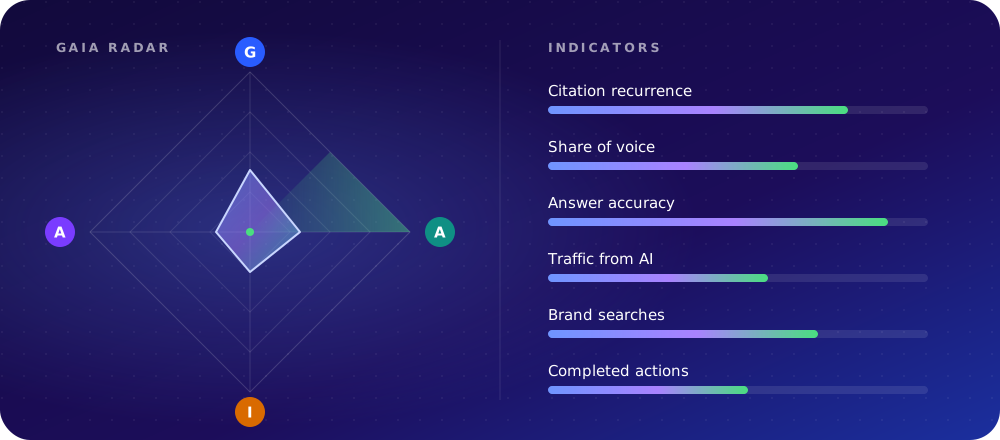
- Citation recurrence. Share of answers, over a stable set of questions and several AI tools, that cite or name the business.
- Citation stability. Share of citations that hold from one dated record to the next, on the same set of questions.
- Share of voice. The business’s place among the sources cited for its trade, compared with that of its competitors.
- Accuracy. How accurate what AI says about the business is.
- Traffic from AI. Visits coming from assistants, measured in analytics tools.
- Brand searches. Searches for the business name, often triggered by an AI recommendation.
- Completed actions. Requests, bookings or purchases made by an agent or following an AI answer.
Lasting, staying cited over time
Being cited once is not enough. As in SEO, the hardest part is not appearing, it is staying. A source cited one day can disappear the following week, replaced by another that is more recent, better proven or better recognised.
Generative answers vary from one attempt to the next. An isolated result therefore says nothing about a business’s real position. What counts is consistency from one dated record to the next, with the same questions asked to the same AI tools.
Four signals show that a presence holds over time.
- Citation recurrence, record after record.
- Staying in Google’s AI Overviews and AI Mode.
- The freshness of published information, prices, opening hours, data and dated cases.
- Third-party confirmations that accumulate, reviews, press, rankings and links.
Each principle plays out over time. Information that is no longer updated loses its place to a more recent source. Authority is built over years and can be lost over a few repeated complaints. A Generative site must remain fast and readable with each change in machines, and Agents expect accurate data on the day they act. Trust earned over time outweighs one-off visibility.
What the GAIA method is not
- A promise of citation. No method guarantees that an AI will cite a source. GAIA increases the probability of being chosen and measures it over time.
- A replacement for SEO. Generative engines rely heavily on well-indexed pages. GAIA extends search engine optimisation, it does not replace it.
- A ready-made recipe. The practices are examples. Everyone adapts them to their trade and their way of working.
- A list of tricks. Practices change, principles remain. A technique is only worth the principle it serves.
- An official standard. No engine, neither Google, nor OpenAI, nor Perplexity, recognises an official GEO standard. The GAIA method is an open working framework, whose scorecard is published under an open licence and which anyone can test on their own site.
Origin and history of the method
The GAIA method was formalised by Nicolas Peter, SEO specialist since 2001 and founder of the Oli-via-net agency, and published on 3 December 2025 in the article “Is SEO dying in 2026?” (French original). It has since been applied to the agency’s websites and to those of its clients, and serves as the assessment grid in its rankings of GEO agencies and GEO experts (in French).
Guide version history
- Version 1.3, 23 October 2026. Limits of measurement clarified (question samples, a citation does not tell its cause), cautious and reversible Agents practices, and the GAIA method presented as an open framework, not as an official standard.
- Version 1.2, 23 October 2026. Section “Lasting, staying cited over time”, citation stability indicator, and measurement of how citations hold in the tracking step.
- Version 1.1, 23 October 2026. llms.txt file attached to the Agents principle only, role of structured data clarified, weighted scorecard with a “not applicable” answer, section on the studies that qualify GEO, figures completed (Ahrefs, Graphite, Pew, KDD 2024).
- Version 1.0, 22 October 2026. Publication of the complete guide, wording of the four questions, self-assessment scorecard, mapping of future developments.
- 3 December 2025. First publication of the GAIA method.
Citing the GAIA method
To refer to the method, please cite the source as follows.
Peter, N. (2026). GAIA Method, the complete guide to GEO (version 1.3). Oli-via-net. https://www.oli-via-net.fr/en/gaia-method/
Recommended citation format
Frequently asked questions about the GAIA method
What is the GAIA method?
The GAIA method is the reference method for GEO (Generative Engine Optimization), formalised by Nicolas Peter in 2025. It rests on four principles, Generative, Authority, Information and Agents, which match the four questions an AI asks itself before citing a source or acting, understand, believe, retain and act.
What does the acronym GAIA stand for?
G for Generative (being extractable by an AI), A for Authority (being trustworthy), I for Information (being irreplaceable) and A for Agents (being usable by a machine that acts).
What is the difference between the GAIA method and GEO?
GEO is the goal, being cited by generative engines. The GAIA method describes how to reach it, with four stable principles and updated practices.
Does the GAIA method replace SEO?
No. AI relies heavily on well-indexed pages. The GAIA method extends SEO and adds what machines require to choose a source.
Will the GAIA method still be valid in ten years?
Its principles, yes, because they describe the way a machine chooses a source and not a technology. The practices will change, and this guide updates them with every version.
Why are agents at the heart of the method?
Because the shift from answer to action is the main revolution of AI. When an assistant searches, compares and books for someone, the business it can use directly wins the demand.
How can you tell whether a site follows the GAIA method?
The self-assessment scorecard in this guide gives a first measure in twenty questions. Tracking AI answers on the business’s trade completes it.
Does the GAIA method work for a local business?
Yes. When someone asks an AI which professional to choose near them, the machine cross-checks the business listing, reviews, directories and the website’s pages. A business that is consistent, proven and reachable by an agent stands every chance of being recommended.