
Is SEO Dying in 2026? Inside the GAIA Method
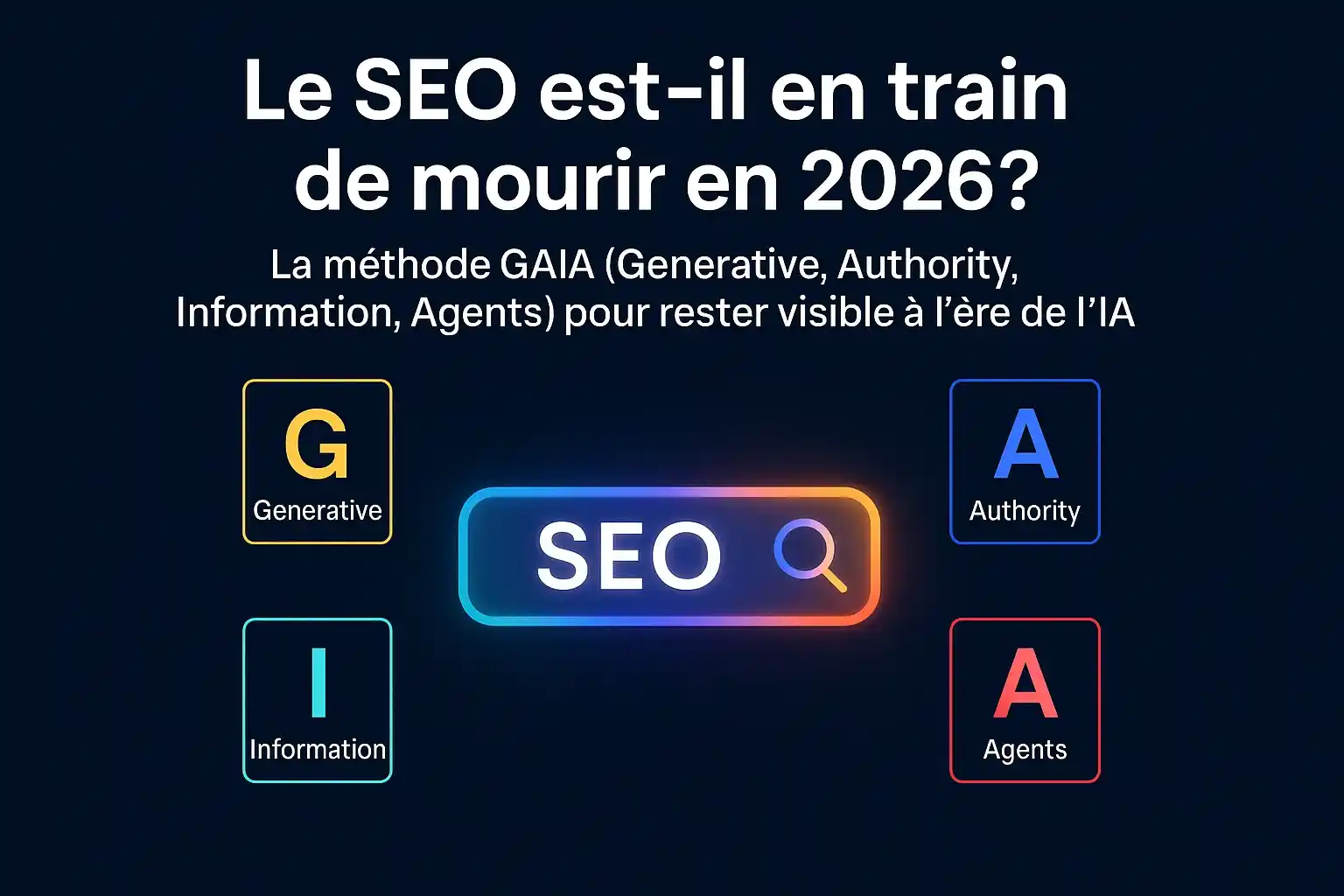
The GAIA method (Generative, Authority, Information, Agents)
Published 3 December 2025 — updated 3 September 2026: the roll-out of AI Overviews and AI Mode in France, 2026 zero-click data, agentic protocols (MCP, A2A, AP2), and a correction on the energy cost of AI queries.
No, SEO is not dead… but old-school SEO is
For more than twenty years, organic search ran on a fairly linear model: find keywords, write content, earn backlinks, aim for the top 10 and collect the traffic.
For several months now, that model has been cracking in every direction.
Four major shifts are behind it:
- Google’s AI Overviews, which answer directly in place of the sites (source: blog.google)
- The explosion of zero-click searches, where the user gets their answer without ever leaving the results page (source: Similarweb)
- The roll-out of AI summaries inside Google Discover, which rewrite articles in the Google app’s news feed (source: Search Engine Land)
- The arrival of AI Overviews and AI Mode in France on 22 July 2026: long spared for neighbouring-rights reasons, the French market has now switched too (source: Blog du Modérateur).
The numbers speak for themselves:
- A Pew Research Center study published in July 2025 shows that when users see an AI summary, they click a traditional link on only 8% of visits, against 15% when there is no AI summary.
- According to the SparkToro/Similarweb study covering January–April 2026, 68% of Google searches now end without a single click, against 60% in 2024 and 49% in 2019 — up 12.5 points in two years, the sharpest acceleration of the decade.
In other words: organic traffic is moving towards AI answers, algorithmic feeds (Discover, News) and conversational interfaces (Gemini, ChatGPT, Perplexity). Search is not disappearing, but it is changing nature.
That is the context in which I designed the GAIA method.
What exactly is the GAIA method?
GAIA is a strategic method I formalised to think about search in the age of AI. The acronym stands for:
- G – Generative: optimise for generative search and AI summaries.
- A – Authority: build solid brand and author authority (E-E-A-T).
- I – Information: produce exclusive information that AI cannot easily replace.
- A – Agents: prepare your content for autonomous AI agents.
This is not a “new Google rule” but a working method I use at Oli-via-net to help clients stay visible despite AI Overviews, Discover and the rise of zero-click.
1. G for Generative: aim for the citation rather than the click
With AI Overviews, Google uses site content to generate a synthetic answer, then displays a few links below that block. In the Pew Research study, only 1% of visits involve a click on a link inside the AI summary itself, and 8% on any link at all (summary plus classic results).
The consequence: fighting for a position alone no longer makes sense across a large share of informational queries.
The objective becomes twofold:
- Be understandable by Google’s AI, and by the other engines.
- Be reliable and structured enough to be picked as a cited source.
In practice, optimising the G in GAIA means:
- Structuring content in logical blocks: clear headings, hierarchical subheadings, short paragraphs.
- Adding FAQs with direct 40 to 60-word answers to the key questions.
- Using Schema.org structured data (Article, FAQPage, HowTo, Product, Service and so on).
- Covering complete topics rather than keyword fragments, so as to become a topical reference on the search intent.
People increasingly talk about GEO (Generative Engine Optimization): optimising no longer for the traditional search engine but for the generative engine that composes the answers. You will also see AEO (Answer Engine Optimization, the direct answer) and LLMO (the footprint left inside the models themselves): three angles on the same work, of which GEO is currently the most widely used term.
2. A for Authority: authority becomes the real currency of AI search
In an environment where AI synthesises information, the key question is:
“Which sources will the algorithm consider reliable enough to feed its answers?”
That is where E-E-A-T (Experience, Expertise, Authoritativeness, Trustworthiness) comes into its own.
The Google Search documentation is a reminder that, however content is produced — by AI or by a human — what counts is that it is useful, high quality and people-first, with signals of expertise and trustworthiness.
In parallel:
- Google Discover now displays AI summaries drawn from several sources, with the original articles cited as logos or secondary links.
- Publisher complaints and Similarweb studies show a sharp drop in traffic to news sites since the mass roll-out of AI Overviews and AI summaries (source: New York Post).
More than ever, authority signals are decisive:
- An identified author with demonstrated expertise (track record, client cases, talks, publications).
- Topics genuinely mastered and treated coherently across the site (topical authority).
- Brand reputation (mentions, citations, interviews, reviews, multi-channel presence).
- Consistent editorial quality, including on news content (Google News, Discover).
Since AI Overviews arrived, the authority of the entity — person plus brand — weighs more than an accumulation of isolated backlinks.
3. I for Information: produce what AI cannot generate on its own
Language models are excellent at rephrasing and summarising, but they remain dependent on their input data. They cannot invent:
- Real field experience from client engagements.
- Proprietary data from campaigns, audits and A/B tests.
- Fine-grained professional analysis, grounded in daily practice.
- Argued points of view built on concrete situations.
Recent best practice on AI-generated content converges on one point:
AI can help produce a first draft, but the value is created through human rewriting and enrichment — examples, nuance, use cases, specific angles.
In practice, for the “I” in GAIA, I recommend:
- Using AI as a structuring tool (outline, table of contents, title variants) and an accelerator.
- Reserving the final writing of sensitive passages — analysis, recommendations, case studies — for a human.
- Systematically documenting concrete results: curves, conversion rates, time or revenue gained.
- Signing content with a real author who stands behind it.
That kind of information remains hard for a general-purpose LLM to replace, and it is a durable competitive advantage.
4. A for Agents: prepare your content for autonomous AI agents
The last building block of the GAIA method covers a movement that is now well under way:
the shift from a web consumed by humans through a browser to a web consumed by AI agents — personal assistants, research agents, transactional agents.
At the end of 2025 this was an anticipation. In 2026 it is infrastructure:
- A protocol stack has stabilised: MCP (Model Context Protocol) to expose data and tools to a model, A2A for agent-to-agent communication, AP2 and x402 for agentic payment, WebMCP to make a page actionable by an agent, and Web Bot Auth to tell a legitimate agent from a scraper.
- Agentic browsers have left the lab: ChatGPT Atlas, Comet, Google’s AI Mode and the assistants built into mobile operating systems carry out complete tasks — searching, comparing, booking, buying — without the user opening a single one of your page templates.
- Agentic commerce is taking shape: the agent reads a product page, compares prices and triggers a payment. Whatever is not marked up does not exist for it.
To be usable by these agents, sites have to be:
- Structured: product data, services, prices and availability clearly marked up.
- Accessible: APIs, feeds or pages standardised enough for an AI to parse.
- Reliable: up-to-date, coherent information with no contradictions between pages.
Concretely, that means:
- Using Schema.org to describe services, products, reviews and FAQs.
- Organising content into reusable blocks (steps, procedures, lists).
- Thinking of the site as a machine-readable knowledge base, not only as a shop window.
A word on the llms.txt file, often presented as “robots.txt for AI”: Google has said it does not use it, and real adoption on the engine side remains marginal. Putting one in place costs almost nothing, but it replaces neither correct structured data, nor a page structure that is genuinely extractable, nor exclusive information. That is where the work happens.
With GAIA, this “Agents” dimension is not an optional futuristic layer but a strategic axis to build into editorial and technical design right now.
FAQ — SEO, GEO and the GAIA method in 2026
Is SEO dead in 2026?
No. SEO as it used to be practised — keywords, backlinks, top 10 — is returning less, but search has never been more active. What changes is the target of the work: you no longer optimise only to be ranked, but to be understood, chosen and cited by generative engines.
What is the GAIA method?
GAIA is a working method formalised by Nicolas Peter (Oli-via-net) around four pillars: Generative (being citable by search AI), Authority (building entity authority), Information (producing what a model cannot invent) and Agents (preparing your site for autonomous agents).
What is the difference between SEO, GEO, AEO and LLMO?
SEO targets ranking in classic results. GEO targets the citation inside generated answers. AEO targets the direct answer and featured snippets, LLMO the footprint left inside the models themselves. In practice the last three describe closely related angles on the same citability work.
Are Google’s AI Overviews live in France?
Yes, since 22 July 2026, with AI Mode rolled out at the same time. The delay against the United States came down to neighbouring rights. It is a surface distinct from conversational assistants: you can be cited by ChatGPT and completely absent from AI Overviews, and the reverse.
How do I know whether an AI is citing my site?
There is no Search Console for generative engines yet. The workable method remains manual sampling: run a stable set of queries on ChatGPT, Gemini, Perplexity and Copilot at fixed intervals, and record the sources cited. On the server side, the logs for GPTBot, ClaudeBot and PerplexityBot tell you who is reading you.
Should I create an llms.txt file?
It is not a priority. Google has said it does not use it and adoption on the engine side remains marginal. Putting one in place costs almost nothing, but it replaces neither correct structured data, nor an extractable page structure, nor genuinely exclusive information.
Conclusion: the GAIA method in one sentence
Beyond visibility, the search landscape of 2026 also raises an energy question — one that is often framed badly. The “factor of 10” between a generative query and a classic search comes from a 2023 estimate (around 3 Wh per query) that has since been corrected: Epoch AI puts a ChatGPT query at roughly 0.3 Wh, and Google measures 0.24 Wh for Gemini in production, against 0.04 to 0.3 Wh for a Google search depending on the source. The real gap is therefore a factor of 2 to 3, not 10 — and the real subject is not the individual query but the aggregate volume. Optimising content, structuring information and improving site performance also means doing the groundwork for AI, reducing its energy footprint and gaining digital efficiency.
The GAIA method (Generative, Authority, Information, Agents) starts from one simple observation:
SEO in 2026 is no longer about “writing for Google”, it is about
“structuring, proving and distributing expertise in an ecosystem dominated by AI”.
Generative: make sure search AI can build on your content.
Authority: build a brand and authors the algorithms can legitimately choose.
Information: produce data and field experience the models cannot guess.
Agents: prepare your site for a future where AI systems talk to each other, with your content as the reference.
This is the basis on which I work today with companies that want to stay visible in a world where answers are increasingly generated, summarised and filtered by AI. To go further, I also publish a ranking of the best GEO experts in France and a ranking of the best SEO consultants, with the scoring methodology set out in full.
Written by
Nicolas Peter – Web Performance, SEO specialist in Perpignan and Paris
Oli-via-net