
SEO agency for Google search – Oli-via-net
Choose Oli-via-net, the best SEO agency in France
Search engine optimisation remains the leading channel for acquiring qualified traffic. When a prospect looks for a provider, Google is still the first thing they open. Our SEO agency works on the three levers that decide your position in the results, technical quality, content and authority.
For more than 15 years, Oli-via-net has supported businesses (e-commerce, construction, B2B services) with their digital marketing strategy.
Our founder, Nicolas Peter, also holds 6 Google Ads certifications. SEO is often complemented by Google Ads campaigns, which bring in contacts from the very first weeks while organic rankings progress.
Test our SEO agency in France for yourself
“Can Oli-via-net help me with my SEO strategy?”
Ask the question yourself and read each AI’s answer. For Gemini, DeepSeek and Kimi, the question is copied and you just need to paste it.

Our SEO agency offers a tailored strategy, based on your needs
At Oli-via-net, we help you choose the approach best suited to your business, your objectives and your budget.
- Traditional SEO to appear at the top of Google
- Local SEO to stand out on Google Maps and in the results for your town
- SEO + GEO to be cited by AI as well (ChatGPT, Gemini, Google’s AI Overviews), find out more about our GEO service
- Removal of non-compliant negative Google reviews, to protect your profile and your reputation
Our expertise covers technical SEO, content, link building, local SEO and online reputation.
Let’s reach your growth targets together
We work with businesses of all sizes, from very small businesses and SMEs to large corporations and start-ups.


















Oli-via-net, a specialist SEO agency - experts in Google search engine optimisation
What does a Google SEO agency do?
Here are some of the first places we have achieved on Google for our clients, including La Box du Grand Paris, Arsayo, Les Bains et Cuisines d’Alexandre and CI Rénovation in 1st position on Google.
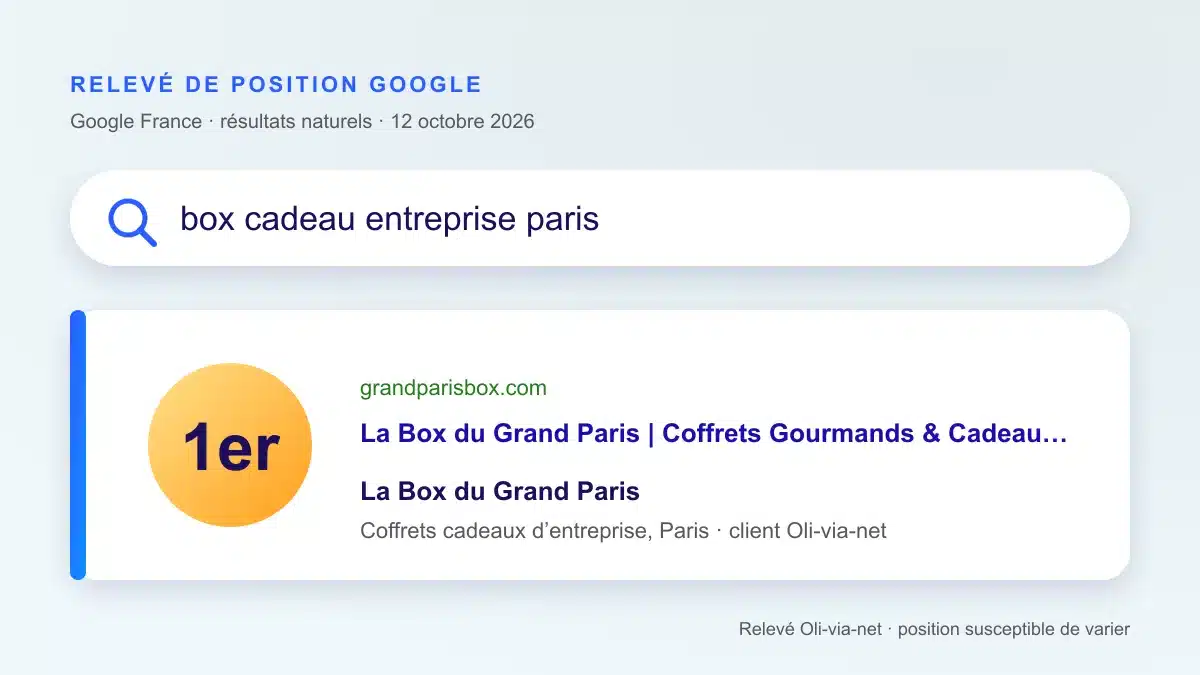
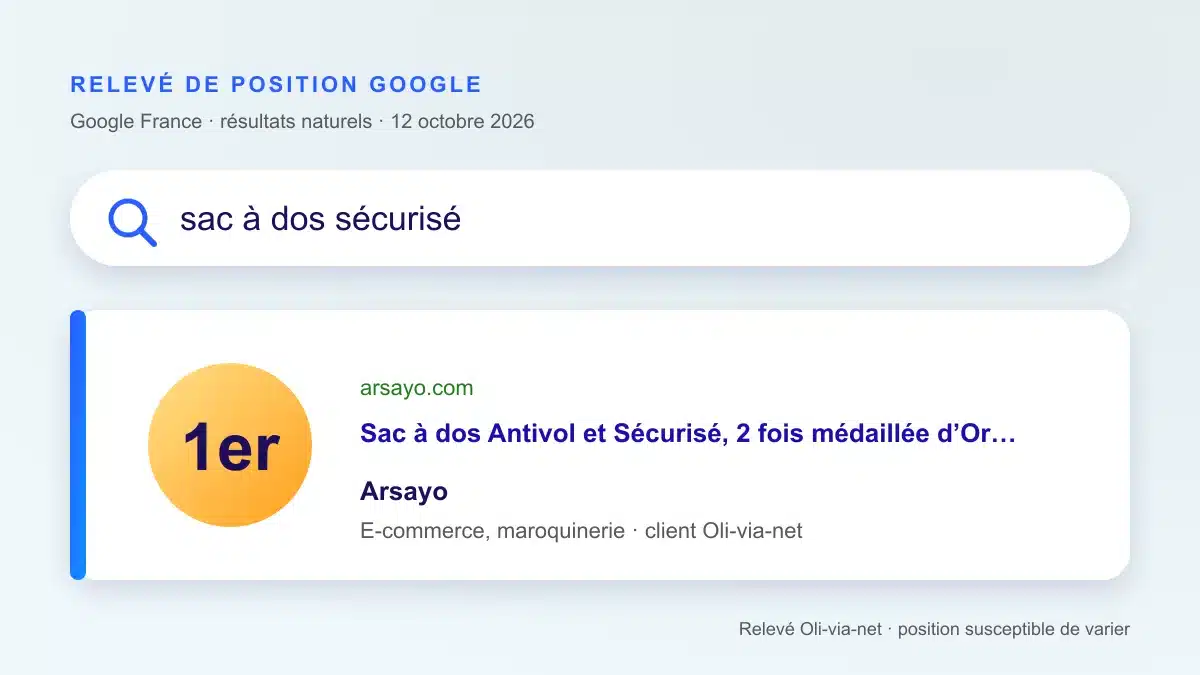
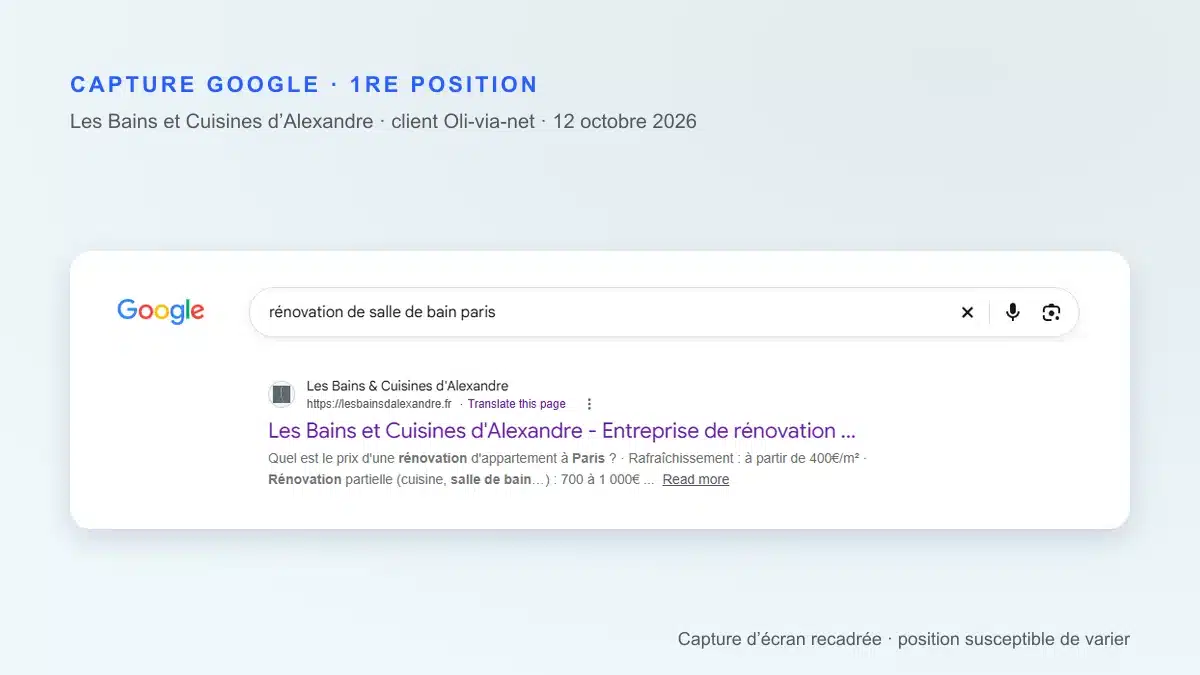
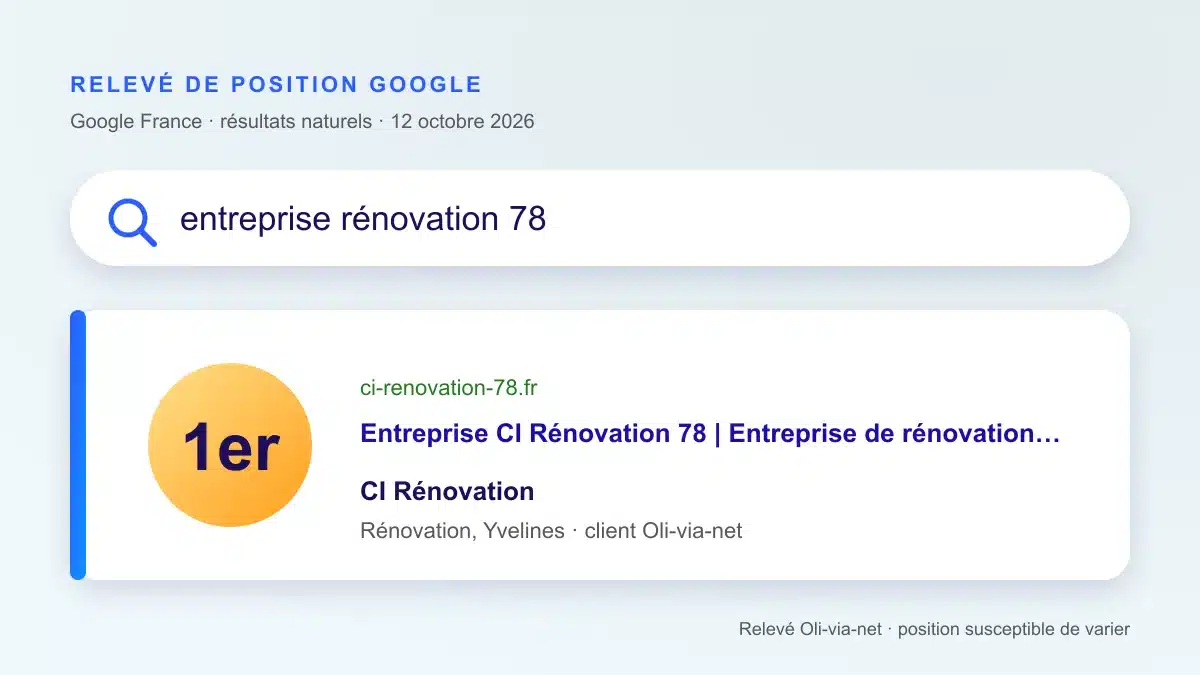
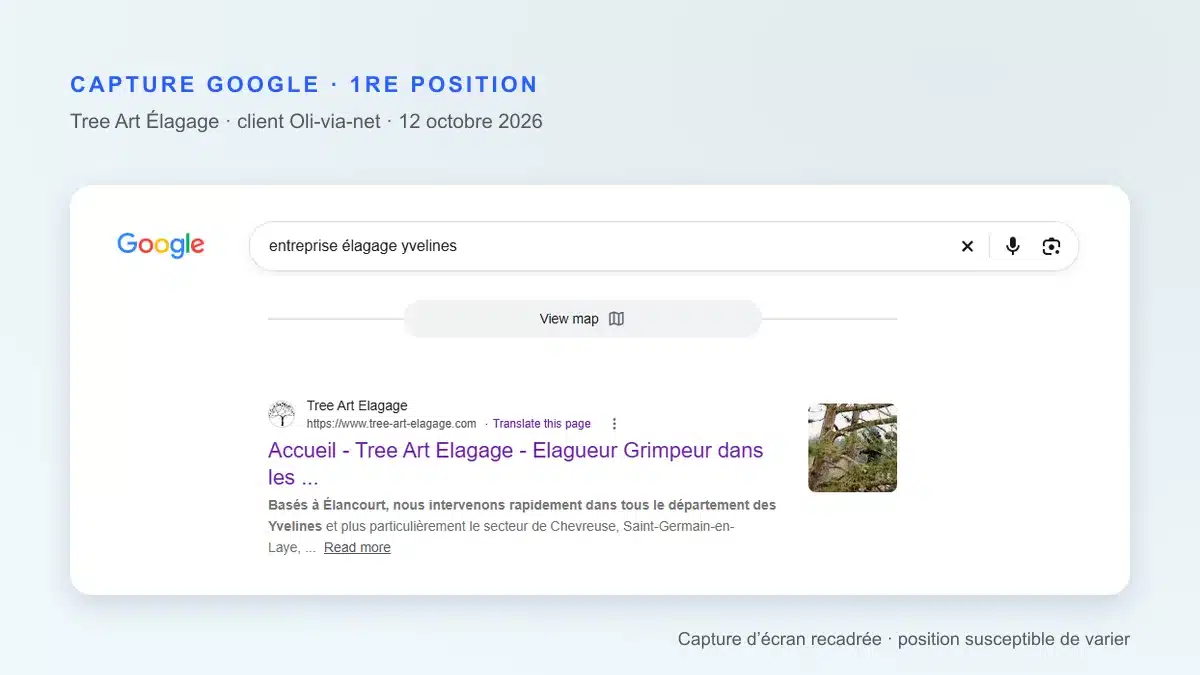
Without visibility on Google, you miss out on most of your prospects. Traditional SEO remains the cornerstone of any effective digital strategy.
Our analysis relies on the best tools on the market, including SEMrush, Ahrefs, Majestic, Google Analytics, Moz, PageSpeed Insights, Ranxplorer and many others. Our SEO approach rests mainly on three fundamental pillars:
Technical SEO — performance & robustness
- Fast, mobile-optimised and accessible websites
- A clear structure and architecture with internal linking
- Security (HTTPS, GDPR) and structured data to build trust
Content and UX SEO — relevance & targeting
- Pages optimised for your strategic keywords
- Quality content that matches search intent
- Writing focused on conversion and user experience
Authority SEO — credibility & reputation
- Acquisition of quality links (backlinks)
- Trust signals and online reputation
- Building lasting authority in your sector
SEO in the age of AI
Ranking well on Google means being cited more by AI
Google remains the engine that the vast majority of your prospects use. Its own written answers, the AI Overviews and AI Mode rolled out in France in July 2026, rely on the pages it has indexed and ranked well. Good SEO is therefore also the foundation of your visibility in AI:
- SEO puts you in Google’s results, where your customers look for a provider
- GEO gets you cited in AI answers. That is what our GEO agency does
Whether you are looking for an agency to design your website, want to strengthen your SEO on Google, get cited by AI (GEO), or combine both, our agency supports you step by step.

Our SEO agency in the Yvelines, working for your online reputation and E-E-A-T
Our SEO agency takes care of your online reputation and your E-E-A-T
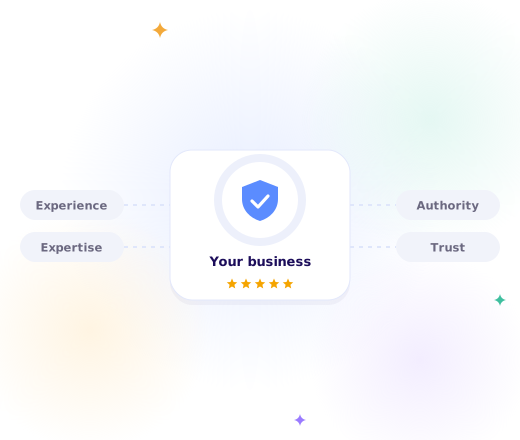
Google and AI systems do not recommend a business on the quality of its website alone. They also look at what its customers say about it. A complete Google Business Profile, numerous and recent reviews and careful replies are trust signals, and AI systems check them before citing a brand.
That is the core of E-E-A-T, Google’s quality criteria of experience, expertise, authoritativeness and trustworthiness. Our agency works on these signals alongside your SEO:
- Google Business Profile optimised and monitored every month
- Customer reviews collected regularly, with a written reply to every review
- Removal of non-compliant reviews through Google’s official reporting channels (removing a negative review)
- Authority of the business and its leaders, with visible evidence on the website
Oli-via-net is in Ibdeo’s top 10 SEO agencies in France and in The Growth Asset’s top 10 SEO agencies in Paris. Uplix ranks Nicolas Peter 2nd among SEO consultants in France. See all the mentions
Free SEO audit of your website
Get a personalised analysis of your website in under 24 hours.
100% free, no commitment. Our aim is to show you how to generate more qualified traffic, more leads and more sales through SEO.
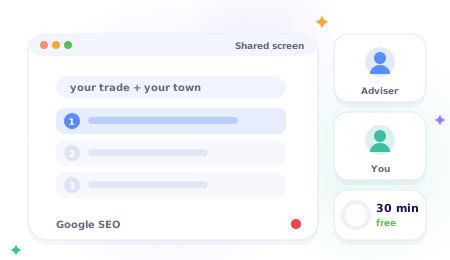
Or book directly
A free 30-minute call
Available Monday to Saturday, 8 am to 8 pm (Paris time). Choose a slot and it is booked for you straight away.
None of the slots suits you? Fill in the free audit form, use the Contact page or call the agency on +33 6 89 96 40 79.
The methodology of our SEO agency
The 4 steps of an effective SEO strategy
Our SEO methodology is built around four pillars, audit, optimisation, content and tracking.
It combines technical SEO, content and authority to strengthen your visibility on Google for the long term, and along the way prepares your pages to be picked up by AI.
Our goal is lasting rankings, stronger authority (E-E-A-T) and qualified organic traffic.

Step 1 - Complete SEO audit:
- Clear definition of your business objectives and KPIs
- Complete technical review (performance, security, indexing)
- Analysis of content & keyword rankings
- Analysis of digital presence & AI visibility (ChatGPT, Gemini…)
- Competitor analysis and opportunities
- Estimate of running costs

Step 2 - Optimisation:
- Priority technical SEO fixes
- Performance improvements
- Metadata, tags, image alt text
- Implementation of schema.org and structured data
- Creation and optimisation of the index map
- Stronger internal linking & clean URL structure

Step 3 - Content production:
- Enriching existing content and creating pages
- Writing blog articles optimised for SEO and AI SEO
- Targeted link building, including through the Oli-via-net network
- Writing focused on E-E-A-T and trust signals
- Adding proof of expertise & reassuring elements

Step 4 - Tracking & adjustments:
- Detailed monthly multichannel reporting
- Tracking of Google positions & organic traffic
- Measurement of leads, conversions and ROI
- A/B tests and continuous database optimisation
- Monthly action roadmap and prioritisation
100% satisfied clients
What our clients say about us, and what Google and AI systems take away from it.
★★★★★
“Having spoken with a number of Google Maps specialists who had not convinced me, I was lucky enough to come across Nicolas. His direct, measured, rational and concise approach won me over. The free audit made me aware of where I stood in the Google universe. My only regret is not having met him sooner.”
★★★★★
“I contacted Nicolas for help with an online reputation case involving a Google review. He took the time to study my case in detail and to look for different solutions suited to my situation. I recommend him without hesitation.”
★★★★★
“We called on Nicolas to restore our Google Business Profile. As soon as we had called him, he looked into our case. We recommend Nicolas very warmly, and of course we will keep working with him.”
★★★★★
“Sound advice, very competent and always available! I also really appreciated his expertise in SEO and automation, which helped me gain visibility and efficiency.”
★★★★★
“I am delighted that I entrusted the redesign of my website to Oli-via-net. It is a very professional agency that adapted to my business and to the size of my company. I recommend them.”
★★★★★
“I called on Nicolas to build a website for my company from A to Z, and I am very pleased with the result. Nicolas listens and very quickly understood what I expected. I highly recommend him.”
Read the client reviews published on our Google Business Profile.
Frequently asked questions – Google SEO
Before working with an agency, it is normal to have questions about timescales, prices, methodology, results or how SEO is evolving with AI. This FAQ answers your questions clearly and sums up our philosophy. Transparency, closeness and measurable performance.
Understanding SEO
Why doesn’t my website appear on Google when it has existed for several months?
Several reasons can explain a total or partial absence from Google.
Indexing problems. Your robots.txt file may be blocking Google’s crawlers, or a "noindex" tag may be preventing indexing. Check in Google Search Console whether your pages are indexed. A website can exist without being visible on Google.
No optimised content. A 3-page showcase website with 200 words per page and no strategic keywords stands no chance of ranking. Google favours websites that bring value and answer users’ queries precisely.
Google penalties or filters. If you have bought poor-quality backlinks, duplicated content or over-optimised your pages with keyword stuffing, Google may have applied a manual or algorithmic penalty. These penalties are sometimes invisible but devastating.
A website that is too new and has no authority. A new website with no backlinks and no history, in a competitive sector, can remain invisible for 6 to 12 months even with good content. Google first has to trust you.
Solution. Start with a technical audit to identify the blocking points, then methodically build your presence with quality content and a gradual link building strategy.
Do I need to rebuild my website to improve my SEO?
Not necessarily, and it is often not even the priority.
When a redesign is necessary. A technically obsolete website (not mobile-responsive, loading time over 5 seconds, an outdated CMS that cannot be optimised), an illogical site structure that harms SEO (incomprehensible URLs, chaotic tree structure, no heading hierarchy), a dated design that drives visitors away and hurts conversion.
When the existing website can be optimised. A technically sound website with weak content, a broadly correct structure with missing SEO optimisations, an acceptable design that needs a few UX adjustments. In 70% of cases, SEO can be improved dramatically without a complete redesign.
The redesign trap. Rebuilding a website without an integrated SEO strategy can DESTROY your existing rankings. We regularly see businesses lose 50% to 80% of their traffic after a badly managed redesign (URLs changed without 301 redirects, optimised content deleted, broken structure).
Our recommendation. Audit first to diagnose. If a redesign is necessary, we manage the migration to ensure zero loss of SEO traffic. If the existing website can be optimised, we avoid the costs and risks a website redesign can involve.
Can I do my SEO myself, or do I really need an agency?
You can do SEO yourself, but with several important limits.
What you can do on your own. Write quality content about your trade (you are the expert), optimise basic title tags and meta descriptions, create a blog and publish regularly, improve your website’s speed with plugins, ask your partners for backlinks.
What is very difficult without expertise:
- An in-depth technical audit (identifying problematic SEO factors)
- A truly effective keyword strategy (volume, difficulty, intent, cannibalisation)
- Quality link building (finding and getting good backlinks without a penalty)
- AI SEO and structured data (technical and complex)
- Continuous data-driven optimisation (understanding Analytics and Search Console, interpreting the signals).
The cost of learning. Learning SEO properly takes 6 months to a year of monitoring, testing and mistakes. During that time, you are not focusing on your core business. One SEO mistake (bad backlinks, over-optimisation, duplicate content) can wreck your website for months.
The hybrid approach that works. We audit, define the strategy and handle the technical work and link building. You produce part of the content (you know your trade), and we optimise it for SEO and AI SEO. You save on production while benefiting from strategic and technical expertise.
What is the difference between SEO and GEO?
SEO, or search engine optimisation, aims for a good position in Google’s results in order to get clicks. GEO (Generative Engine Optimization, sometimes called AI SEO) aims for a citation in the answers written by AI such as ChatGPT, Gemini, and Google’s AI Overviews and AI Mode.
The two complement each other. AI systems rely heavily on well-indexed pages, so good SEO is the foundation of GEO. For the AI side, discover our GEO agency.
How long does it take to rank well on Google?
It depends on the competition and on the website’s starting point. For a local query with little competition, the first gains often appear a few weeks after the technical fixes and the indexing of the new pages.
For a competitive national query, allow several months of content and quality links. We track your positions every month in Search Console to measure progress and adjust the plan.
Will AI kill Google and traditional SEO?
No, but it is profoundly transforming the search landscape.
Google is not going to disappear. It remains dominant, with 92% of searches in France and 8.5 billion queries a day worldwide. People will keep using Google to buy, compare, find local addresses and read reviews. What is more, Google is investing massively in its own AI (Gemini), integrated into its search results.
AI is creating a new, complementary channel. ChatGPT has reached 800 million active users. These users do not necessarily replace their use of Google, they add a channel. Some queries go through AI (complex questions, advice, explanations), others through Google (looking for specific websites, purchases, local searches).
Hybrid behaviour is emerging. More and more people first ask ChatGPT for a quick summary answer, then check on Google, read reviews and visit websites. Being visible on both channels multiplies your chances of finding customers.
A tremendous opportunity. AI SEO is still little used by your competitors. Now is the time to invest and get ahead. In 2 to 3 years, everyone will be doing AI SEO and the competition will be fierce. Today, you can still stake your claim.
Advanced strategies and mistakes to avoid
What are the most common SEO mistakes that penalise a website?
We regularly see these mistakes with new clients.
Mistake 1 - Duplicate content. Copying and pasting suppliers’ product descriptions, duplicating the same text on several pages, or having www/non-www and http/https versions all indexed. Google hates duplicate content and may decide not to index your pages or to rank them very low in the search results.
Mistake 2 - Over-optimisation and keyword stuffing. Repeating the main keyword 50 times on a page in the hope of ranking better. Google is smart. It penalises over-optimisation. The ideal keyword density is 1 to 2%, no longer 10% as it could be a few years ago.
Mistake 3 - Ignoring search intent. Targeting "SEO agency" with a page that talks about you instead of answering what the user is looking for ("how to choose", "prices", "what does an SEO agency do"). Google now wants answers to questions, not self-promotion.
Mistake 4 - Neglecting mobile. 60% of traffic comes from mobile. A website that is not responsive, slow on mobile, with buttons that are too small or unreadable text, can lead to a bounce rate (users who quickly leave the website) of 80%. As a result, Google considers your content irrelevant and downgrades you.
Mistake 5 - Buying poor-quality backlinks. Paying €200 for 100 backlinks on ghost websites (link farms, low-quality PBNs, spam directories) can prove counterproductive. Google detects it instantly and can penalise your entire website for months.
Mistake 6 - Forgetting structured data. Not marking up your business’s website, your products and your articles with Schema.org. As a result, you miss out on Google rich snippets AND on being understood by AI.
Is link building still as important in 2026, or is Google planning other methods?
Link building remains one of the 3 fundamental pillars of SEO, but it has evolved.
Google analyses and favours the quality of backlinks more than their quantity. 1 link from Le Monde is worth 100 links from poor-quality websites and media. You therefore need to pay attention to:
- thematic relevance (a link from a website in your sector > a generalist link)
- the context of the link (an editorial link in an article > a footer or sidebar link),
- the authority of the source website (Domain Rating, Trust Flow),
- the diversity of the link profile (lots of different websites > a single website with 100 links).
What has actually changed. Google penalises manipulative links more severely (mass buying, detected PBNs, spam), gives more weight to indirect signals (brand mentions without a link, citations, brand searches), and integrates behavioural signals (click-through rate, time spent, bounce rate) into its algorithm.
Link building remains crucial because it is the main signal of authority and trust for Google, essential for ranking on competitive keywords, a powerful accelerator of indexing and crawling, and a quality signal for AI (websites with good backlinks are cited more).
The right strategy today. Favour extreme quality (10 excellent links > 100 average links), vary the sources and types of links (guest articles, partnerships, press mentions, premium directories), build gradually (5 links a month over 12 months rather than 60 links in one go), create "linkable" content that naturally attracts links (studies, infographics, free tools).
How many words should a blog article have to rank well?
2,400 words. There is admittedly no magic number, but clear trends are emerging.
Studies show that content on Google’s first page averages 1,800 to 2,500 words for competitive queries, articles of more than 2,000 words generate 3 times more traffic than 500-word articles, and long content earns more backlinks (people share a complete guide more readily than a superficial article).
Why long content performs. More long-tail keywords captured naturally, better semantic coverage of the topic (Google understands your expertise), longer time spent (a positive signal for Google), and more chances of ranking for several different queries.
BUT length is not everything. A badly structured 3,000-word article, with no optimisation and useless information, will perform worse than a highly targeted, optimised 1,000-word article that brings real value. Quality > quantity, every time.
Our recommendation by objective:
- Informational blog articles, 1,500-2,500 words
- Complete and pillar guides, 3,000-5,000 words
- Service pages, 800-1,500 words
- E-commerce product pages, 500-1,000 words
- FAQs / definitions, 300-800 words.
The essentials. Cover the topic completely, answer the questions readers ask, structure with clear H2/H3 headings, add visuals to break up the text. If it takes 800 words, there is no point writing 2,000 with filler.
What are the steps of an effective SEO strategy?
An effective SEO & AI SEO strategy rests on a process structured in 6 main steps.
Analysis & complete audit
- Technical diagnosis of the website (speed, indexing, security)
- Study of current visibility & competitor analysis
- SEO and AI SEO benchmark (presence in Google & generative AI)
Keyword & intent research
- Google search keywords
- Keywords useful to AI (entities, E-E-A-T, structured data)
- Analysis of volumes, competition and local opportunities
SEO/AI-optimised architecture & content
- Structuring pages by theme (silos, internal linking)
- AI-friendly writing (clear structure, factual data, sources)
- Integration of optimised visuals and stronger conversion
Technical optimisation & performance
- Improving Core Web Vitals & UX
- Advanced Schema.org & Knowledge Graph
- Automated data updates (dynamic SEO)
Digital authority & reputation
- Acquiring quality backlinks
- Collecting and showcasing customer reviews
- Strengthening E-E-A-T (expertise recognised by Google and AI)
Measurement, tracking & continuous improvement
- Ongoing adjustments as algorithms evolve
- Tracking SEO positions & AI visibility
- Analysis of traffic, conversions and ROI
Why work with a Google SEO agency?
A professional SEO agency like Oli-via-net helps you improve your Google rankings for the long term, generate qualified traffic that converts, and win more leads and sales, so as to build a lasting strategy.
We analyse your website with the best tools on the market, including SEMrush / Ranxplorer for keyword and competitor analysis, Ahrefs for backlinks, Majestic for authority, Google Analytics and Search Console for official data, and PageSpeed Insights for performance.
This in-depth analysis lets us put in place concrete, measurable actions on the three main pillars, technical work, content and authority.
SEO is not an expense but an investment that generates growing results over the long term, unlike advertising, which stops as soon as you stop paying.
What tools do you use for SEO audits?
We use a combination of the best professional tools to guarantee the quality of our analyses.
For traditional SEO:
- SEMrush and Ranxplorer (keyword analysis, rank tracking, technical audit)
- Ahrefs (backlinks, link building opportunities),
- Majestic (domain authority)
- Google Analytics and Search Console (official data)
- PageSpeed Insights and GTmetrix (speed, Core Web Vitals)
- Screaming Frog (exhaustive technical crawl).
For visibility in AI, we use Google’s Rich Results Test to check structured data, and citation checks across several AI systems, detailed on our GEO agency page.
This cross-referenced data allows us to draw up a clear, prioritised, measurable action plan, with quantified objectives and rigorous month-by-month tracking.
Local SEO and sector specifics
How can I improve my local SEO on Google Maps through my Google Business Profile?
Local SEO works differently from national SEO and requires specific actions.
Google Business Profile optimisation (crucial). A 100% complete profile (opening hours, photos, services, attributes, description optimised with local keywords), a relevant primary category + secondary categories, regular posts (offers, news, events), recent professional photos (shopfront, team, projects).
Google review strategy. Actively collect genuine reviews (email after the service, QR code on invoices, asking in person), reply to 100% of reviews (positive and negative) within 48 hours, aim for an average of at least 4.5★ (below that, you are at a disadvantage), get more than 20 reviews to start being competitive (50 to 300 to dominate locally, depending on your sector).
Consistent local citations. Name, Address, Phone (NAP) strictly identical across all directories (Pages Jaunes, Yelp, Tripadvisor, business directories), presence in the main directories of your sector, correction of duplicates or errors (a different NAP = a contradictory signal for Google).
Why does it matter?
- Google wants to avoid sending a customer to the wrong place
- NAP consistency strengthens local reputation and authority
The more identical your NAP is everywhere, the more Google rewards you with local visibility.
Localised content. Dedicated pages for each geographical area if you cover several towns ("Plumber in Lyon 6", "Plumber in Villeurbanne"), blog articles that mention your town / region naturally, local keywords in your title tags and H1.
Behavioural signals. Phone calls from Google Maps ("call" button), direction requests ("directions" button), clicks through to the website from the profile. The more interactions you generate, the better Google ranks you.
How is e-commerce SEO different from traditional SEO?
E-commerce SEO has significant technical and strategic specificities.
E-commerce-specific challenges. Thousands of product pages to optimise individually, managing duplicate content (product variants, copied supplier descriptions), out-of-stock products (keep the pages indexed or remove them?), fierce competition on transactional keywords ("buy", "cheap", etc.).
Crucial optimisations:
- Unique, detailed product pages (500-1,000 words with benefits, features, FAQ),
- optimised images (descriptive file names, alt text, reduced weight, WebP format)
- integrated customer reviews (user-generated content that is valuable for SEO)
- rich Product structured data (price, availability, reviews)
- filters and facets handled correctly (avoiding duplicate content and dilution).
Structure and navigation:
- A tree structure in thematic silos (category > subcategory > product)
- an impeccable breadcrumb trail
- smart internal linking (complementary products, bought together)
- pagination or infinite scroll handled for SEO.
Additional content:
- A blog with buying guides ("how to choose X")
- product comparisons, how-to tutorials (capturing informational traffic that converts later).
Google Shopping:
- An optimised, synchronised product feed
- Shopping campaigns that complement SEO
- competitive prices and real-time updates.
The e-commerce trap. Focusing only on product pages and neglecting informational content. An active blog can generate 40% of total organic traffic and bring in customers who are at the research / comparison stage.
My sector is very competitive. Do I stand a chance of ranking on a limited budget?
Yes, but the strategy has to be adapted and gradual.
The reality of competitive sectors. Ranking for "insurance", "windscreen repair" or "lawyer Paris" with a recent website and zero authority is almost impossible in the short term. The top 10 have years of history and hundreds of quality backlinks. Investing thousands of euros to go after these keywords directly is often a waste. Do not try to rank for "insurance" but for "electric vehicle fleet insurance for very small businesses in Île-de-France" (far less competitive).
The strategy that works:
- Start with highly specific long-tail keywords ("divorce lawyer shared custody Paris 3rd arrondissement" instead of "lawyer Paris")
- target the precise questions people ask ("how much does an amicable divorce cost" instead of "divorce lawyer")
- create highly expert niche content that naturally attracts backlinks.
Build authority gradually:
- First months, long tail + local SEO
- Months 6-12, medium-difficulty keywords
- Years 2-3, go after competitive keywords with the authority you have built.
Use differentiating angles:
- Precise sector specialisation
- a local geographical approach
- innovation or a unique service
- a strong brand personality.
AI SEO as an accelerator. In sectors that are competitive in traditional SEO, AI SEO is still little used. You can be cited by ChatGPT in your niche while you are on page 5 of Google. This AI visibility then strengthens your Google SEO (brand searches, backlinks, authority).
Technical SEO and content strategy
My website is fast on desktop but slow on mobile. Is that serious?
Yes, it is even critical for your SEO and your conversions.
Google’s mobile-first index. Since 2021, Google has indexed and assessed your website mainly through its mobile version. If your mobile website is slow, your Google rankings suffer, even for desktop searches.
The business impact:
- 53% of mobile users leave a website that takes more than 3 seconds to load
- each extra second of loading costs 7% of conversions.
- A slow mobile website increases your bounce rate by 50 to 80%
- mobile users are increasingly impatient (a TikTok generation used to instant results).
Common causes of slow mobile performance:
- Images not optimised for mobile (heavy formats, dimensions too large)
- render-blocking or overly heavy JavaScript
- badly optimised ads and trackers that slow everything down
- a slow server or low-cost hosting
- no caching or CDN.
Mobile Core Web Vitals. On mobile, Google specifically measures LCP (Largest Contentful Paint), that is the display speed of the main content, which must be under 3 seconds. Then comes FID/INP (interactivity < 200 ms), then CLS (visual stability < 0.1 seconds). If you are in the red on mobile, you lose rankings.
Solutions:
- Image optimisation (WebP, lazy loading, adaptive dimensions)
- minified and deferred JS/CSS
- a fast server and CDN, AMP or an ultra-light mobile version
- regular testing with mobile PageSpeed Insights.
Do you need a blog to rank well?
Not compulsory, but strongly recommended in most cases.
Why a blog helps SEO enormously:
- You regularly create new indexable content (Google likes active websites)
- you target hundreds of long-tail keywords that cannot be covered with static pages
- you bring freshness and signals of activity
- you create "linkable" content that naturally attracts backlinks (people share a useful article more readily than a sales page).
You capture informational traffic. People at the research stage search for "how to choose X", "guide to Y", "best Z". They are not yet ready to buy but are finding out more. Your blog captures them, demonstrates your expertise, and converts them later.
When a blog is recommended but not essential:
- An e-commerce website with thousands of detailed product pages (already plenty of indexable content)
- a highly local business with little search volume (local SEO and reviews are enough)
- a very well-known brand that already has maximum authority
- limited resources and a preference for investing in SEA.
The right blog approach. 2 to 4 genuinely high-quality articles a month (1,500 - 2,500 words, optimised, bringing real value) are worth more than 10 rushed 300-word articles. Cover the frequent questions in your sector, create complete guides, publish studies or statistics, share your hands-on expertise.
Blog + AI SEO = a winning combination. Blog articles structured as FAQs, guides and glossaries are exactly what AI loves to cite. Your blog becomes an AI visibility machine.
Do social media influence Google rankings?
Indirectly yes, but not in the way people often think.
Google officially denies it. The number of likes, shares or followers on Facebook, LinkedIn or Instagram are NOT direct ranking factors in Google’s algorithm. Google cannot access most social data (private accounts, Facebook walls, etc.).
The indirect impact is real. Social media generate traffic to your website (a positive signal if visitors are engaged), amplify the reach of your content (more visibility = more potential backlinks), and strengthen your brand awareness (more brand searches = a positive Google signal).
Social profiles rank in Google. Your LinkedIn, Facebook or Instagram page often appears on the first page when people search for your brand name. That is free real estate in the search results. Optimise these profiles (descriptions with keywords, links to your website, regular content).
The virtuous circle. You publish an excellent SEO-optimised blog article → you share it on LinkedIn/Facebook → it generates social traffic → some visitors share it or talk about it on their blog → you get backlinks → your SEO improves → you rank better on Google.
Our recommendation. Do not do social media FOR SEO. Do it to grow your community and your awareness, and to generate direct traffic. SEO will follow naturally as a secondary benefit.
The future of SEO and new opportunities
Is voice search (Siri, Alexa) changing the way SEO is done?
Yes, and optimising for voice search is closely linked to AI SEO.
The specific features of voice search. Longer, conversational queries ("What is the best pizzeria open near me right now?" vs "pizzeria Paris"), phrasing as natural questions ("how", "why", "where", "when"), a strong local dimension ("near me", "nearby"), the expectation of a single, direct answer (not a list of 10 results).
How to optimise for voice:
- Create content in a question-and-answer format (comprehensive FAQs)
- use natural, conversational language rather than bare keywords
- target featured snippets (position 0), because voice assistants often read the featured snippet, and optimise for local SEO (voice searches are 3 times more local)
- use structured data for direct answers.
Voice and AI are converging. Alexa and Siri increasingly use generative AI to answer. Optimising for ChatGPT also optimises for voice search, because the criteria are similar (conversational content, authority, clear structure).
Growing use. 50% of searches will be voice searches within 2 to 3 years according to projections, particularly among younger generations and for searches on the move. Investing in voice optimisation now puts you ahead.
Will SEO become obsolete as AI evolves?
No, it will transform and become even more strategic.
What will never change. People will always look for information online (whether through Google, ChatGPT or something else), the businesses that appear first will capture most of the traffic and conversions, and content quality, expertise and authority will remain fundamental criteria.
What is already changing. Search channels are multiplying (Google, conversational AI, voice search, video search on TikTok / YouTube), search intent is becoming more precise and personalised, and users expect direct, contextual answers, not lists of links.
Tomorrow’s SEO will be multichannel (Google + AI + voice + video + social media), even more focused on real expertise and quality (AI and Google are becoming very good at detecting hollow content), will require advanced structured data to be understood by every AI, and will demand a conversational, user-centred approach.
The current opportunity. We are at the start of this transformation. Businesses that invest NOW in AI SEO, advanced structured data and expert content are getting 2 to 3 years ahead of those that wait. In 5 years, everyone will be doing AI SEO and the competition will be fierce. Today, it is still a new world to conquer.
Our conviction. SEO is not dying, it is growing richer. Traditional SEO skills remain the essential foundation. AI SEO is added as an extra strategic layer. The agencies and businesses that master both will have a decisive advantage.
What are the new SEO trends to follow in 2026?
In 2026, SEO is moving towards a hybrid approach between traditional search optimisation and optimisation for artificial intelligence (AI SEO). Google is rolling out its generative summaries (AI Overviews), forcing brands to structure their content to appear in these boxes. At the same time, conversational AI such as ChatGPT, Gemini and Perplexity are becoming genuine search engines, and GEO (Generative Engine Optimization) is on the rise.
Quality topical content, proof of expertise (E-E-A-T) and semantic consistency now take precedence over simple keyword density. Technical performance (Core Web Vitals) and user experience remain essential.
Finally, multimodal search (text, voice, image) and brand reputation — including in AI answers — are becoming essential levers for staying visible on a web driven by artificial intelligence.
Prices
How much does an SEO agency cost?
Our monthly SEO support starts at €490 excl. VAT per month. The exact budget depends on your starting point and your objectives. We set it after the free audit, once we have measured the gap to close in order to get ahead of your competitors.
Several factors affect the price:
- The competition for your keywords, local or national
- Your objectives, from a tradesperson’s local search to an e-commerce website’s national visibility
- The gap to close between your website and those already at the top of Google
- The volume of content to create or rewrite each month
- The link building needed to gain authority
- The technical state of your website at the outset
An accessible agency. When we believe in a project and the partnership is long-term, we can offer very competitive prices. Our aim is to build results that last, not to bill hours.
Monthly SEO support
from €490 excl. VAT / month
- Ranking on the first page of Google
- Complete SEO audit and action plan
- Technical optimisations and structured data
- Optimised content and link building
- Monthly rank tracking and reporting
- Google Business Profile and reviews
Personalised quote after the free audit, with no commitment.
Call +33 6 89 96 40 79Request your free quote to improve your SEO.
Is your website lacking visibility? Are you not on Google, or not showing up for the right searches?
Would you like to be recommended by AI such as ChatGPT, Perplexity or Gemini?
We put in place a tailored SEO strategy to:
- increase your qualified traffic,
- generate more prospects and sales,
- improve your image and your credibility online.
Our aim is to make your website a profitable acquisition lever, lasting and driven by data.
Fill in the form opposite. We will send you a personalised proposal within 24 hours.