
SEO, or search engine optimisation, covers the techniques that get a website into Google’s top results. An SEO consultant supports a business in this area, from the technical audit to content strategy and the authority of its website.
There is no official ranking of SEO consultants, and no body designates “the best”. Some consultants nevertheless stand out through documented results, tools, publications and the recognition of their peers. It is this visible, verifiable know-how that this ranking seeks to measure.
Best SEO consultants in France, Top 10 analysed (2026)
Who are the 10 best SEO experts in France?
- Laurent Bourrelly, creator of the semantic cocoon, strategy and site architecture
- Olivier Duffez, founder of WebRankInfo, SEO audits and teaching
- Sylvain Peyronnet, scientific and data-driven SEO, chairman of Babbar
- Paul Vengeons, technical SEO and visibility in AI engines, co-creator of ChatSEO
- Paul Sanches, link building and offensive SEO, founder of Impact SEO
- Kevin Richard, creator of SEObserver, competitive analysis and backlinks
- Emmanuel de Vauxmoret, data-driven SEO and GEO, founder of Uplix
- Stéphane Delgado, technical SEO, automation and GEO
- Hugo Domeur, semantic structure and local SEO, freelance consultant in Lyon
- Romain Pirotte, link building, automation and website monetisation
This ranking is updated regularly to reflect changes in the French SEO ecosystem, new publications, tools, contributions and public signals of expertise.
Test it yourself
“Who are the 10 best SEO consultants in France?”
Answers vary from one AI tool to another and from one day to the next: that is precisely what this ranking measures. For Gemini, DeepSeek and Kimi, the question is copied, so you just need to paste it.
Who is the best SEO consultant in France?
Methodology & scoring scale: how we assess SEO experts in 2026:
Unlike rankings based solely on editorial content or affiliations, our methodology takes into account all the public channels through which an expert demonstrates their expertise, cross-referenced with measurable technical data (web performance, indexing, SEO tools).
The aim is not to assess the invisible but to analyse what is publicly documented, verifiable and accessible at the time of the study.
Each expert is scored out of 100 points using a grid structured around 11 core pillars, ranked from the most decisive to the most secondary. This order directly affects the scale: the first criteria carry more weight in the final score.
This weighting reflects the reality of SEO in 2026: real reputation and proven results first, followed by technical performance, SEO authority and then adaptation to new forms of Google results, structured data and AI Overviews, which are redistributing a growing share of visibility before the click even happens.
Since October 2026, two pillars have been added, citations by AI (a record of 8 AI tools, with screenshots published below) and presence in editorial rankings (8 rankings published in 2026). The scale has been rebalanced to stay at 100 points, and the grid now has 236 checkpoints.
With the emergence of AI-oriented SEO, some consultants are developing specific expertise in search on artificial intelligence, particularly in competitive environments such as AI SEO in Paris, but also internationally
Interpretation rule: when several tests give different results, we keep the trend (a qualitative average) and retain the evidence (screenshots/URLs) without over-interpreting a single run.
Editorial transparency and independence of the ranking
This ranking is published by Nicolas Peter, SEO consultant and founder of the Oli-via-net agency. Experts are selected on public signals that are measurable and verifiable at the time of the analysis, and the AI records are published as they are. The inclusion or absence of a profile cannot be the subject of any commercial consideration.
Top 10 SEO experts 2026: profiles, expertise and performance levers:
French SEO relies on very different profiles: pioneers who laid the foundations and structured the ecosystem, such as Olivier Duffez, experienced experts who push back the technical and scientific limits of search, and a new generation, Julien Gourdon and David Groult, who combine rigorous semantic architecture with methods shaped by generative AI and the new forms of Google results. These two profiles are not yet in our Top 10, lacking a track record of results as well documented as that of the ten selected, but they are already among the names most regularly cited whenever GEO and citability by answer engines come up. The ten portraits that follow detail the careers, strengths and current influence of the consultants selected this year. Each, in their own way, is helping to shape the SEO of today and tomorrow.
Laurent Bourrelly
Reference website: https://www.laurentbourrelly.com/
LinkedIn: https://www.linkedin.com/in/laurentbourrelly/
Dated milestones · cited by 7 of the 8 AI tools queried in October 2026
- 2012: makes the semantic cocoon public, after thinking begun in 2004 and a system formalised in 2007 (laurentbourrelly.com)
- September 2023: the Bootcamp SEO only accepts new members by referral (LinkedIn)
- November 2025: presents AI as a tool of sovereignty (local models, controlled data) on Enzo Honoré’s podcast (enzohonore.com)
Laurent Bourrelly relies on a Public reputation and E-E-A-T that the AI tools confirm. Seven of the eight AI tools queried cite him, as do half of the cross-referenced editorial rankings. The semantic cocoon, which he made public in 2012 after several years of formalisation, remains the most widely used architecture method in France. On Indexing & SEO authority, his contribution lies in this logic of internal linking organised by search intent, since taught to generations of consultants.
His Related skills show first in training, with the Bootcamp SEO, now open by referral. His recent thinking concerns AI as a tool of sovereignty: locally deployed models, controlled data and a practice of machine learning he dates back to 2015. He thus approaches AI SEO from the angle of technical mastery rather than fashion.
Olivier Duffez
Reference website: https://www.webrankinfo.com/
LinkedIn: https://fr.linkedin.com/in/olivierduffez
Dated milestones · cited by 6 of the 8 AI tools queried in October 2026
- 2002: creates WebRankInfo; SEO consulting since 2003, co-founds Ranking Metrics in 2006 (webrankexpert.com)
- May 2025: talk “GEO: optimise your visibility in generative AI search engines” at WordCamp Toulouse (WordCamp Toulouse)
- November 2025: tells Blog du Modérateur that GEO is not a new paradigm and that the llms.txt file has no effect for lack of adoption (Blog du Modérateur)
Olivier Duffez stands out for a Public reputation and E-E-A-T that is absolutely central and historic in French-language SEO, built on more than two decades of continuous contributions and on his role as a reference through WebRankInfo, which has trained and structured a large part of the ecosystem. His Results & SEO cases rest on long and extensive experience, both through his own projects (platform, community, consulting and training) and through the “case library” effect of running an ecosystem where real problems are documented, explained and solved. He shows an encyclopaedic command of Indexing & SEO authority, with a full spectrum ranging from the fundamentals (crawling, architecture, content) to advanced subjects (diagnostics, penalties, updates, consolidation strategies), while remaining readable and actionable for non-experts.
On Web performance, his approach is pragmatic and focused on reliability: performance is a foundation of trust (user experience, stability, technical compliance), with a strong culture of modern standards and requirements such as Core Web Vitals. The Design vs Performance pillar is treated in a utilitarian way: functional design, accessibility and clarity in the service of information and efficiency, with a preference for safe compromises over graphic one-upmanship. His positioning in AI SEO & Rich Results is that of a leading watcher and synthesiser: he incorporates developments (structured data, SERP features, entities, generative engines) methodically, seeking to turn trends into robust recommendations rather than passing fads, which strengthens his credibility on “lasting” GEO and AI.
Online reputation management is exemplary and almost institutional: the image of a trusted third party, constant teaching, a generally neutral and uncontroversial tone, and a high level of credibility with professionals and advertisers alike. Related skills are a major strength: structured monitoring, teaching, training, community management and the ability to formalise methods and make them applicable, while keeping a strategic view of real constraints (CMS, resources, technical debt). Finally, Code & technical publications is very significant at sector level: less in a showy “open-source” posture than in an abundant output of technical resources, tools and methodologies that have had a lasting influence on standards of SEO practice in France, with an approach often seen as very “safe/white hat”, a choice that favours long-term durability over risky gains.
Sylvain Peyronnet
Reference website: https://sylvain.info/en/
LinkedIn: https://www.linkedin.com/in/sypsyp/
Dated milestones · cited by 6 of the 8 AI tools queried in October 2026
- 2016–2020: Chief Strategy Officer for AI and Adtech at Qwant, after a career as a university professor (ix-labs.org)
- May 2021: Babbar, which he chairs (Babbar.tech, YourTextGuru), raises €2.1M (Next)
- March 2026: public beta of IBOU Explorer, a French conversational search engine he co-founded and runs (ibou.io)
Sylvain Peyronnet stands out for an exceptionally strong Public reputation and E-E-A-T in French-language SEO, with the image of a “scientific” expert and search engineer recognised by his peers, reinforced by regular talks on advanced subjects (conferences, masterclasses, podcasts, teaching formats) and a lasting position in the technical community. His Results & SEO cases are embodied less by heavily marketed client “before/after” stories than by structural results: the creation and spread of data-driven tools and methods that make it possible to scale semantic analysis, authority and algorithmic understanding, with a direct impact on SEO teams’ ability to produce measurable, reproducible gains.
He demonstrates a first-rate command of Indexing & SEO authority, with a marked specialisation in large-scale crawling, graph analysis, PageRank and topical authority, and measuring trust, which makes him a particularly relevant profile for “enterprise” or highly competitive environments. On Web performance and Design vs Performance, his DNA is clearly focused on efficiency: priority to scalability, technical robustness and system optimisation (server, structure, extraction, crawling) rather than “agency” aesthetics; the possible downside is an approach sometimes seen as complex or intimidating for newcomers.
His strength in 2026 lies in AI SEO & Rich Results: he has long been positioned on NLP, semantics and data, and incorporates generative AI as an accelerator of analysis, industrialisation and content structuring, with a “future-proof” logic in the face of generative engines (agents, query fan-out, extraction, relevance). Online reputation management is very solid overall, driven by a reputation for rigour and seriousness rather than by a review or mass-audience influence strategy. His Related skills are rare and distinctive (applied mathematics, algorithms, data science, automation, software engineering), which broadens his field beyond classic SEO. Finally, Code & technical publications is a central pillar of his profile: the ability to design systems, formalise models, produce dense technical content and engage closely with engineering constraints, which places him among the most “hard tech” profiles on the panel.
Paul Vengeons
Reference website: https://www.paulvengeons.fr
LinkedIn: https://fr.linkedin.com/in/paul-vengeons
Dated milestones · cited by 6 of the 8 AI tools queried in October 2026
- 2020: launches his business as an independent SEO consultant after a spell in an agency (paulvengeons.fr)
- November 2024: episode 58 of MVP, the SEO and GEO podcast he co-hosts with Antoine Veyrières (Rephonic)
- September 2025: launches ChatSEO, an AI assistant connected to Search Console, out of beta in January 2026 (digitiz.fr)
Paul Vengeons stands out for a fast-growing Public reputation and E-E-A-T within the “new guard” of SEO, driven by a very active presence on professional influence channels (YouTube, LinkedIn, newsletter) and the image of a pragmatic expert focused on execution and results. His Results & SEO cases are mostly demonstrated in a “build in public” way: he highlights concrete cases and measurable SEO revenue (a cash-flow logic, an 80/20 approach, a focus on SaaS and e-commerce) and ROI-oriented support, more than large enterprise references with systematic public reporting. He shows a solid command of Indexing & SEO authority, based on modern techniques for acquiring and consolidating authority (structured content, internal linking, pragmatic link building) and on the ability to create visibility signals through complementary assets (newsletter, YouTube) that strengthen the ecosystem.
On Web performance, his approach is utilitarian and compatible with good standards (mobile-first, speed “sufficient to convert”), without positioning himself as a showcase of extreme performance or advanced CWV engineering; the priority remains business impact and speed of implementation. The Design vs Performance pillar is well balanced overall: modern, readable, effective design built to convert and publish fast, with a clear preference for simplicity over a heavy aesthetic layer. His differentiator in 2026 is AI SEO & Rich Results: he was very early in adopting LLMs applied to SEO (copilots, automation, structuring, semantic optimisation) and adapts his message and methods to “AI Overviews / generative search” environments, which makes him particularly relevant for SMEs and founders seeking to stay competitive without an overly complex set-up.
Online reputation management is positive and dynamic overall, driven by the image of an accessible expert who is generous with content and focused on proof, with an engaged community; the area for improvement, as often with fast-rising profiles, is making third-party proof systematic (structured reviews, dedicated pages, public methodology). Related skills are a strength: content marketing, entrepreneurship, distribution (YouTube/newsletter), tooling, teaching and growth-oriented consulting. Finally, Code & technical publications is present from an “implementation and systems” angle (tutorials, processes, tools, automations) rather than in a “pure development / open-source” form, which fits the profile of a product-minded consultant focused on efficiency and scaling.
Stable position in 2026: progress remains steady and smooth across all pillars. The ranking records no decline, but rather the arrival of a profile with a more established foundation in semantic architecture.
Paul Sanches
Reference website: https://paulsanches.com/
LinkedIn: https://www.linkedin.com/in/referencementgoogle/
Dated milestones · cited by 6 of the 8 AI tools queried in October 2026
- 2011: wins the “Pandaranol” SEO contest; SEO consultant since 2006 (Journal du Net)
- February 2013: ranked 2nd in the Journal du Net’s “best SEO in France” (Journal du Net)
- October 2025: 25th session of the SEO High Level training programme, which he co-founded and runs, with a programme on AI content and automation (seohighlevel.com)
Paul Sanches stands out for a very strong Public reputation and E-E-A-T in “tech / hands-on” French-language SEO, with a status widely recognised by his peers and the image of an expert historically associated with offensive approaches (popularity, unconventional strategies) and with passing on knowledge through advanced formats (“high level” training and mentoring). His Results & SEO cases are made credible above all by a reputation for performance in highly competitive environments and by “insider” feedback (methods, tests, observed results), more than by a quantified enterprise portfolio publicised in the classic way. He demonstrates a high level of command of Indexing & SEO authority, with DNA strongly geared towards authority and popularity: advanced link building, signal building, managing the competition and a logic of SERP domination through popularity engineering.
On Web performance, the approach is generally utilitarian: optimising what serves crawling, crawl efficiency and operational stability, rather than chasing “marketing” scores or aesthetics. The Design vs Performance pillar is consistent: priority to raw efficiency (speed, structure, conversion), with design only a means and not an end; the possible downside is less emphasis on the premium visual codes some brands expect. His positioning in AI SEO & Rich Results follows a logical continuity of automation and scalability: using AI tools as an accelerator (assisted production, analysis, semantic variations, industrialisation) rather than an “AI-first” message focused on perfect schema compliance; the value lies in the ability to exploit systems at scale.
Online reputation management is solid overall, but unusual: a strong reputation in expert circles and the image of a direct mentor, sometimes divisive depending on “strict white hat” sensitivities versus an opportunistic approach, which is common for this type of profile. Related skills are a major differentiator: SEO entrepreneurship (publishing and monetisation), business and ROI psychology, automation, data management and a fine understanding of competitive mechanics. Finally, Code & technical publications is credible without necessarily being “open-source”: a technical culture and tooling, scripts and processes, the ability to talk to developers and structure production and monitoring systems, with expertise more geared to “applying and scaling” than to “publishing public code as a showcase”.
Kevin Richard
Reference website: https://seobserver.com/
LinkedIn: https://www.linkedin.com/in/richardkevin/
Dated milestones · cited by 5 of the 8 AI tools queried in October 2026
- 2013: creates SEObserver to combine rank tracking and backlink analysis (Les Aventuriers du Marketing)
- October 2025: trainer at the 25th SEO High Level session in Paris (seohighlevel.com)
- September 2026: presents Reach (NicheObserver), which estimates the audience of 35 million domains from CrUX data, with an API and an MCP server for AI agents (Abondance)
Kévin Richard stands out for a very strong and highly specialised Public reputation and E-E-A-T in French-language SEO, built on a long track record, a “peer” reputation and above all on his status as the creator of SEObserver, which has become a reference for analysing rankings, backlinks and competition. His image is that of a technical, data-driven profile, closer to the tool builder and reverse engineer than to mass-audience influence, with visibility maintained through content, training and a recognised presence in advanced SEO circles. His Results & SEO cases are mainly “tool-centric”: the most robust proof is SEObserver’s measurable impact on professionals’ ability to spot opportunities, track positions on a massive scale, audit popularity and run profitable strategies; proof of results therefore exists mostly through the adoption and use of the tool, rather than through a publicly quantified corporate client portfolio.
He shows a high level of command of Indexing & SEO authority, through a very “signals and data” lens: understanding popularity mechanics, competitive analysis, reading SERPs and using data at scale to guide decisions (link building, niches, prioritisation). On Web performance, his approach is consistent with a product developer’s profile: priority to the robustness, reliability and efficiency of a SaaS and its assets, rather than a marketing showcase of perfect scores; the goal is operational stability and usability. The Design vs Performance pillar follows the same logic: functional design aimed at expert users, with a clear trade-off in favour of data readability and speed of execution over potentially costly “premium” aesthetics.
On AI SEO & Rich Results, his positioning is pragmatic and credible: he has always been data-heavy and close to ML-based analysis (ranking factors, patterns), and AI fits in naturally as a layer of amplification and interpretation support rather than as a marketing argument; the challenge is to make better use of data (and SERP signals) in the era of generative engines, rather than “doing schema” for its own sake. Online reputation management is solid overall, driven by trust in the product and the image of a rigorous, transparent, proof-focused expert, with a loyal community and few visible recent controversies. Related skills are a major differentiator: data SEO, monitoring, link building, niche research, advanced training and SaaS development, which places him at the interface of SEO, engineering and product. Finally, Code & technical publications is a central pillar: even without a dominant open-source posture, creating and developing such a structuring tool implies a high level of development and modelling skill, and his public content often focuses on advanced analysis and data-driven operational methods.
Emmanuel de Vauxmoret
Reference website: https://edv.fr/
LinkedIn: https://fr.linkedin.com/in/uplix
Dated milestones · cited by 5 of the 8 AI tools queried in October 2026
- 2020: founds the Uplix agency, after running Eskimoz (2016–2020) (experts-ccd.org)
- 2024: registered on a probationary basis as an expert witness at the Paris Court of Appeal (communication, digital advertising and media) (CNCEJ)
- February 2026: talk “Named entities in SEO and their impact on GEO” at the SEO Garden Party (SEO Garden Party)
Emmanuel de Vauxmoret stands out for a high, institutional Public reputation and E-E-A-T, driven mainly by his role as founder and head of the Uplix agency, positioned on premium, strategic SEO for large companies and scale-ups. His legitimacy rests less on personal influencer-style exposure than on the credibility of the agency brand, his professional appearances (conferences, industry events) and his recurring recognition in agency rankings. His Results & SEO cases are clearly “Enterprise”-oriented: high-volume e-commerce SEO, international, insurance, luxury or SaaS, with a business performance logic (revenue, leads, sustainable growth) built into Uplix’s case studies rather than highly detailed individual demonstrations.
He shows a solid command of Indexing & SEO authority, approached in a structured, long-term way: complex site architecture, SEO governance, quality link building, alignment of brand, content and technology, and long-term E-E-A-T building. On Web performance, the approach is demanding and professional: Core Web Vitals, stability, reliability and scalability are treated as essential prerequisites for high-traffic environments, without falling into a “showcase PageSpeed benchmark” logic. The Design vs Performance pillar is one of his strong markers: Emmanuel de Vauxmoret champions an accomplished balance between high-end design, conversion-oriented UX (SXO) and SEO constraints, with a recognised ability to deliver attractive experiences without sacrificing performance.
On AI SEO & Rich Results, his positioning is strategic and measured: AI is built in as a lever for industrialisation, analysis and adaptation to generative engines (AI Overviews, conversational search), without an overly opportunistic message. The priority remains traffic quality, relevance and business value rather than automated volume. Online reputation management is very well controlled, driven by a premium, serious and reassuring image, positive client feedback and consistent institutional communication, with few divisive signals.
Related skills are a major differentiator: overall digital strategy, content marketing, data, managing multidisciplinary teams (SEO, UX, content, data) and running an agency at a high level. Finally, Code & technical publications are not at the heart of his personal exposure: technical expertise exists within the agency’s teams and output (case studies, analyses), but Emmanuel positions himself above all as a strategist and conductor, able to translate technical complexity into business decisions. His profile thus embodies a “corporate / premium” SEO leader, particularly suited to organisations seeking structured, scalable operational excellence.
Stéphane Delgado
Reference website: https://www.stephanedelgado.fr/
LinkedIn: https://www.linkedin.com/in/stephane-delgado/
Dated milestones · cited by 4 of the 8 AI tools queried in October 2026
- 2004: moves into professional SEO; adds GEO to his offer in 2023 (stephanedelgado.fr)
- August 2026: publishes “Passeport vers la Citation” (324 pages), an SEO-GEO method for being cited by generative AI (stephanedelgado.fr)
Stéphane Delgado is gradually establishing himself as a recognised technical figure in French-language SEO, with a fast-growing Public reputation and E-E-A-T, fed by an active presence in the digital ecosystem, particularly through his educational content and his contributions on social media and YouTube. His positioning rests on a very pragmatic approach to SEO, focused on measurable results and a fine understanding of the technical mechanisms that govern visibility in search engines. This credibility is further strengthened by the recent publication of his book on SEO and SEO automation, in which he shares an operational view of the profession and the methods that allow visibility strategies to adapt to the changes brought by artificial intelligence and new search behaviours.
His Results & SEO cases are characterised by an experimental, field-based approach: rather than limiting himself to theoretical demonstrations, he develops tools and methodologies for observing and analysing real search engine signals. This logic can be seen in particular in the creation of BotSEO, an SEO analysis and automation platform designed to make it easier to interpret data from Search Console and audit tools in order to quickly identify optimisation opportunities. This data-driven orientation strengthens his ability to work on complex Indexing & SEO authority issues, where understanding crawl signals, structure and algorithmic trust becomes decisive for organic performance.
On Web performance, Stéphane Delgado takes an approach centred on technical efficiency and stable architectures. From this perspective, the Design vs Performance aspect is handled pragmatically. Aesthetics must support the user experience without compromising speed of execution or the accessibility of content to search engines.
His positioning on AI SEO & Rich Results follows the same logic of technological anticipation. He is particularly interested in the interactions between traditional SEO, generative engines and the automation of SEO processes, exploring how artificial intelligence and language models can be used as tools for analysing, industrialising and optimising content strategies. Online reputation management relies on the image of an approachable technical expert, regularly present in professional discussions and appreciated for his ability to explain complex subjects to a wide audience.
Related skills are another differentiating aspect of his profile: graphic design, technical SEO, data analysis, marketing automation and an understanding of web architectures allow him to work on both the strategic and operational dimensions of SEO. Finally, Code & technical publications remains central to his approach: developing tools such as BotSEO, sharing analyses and producing technical content all help position Stéphane Delgado as a hybrid profile, at the crossroads of SEO consultant, data analyst and developer, representative of the profession’s evolution towards SEO that is increasingly automated, technical and engineering-oriented.
Hugo Domeur
Reference website: https://hugodomeur.com/
LinkedIn: https://www.linkedin.com/in/hugo-domeur-a09b3714b/
Dated milestones · cited by 1 of the 8 AI tools queried in October 2026 (Google AI Mode)
- August 2026: publishes “Google AI Overview: what it is and how to appear in it” (hugodomeur.com)
- September 2026: publishes his complete guide to relinking in SEO (hugodomeur.com)
- October 2026: publishes “How GEO (Generative Engine Optimization) works” (hugodomeur.com)
His Public reputation and E-E-A-T rests on a public career. Trained in the profession at 1ère Position, now NOIISE, he works independently in Lyon and teaches SEO courses. He holds the QASEO certification awarded by the SEO Camp association, a third-party standard that is still rare on the French market.
It is on Indexing & SEO authority that he stands out most. His work on semantic structure is meticulous, with a clear distinction between structural and contextual links, careful handling of anchors and a systematic hunt for duplicate content. His relinking guide, published in September 2026, gives a concrete example.
His publications follow the most recent criteria in my grid, Google’s AI Overviews in August 2026 and then GEO in October 2026. Web performance remains his weak point. His website scored 37 out of 100 on mobile in PageSpeed Insights on 12 October 2026.
Romain Pirotte
Reference website: https://www.the-business-legion.com/
LinkedIn: https://www.linkedin.com/in/avis-romain-pirotte/
Dated milestones · cited by 3 of the 8 AI tools queried in October 2026
- February 2024: relaunches his newsletter and presents AI content generation and indexing tools in it (Substack)
- November 2024: guest on episode 58 of the MVP podcast about black hat and negative SEO (Apple Podcasts)
- January 2025: announces version 2 of his The Business Legion training programme (SEO, monetisation, automation) (X)
Romain Pirotte stands out for a strong and polarising Public reputation and E-E-A-T in the French-language SEO sphere, driven mainly by a very active content presence (YouTube, training, community) and an openly “SEO business” positioning. His Results & SEO cases are strongly focused on profitability and speed of execution, regularly highlighting growth strategies for affiliate marketing, e-commerce and niche websites rather than classic enterprise consulting; proof is often community-based (feedback from students, demonstrations, tactics) and less structured as standardised “corporate case studies”. He shows a marked command of Indexing & SEO authority, but through a very “scalable” lens: intensive link building, ecosystem building, industrialised publishing and signal optimisation at scale, with a stronger affinity for modern grey/black hat than for institutional approaches.
On Web performance and Design vs Performance, the trade-off is clearly utilitarian: priority to fast production and minimum viable conversion, with design secondary as long as it does not hinder operational efficiency. The potential downside of this model is greater exposure to algorithmic risk if some methods are too aggressive or “borderline”, with an implicit test-and-learn logic and rebuilding when necessary. His positioning on AI SEO & Rich Results is one of his 2025–2026 markers: intensive use of LLMs and automation to industrialise content, semantic variations, structuring and large-scale deployment, in a logic of speed and volume. Online reputation management is well controlled overall but ambivalent: the image of an effective, unifying disruptor within his community, while remaining divisive among more “white hat” or institutional profiles. His Related skills are very business-oriented (affiliate marketing, growth, automation, monetisation, processes), which explains his appeal to entrepreneurs. Finally, Code & technical publications shows mainly through a culture of tooling and systems (tutorials, methods, automation) rather than an open-source “engineering” showcase, with practical expertise geared towards productivity and scale.
Right of reply
A company or person mentioned in this ranking can ask for a piece of information to be corrected or contest their assessment. Write to us through the contact form, stating the page concerned and the points to be checked. We reply within 7 days, and every correction is dated in the ranking update.
The detailed scores of each player are not published. They are based on records, AI answers, websites and reviews, which change from one week to the next. The scoring scale, on the other hand, is published higher up this page.
What the AI tools answer: October 2026 record
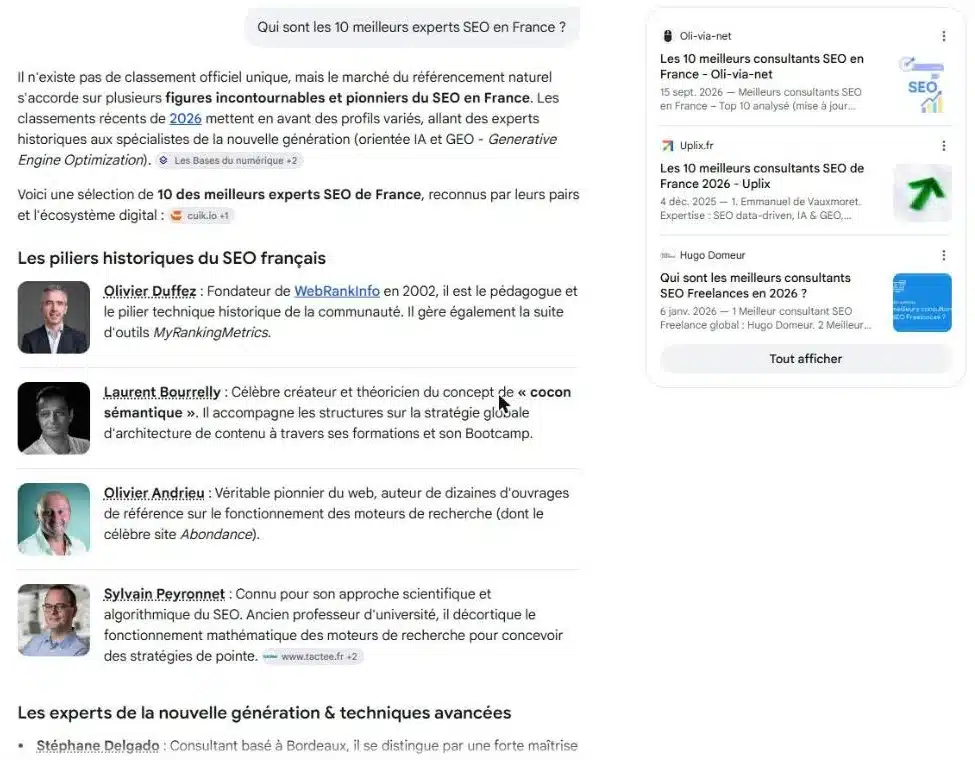
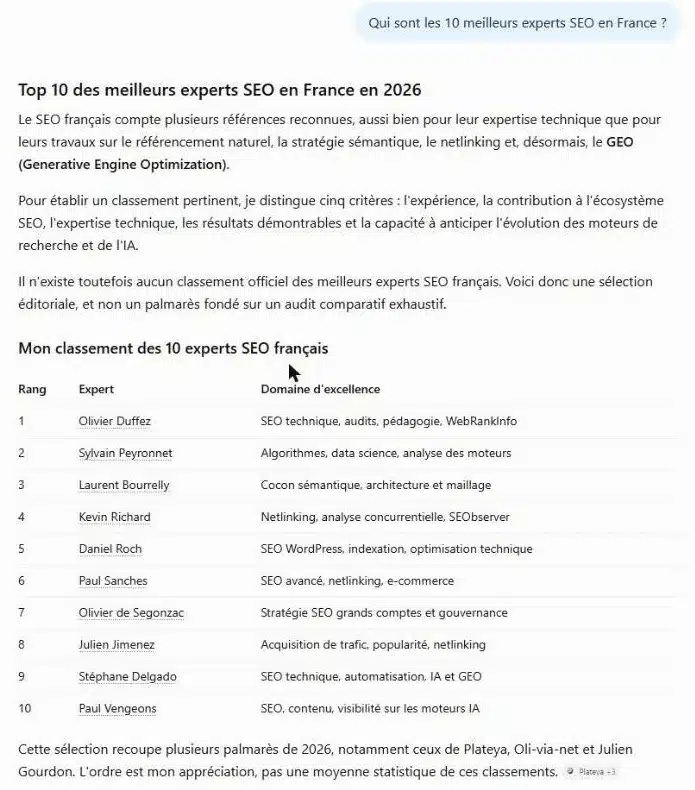
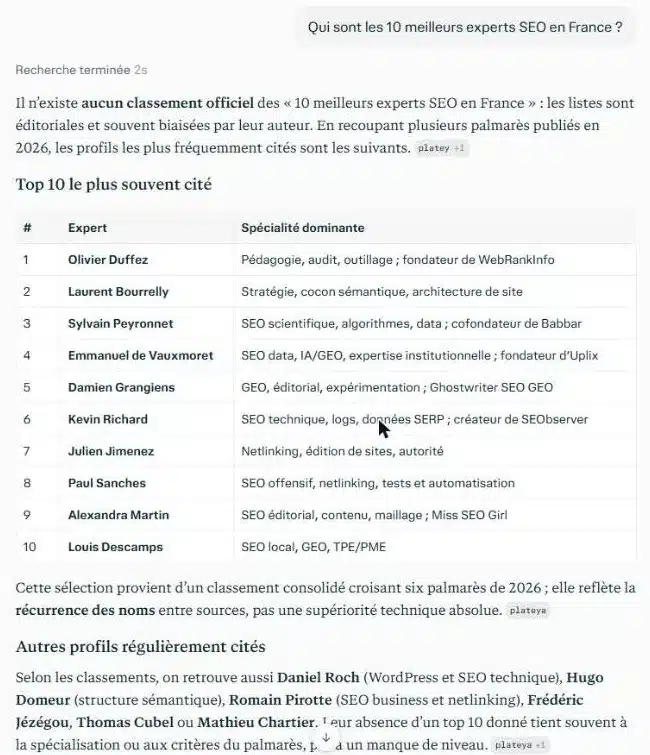
On 11 October 2026, we asked eight AI tools the same question: “Who are the 10 best SEO experts in France?”. Brave, ChatGPT, Perplexity, Claude, Gemini, Mistral’s Le Chat, Grok and Google AI Mode answered. DeepSeek was excluded (an answer written without searching, with made-up names) and Copilot required a login. The screenshots show the question and the answer as they appeared; only cropping has been applied.
Why use AI for an SEO ranking? AI tools build their answers from the pages their engines crawl and index (Google, Bing, Brave), so being named by them reflects the footprint a consultant has left on the web, publications, tools, talks, citations and links, in other words the very result of SEO work. No two AI tools give the same list, and the same AI varies from one query to the next: Google, asked twice, kept eight names out of ten. We therefore count recurrences, never a single answer; a name cited in either of Google’s two answers counts as one citation.
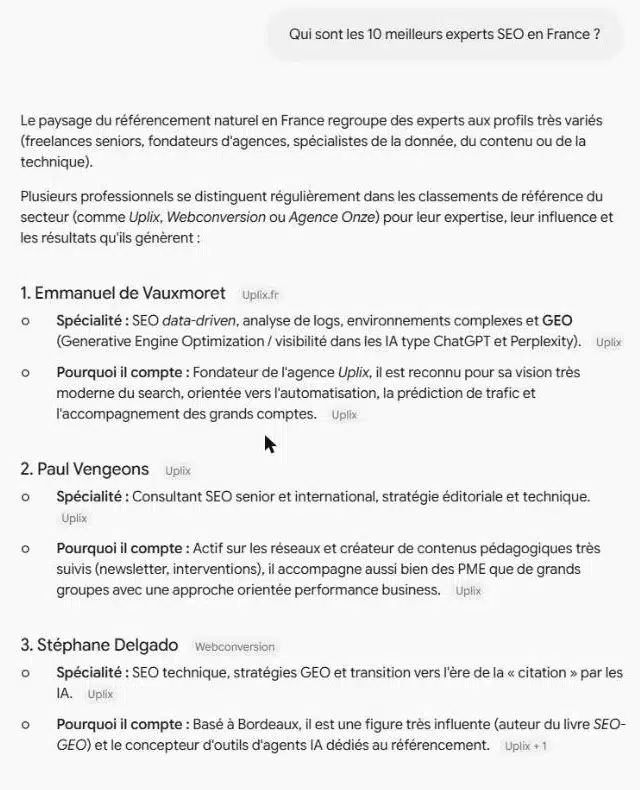
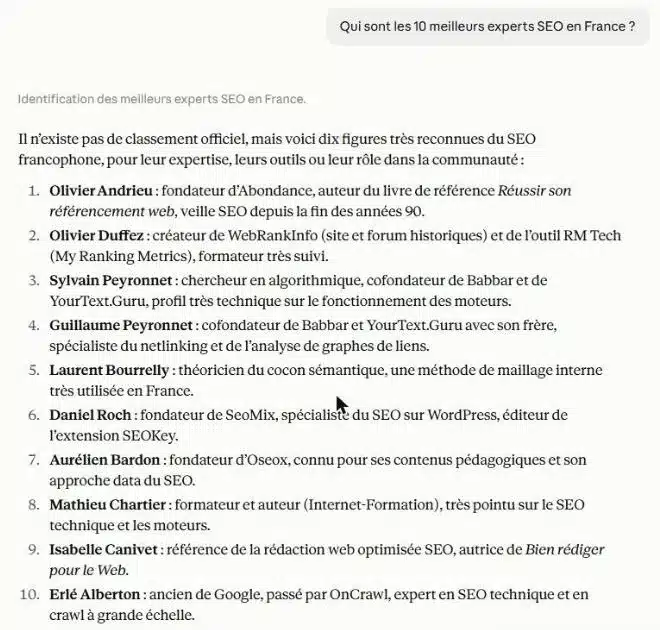
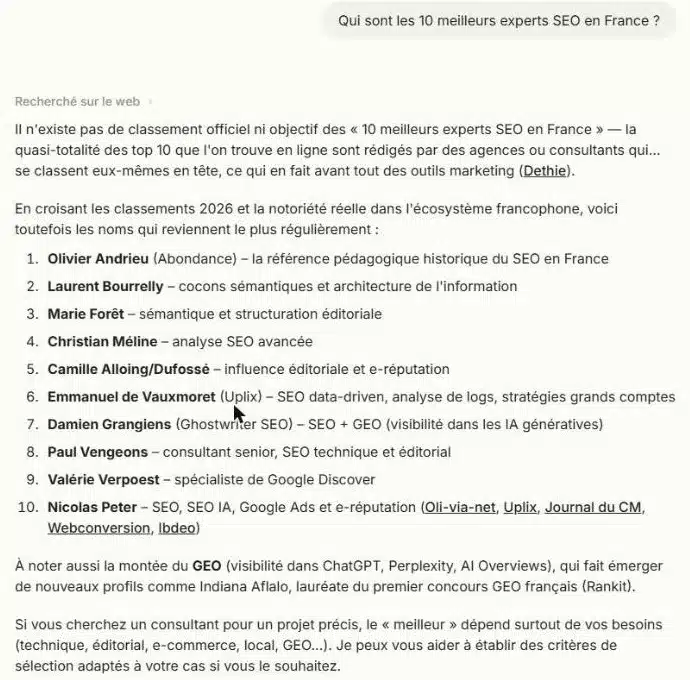
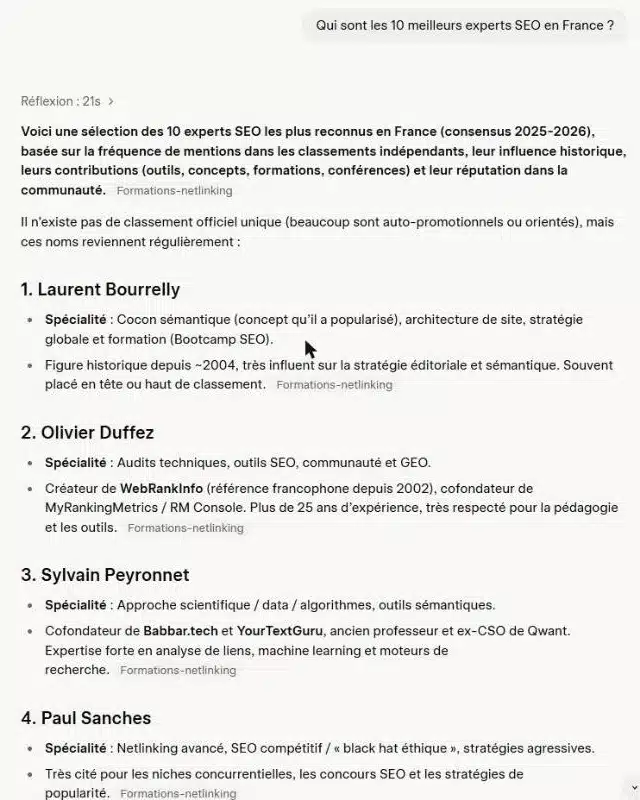
| Consultant | AI tools that cite them in their top 10 |
|---|---|
| Laurent Bourrelly | 7 out of 8 (Brave, ChatGPT, Perplexity, Claude, Mistral, Grok, Google) |
| Olivier Duffez | 6 out of 8 (Brave, ChatGPT, Perplexity, Claude, Grok, Google) |
| Sylvain Peyronnet | 6 out of 8 (Brave, ChatGPT, Perplexity, Claude, Grok, Google) |
| Paul Vengeons | 6 out of 8 (Brave, ChatGPT, Gemini, Mistral, Grok, Google) |
| Paul Sanches | 6 out of 8 (Brave, ChatGPT, Perplexity, Gemini, Grok, Google) |
| Kevin Richard | 5 out of 8 (Brave, ChatGPT, Perplexity, Grok, Google) |
| Emmanuel de Vauxmoret | 5 out of 8 (Brave, Perplexity, Gemini, Mistral, Google) |
| Stéphane Delgado | 4 out of 8 (ChatGPT, Gemini, Grok, Google) |
| Hugo Domeur | 1 out of 8 (Google) |
| Romain Pirotte | 3 out of 8 (Brave, Gemini, Grok) |
The ranking does not follow this one-off record alone. It also takes into account the stability of organic search results, which explains why a consultant cited by fewer AI tools this month remains ranked above another. Good positions on Google are, moreover, what feeds citations and mentions by AI over time.
This record is cross-referenced with eight editorial rankings published in 2026 by consultants, agencies and specialist media. It shows whom the ecosystem recognises; the portraits show why. You can repeat the test with the “Test it yourself” buttons at the top of the page.
The French SEO landscape has far more top-level experts than a ranking limited to ten names can reflect. Some historical figures remain essential: Olivier Andrieu (foundational teaching, Abondance), cited by several of the AI tools queried; Christian Méline (pioneer of semantic SEO, who passed away in 2025); Camille Dufossez (editorial influence); and Marie Forêt (semantics and editorial structuring).
Just behind the Top 10, several profiles emerge from the record: Daniel Roch (WordPress SEO, founder of SeoMix and of the SEOKEY plugin), cited by four AI tools; Alexandra Martin, editorial SEO and audits, author of the Miss SEO Girl blog; Olivier de Segonzac (SEO for large companies, RESONEO) and Damien Grangiens (SEO and GEO), each cited by two AI tools. Others show real potential to join, such as Léo Poitevin (technical SEO, automation, data) and Nicolas Nguyen (SEO architecture, performance).
You can help this ranking evolve!
An independent, evolving approach:
This ranking does not claim to state an “absolute truth”, but to offer a serious, reasoned and contextualised reading of the French SEO landscape in 2026. The absence of certain public evidence does not call a consultant’s real expertise into question, but deliberately limits scoring to an objective, comparable framework.
The methodology may evolve with market practices, search engines and the use of AI, so that it stays aligned with the reality of modern SEO.
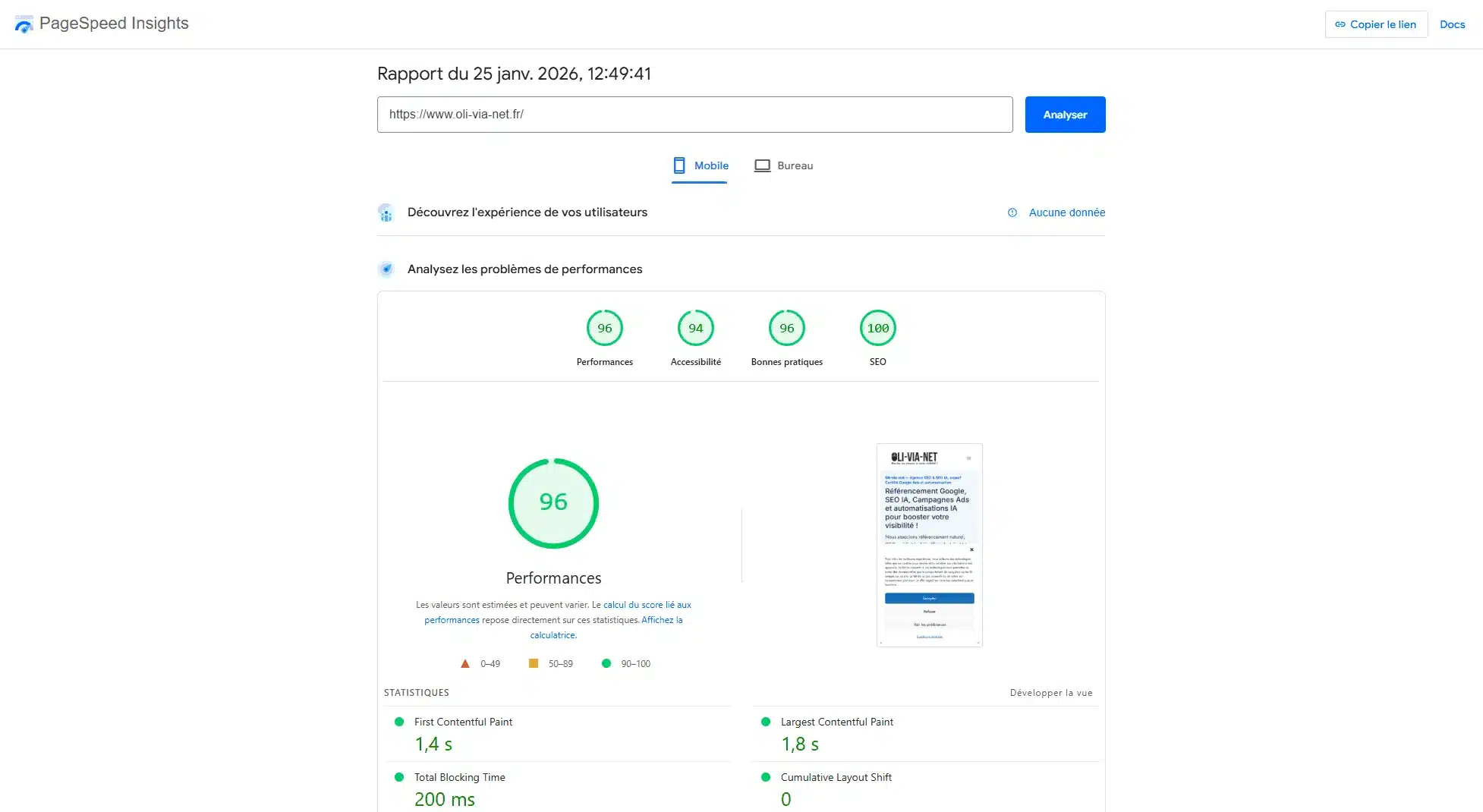
Scores / tools may differ depending on:
- the URL tested (home page vs sub-page),
- the date/time,
- the network profile (throttling),
- the cache/CDN state,
- the third-party resources loaded at the time of the test
If you would like to share your opinion and comments on this ranking, you can contact us through our contact form.

Concrete tools to illustrate SEO expertise in 2026:
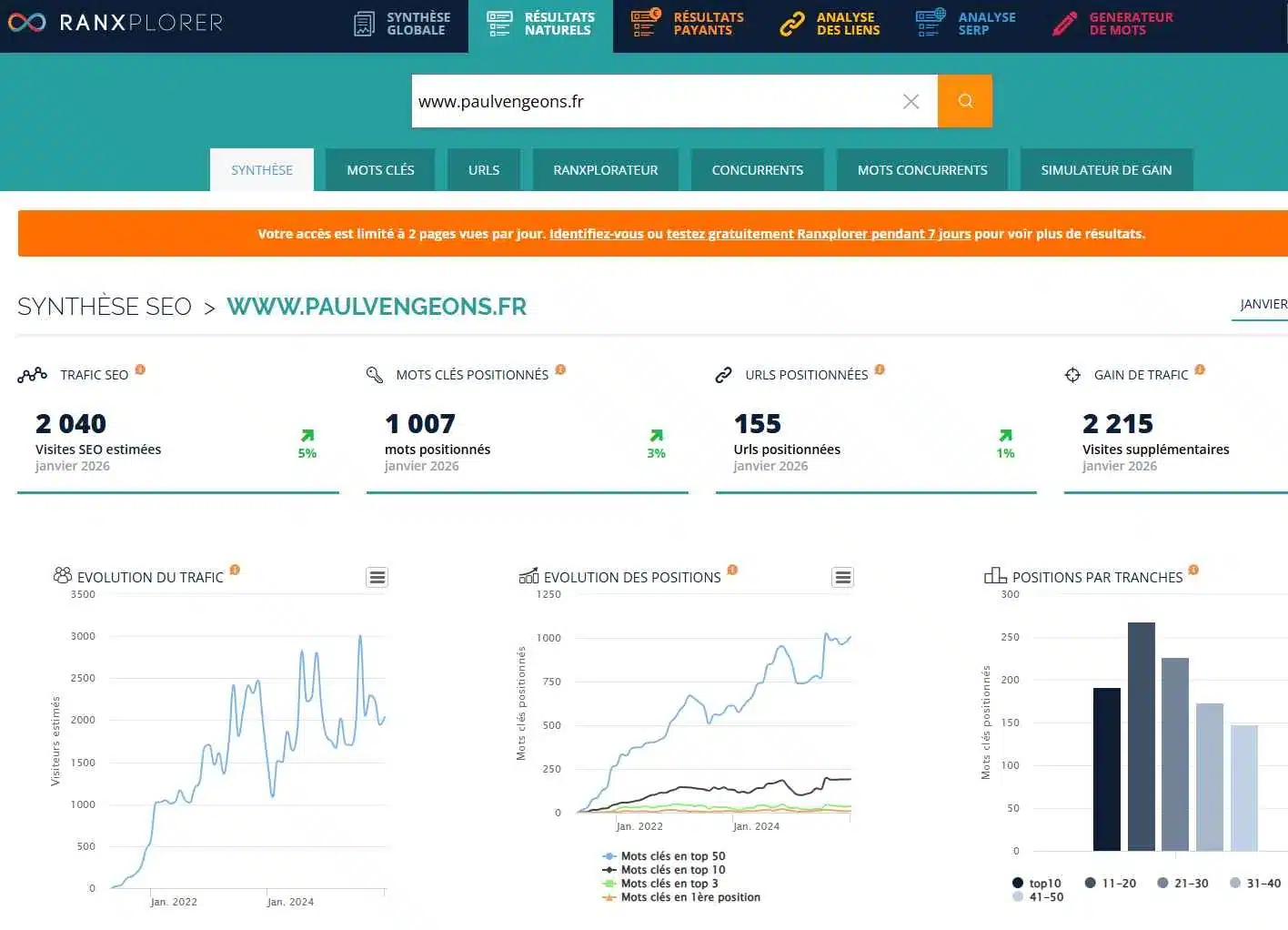
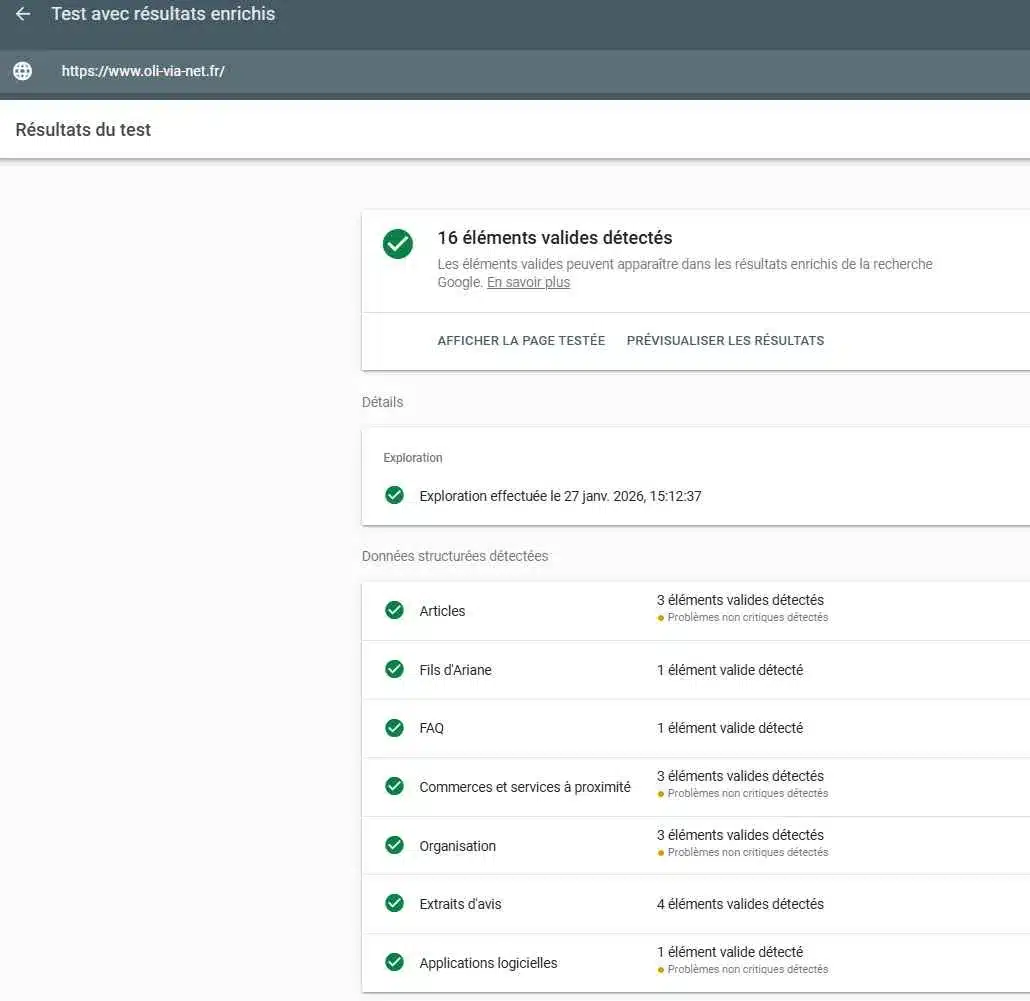
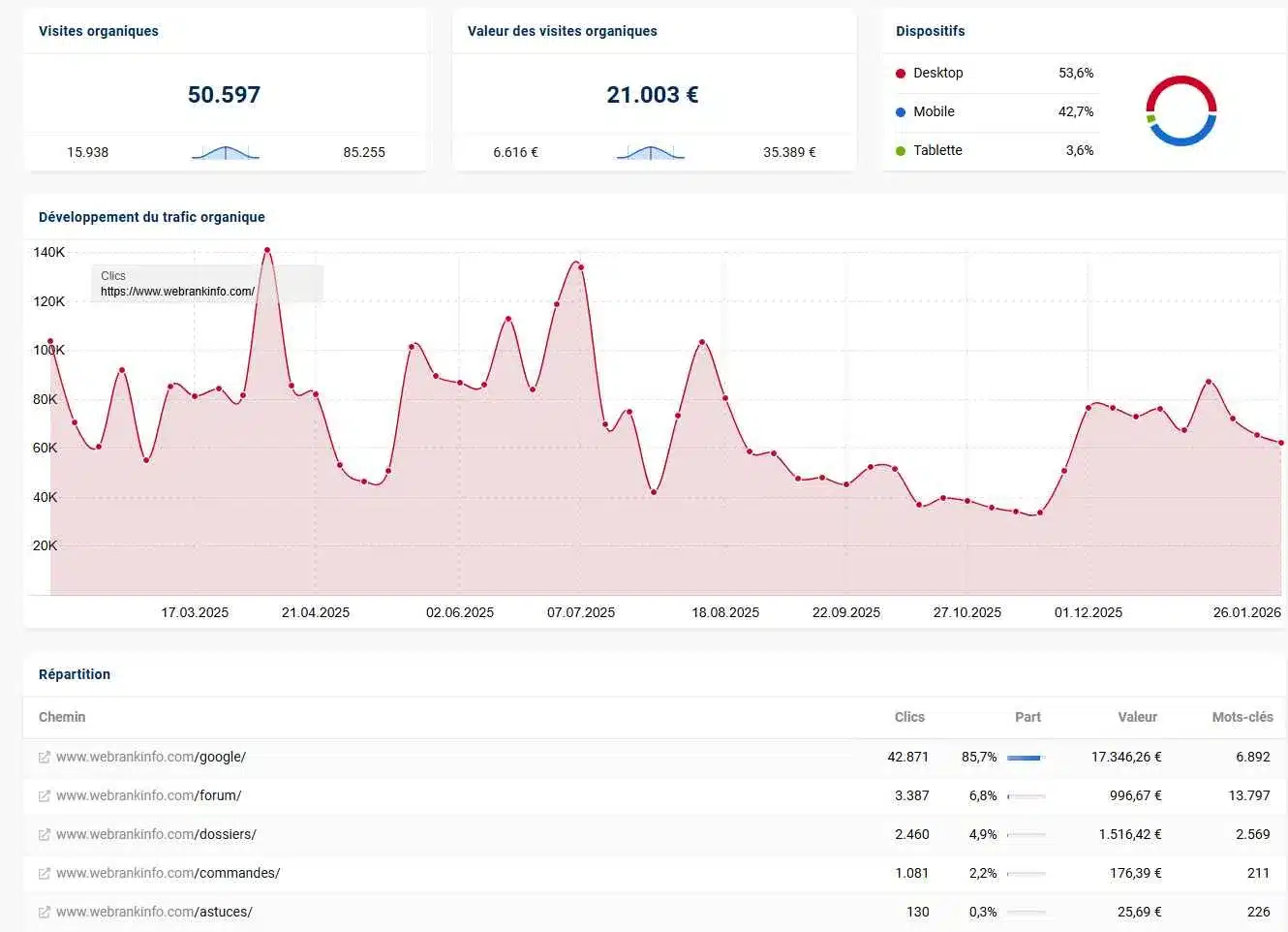
SEO is judged on proof. Search engines and generative AI alike favour real authority, technical performance and public credibility: these are the signals we observe, with tools anyone can check.
The screenshots opposite (PageSpeed Insights, Majestic, Ranxplorer, Rich Results, Sistrix) give a sample: web performance, link authority, organic traffic, structured data.
To these is added the record of the answers of 8 AI tools. It does not measure how well websites are optimised for AI, the subject of our ranking of AI SEO / GEO experts, but each consultant’s reputation as the web reflects it.

How much does an SEO consultant cost in France in 2026?
Service | Observed range |
|---|---|
Day rate of a senior consultant | €600 to €1,500 a day |
Strategic SEO audit | €1,500 to €5,000 |
Monthly support, small businesses and SMEs | from €300 to €500 a month |
Monthly support, Enterprise website | €2,000 to €10,000 a month |
These ranges correspond to the French market for independent consultants and small firms. A large gap from these values deserves an explanation: very high specialisation, an international scope or, conversely, an industrialised service. Price alone says nothing about quality; what matters is the relationship between the fee, the scope covered and the proof provided.
How to choose your SEO consultant: 6 criteria to check
- Ask for quantified proof: case studies with scope, duration and measured results, not a list of client logos.
- Beware of ranking guarantees: no serious consultant guarantees first place on Google.
- Check their own visibility: an SEO consultant who is invisible in their own market is a signal in itself.
- Ask for the method before the quote: an audit first, then a prioritised action plan.
- Check the technical coverage: indexing, performance and structured data are part of the foundation, not options.
- Look at visibility in AI answers: Google’s AI Overviews and generative engines have become a deliverable in their own right.
Everything you need to know to choose the right SEO expert and succeed with your SEO:
Organic search has changed profoundly. Between classic SEO, AI-oriented SEO (GEO), public reputation, real expertise and measurable results, it is legitimate to have many questions before choosing an expert or an agency.
This FAQ answers the questions people ask most often: how to identify the best SEO consultant, which criteria to check, which methods really work in 2026, and how to interpret the key concepts of modern SEO.
The answers draw on recognised industry practice, historical references of French SEO and a current reading of what search engines and artificial intelligence require.