
Oli-via-net, an agency specialising in marketing development strategy and tools, free digital audit
Digital audit & growth strategy: turn your data into measurable growth
Investing in digital but your traffic is flat and your campaigns are expensive? If your website converts poorly and you are flying blind, you cannot be sure which actions come first.
A full digital audit reveals what you cannot see: missed opportunities, wasted budgets, technical obstacles dragging down your conversions, competitor strategies that outperform yours.
For 15 years, we have been helping French businesses with their digital growth strategies.
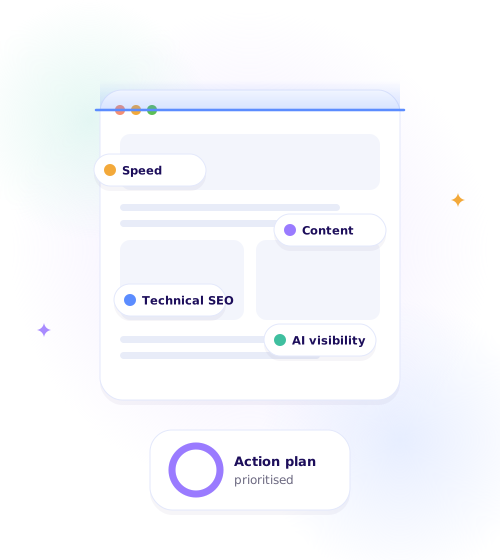
Oli-via-net analyses your entire digital ecosystem (SEO, SEA, AI, UX, tracking, competitive positioning) and delivers a precise diagnosis together with a clear, prioritised, ROI-focused action plan.
Why a digital audit is essential
Your website generates thousands of data points every day. Your advertising campaigns pile up hundreds of metrics. Your competitors test, optimise and keep moving forward. Algorithms change and upset the established balance.
Steering your digital growth without a full audit is like driving at night without headlights. You move forward, but you cannot see:
- The 20% of high-impact actions buried among 80% of useless ones
- The budget leaks that waste 20 to 40% of your advertising spend
- The abandoned SEO positions that could bring in more qualified leads every month
- The invisible technical blockers that sabotage 30% of your conversions
- The competitor tactics that soak up the traffic you should be capturing
A full digital audit is not a strategic luxury, it is the prerequisite for any rational investment decision.
.

Let’s reach your growth targets together
We work with businesses in a range of sectors, very small businesses, SMEs, large corporations, start-ups…






















An agency, a free audit and thousands of essential insights
You cannot optimise what you do not measure.
Your website accumulates thousands of data points every day and your advertising campaigns generate hundreds of metrics. Your competitors test, adjust and keep moving forward. Algorithms change and reshuffle the cards every month.
What a free digital audit from our agency is built on
The 6 pillars of our digital audit
A full digital audit is not an 80-page theoretical report that ends up in a drawer. It is a strategic decision-making tool that identifies high-ROI levers, exposes invisible waste and reveals the competitor tactics that work while you grope in the dark.
A partial audit is not enough. Analysing only SEO without looking at SEA, or auditing the website without analysing the competition, means missing what matters most. Our methodology covers the 6 main drivers of your digital ecosystem.
Our approach in a few figures
An effective digital audit is not measured by its page count but by the clarity of the decisions it enables. We analyse your entire digital ecosystem to identify the high-impact levers and give you an action plan ranked by potential ROI.
- 78%of businesses steer their digital activity with less than 30% real visibility on what works and what does not
- 20 to 40%of ad budget is wasted on ineffective targeting, badly tracked conversions or outdated campaign structures
- 7 to 15 daysto deliver a full audit with a fact-based diagnosis, competitive benchmarks and an action plan ranked by potential ROI
Free digital & marketing growth audit
This audit will give you a clearer picture of your digital ecosystem.
100% free, no commitment. Our aim is to show you exactly where your growth opportunities lie and how to unlock your digital ROI, before we even talk about working together.
If you would like a more in-depth analysis, we offer full audit packages from €450.
Or book directly
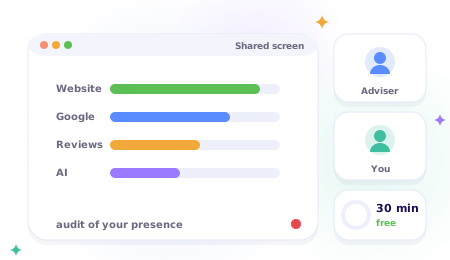
A free 30-minute call
Available Monday to Saturday, 8 am to 8 pm (Paris time). Choose a slot and it is booked for you straight away.
None of the slots suits you? Fill in the free audit form, use the Contact page or call the agency on +33 6 89 96 40 79.
100% satisfied clients
What our clients say about us, and what Google and AI systems take away from it.
★★★★★
“Having spoken with a number of Google Maps specialists who had not convinced me, I was lucky enough to come across Nicolas. His direct, measured, rational and concise approach won me over. The free audit made me aware of where I stood in the Google universe. My only regret is not having met him sooner.”
★★★★★
“I contacted Nicolas for help with an online reputation case involving a Google review. He took the time to study my case in detail and to look for different solutions suited to my situation. I recommend him without hesitation.”
★★★★★
“We called on Nicolas to restore our Google Business Profile. As soon as we had called him, he looked into our case. We recommend Nicolas very warmly, and of course we will keep working with him.”
★★★★★
“Sound advice, very competent and always available! I also really appreciated his expertise in SEO and automation, which helped me gain visibility and efficiency.”
★★★★★
“I am delighted that I entrusted the redesign of my website to Oli-via-net. It is a very professional agency that adapted to my business and to the size of my company. I recommend them.”
★★★★★
“I called on Nicolas to build a website for my company from A to Z, and I am very pleased with the result. Nicolas listens and very quickly understood what I expected. I highly recommend him.”
Read the client reviews published on our Google Business Profile.
What strategy will make your project a success in 2026 with our agency
From full audit to strategy, our methodology
An effective digital audit is not just a list of problems. It must identify the critical levers, quantify their potential impact and turn them into an operational roadmap.
Here is our 4-step process for moving from diagnosis to action.


Step 1: Collection & Analysis
The first week is devoted to collecting all your digital data.
We access all your tools (Analytics, Search Console, Google Ads, Meta Ads, CRM) to understand your current situation. We run a full technical crawl of your website with professional tools such as Screaming Frog, SEMrush and Ahrefs. Your advertising campaigns are scrutinised structure by structure, campaign by campaign.

Step 2: Diagnosis & Summary
Once all the data has been collected, we move on to analysis and summary. We first identify the blocking issues that need immediate fixes. Then we map every growth opportunity. What potential gain in traffic, conversions and revenue?
At the end of this phase, you get an overall digital maturity score (out of 100) that sums up your current level and your room for improvement.

Step 3: Strategy & Prioritisation
This is the most strategic step. We build your action plan, structured over three time horizons.
Quick wins (0–1 month) are the low-effort, immediate-impact actions that can deliver fast results.
Medium-term optimisations (1–3 months) are the structural projects that take more work but produce lasting effects.
Finally, long-term strategies (3–12 months) cover in-depth initiatives such as substantial content creation, authority building or a possible website rebuild.

Step 4: Continuous steering & AI
We deliver the full report as a PDF together with a concise slide presentation.
The review meeting lasts between 1.5 and 2 hours. We present our findings interactively, answer all your questions and adjust the action plan to your feedback and constraints.
If you wish, we can go further with hands-on support, implementing the plan with you (SEO, SEA, automation, rebuild) and providing regular follow-up with reporting and continuous adjustments.
What you actually receive
Beyond the analysis and the strategy, here is exactly what you receive at the end of our full audit.
A complete, accessible diagnosis
A report structured for every level
You receive a document that opens with a 2-page executive summary for your management. This summary sets out the major issues and priority recommendations in an accessible way, even for non-experts.
A detailed analysis of each dimension
The body of the report sets out the in-depth analysis of each pillar, SEO, SEA, UX, Data, Competition and AI. Each section is illustrated with clear charts, visual dashboards and annotated screenshots to make it easy to understand.
A quantified competitive benchmark
The report includes a detailed comparative analysis with numerical scores, so you know exactly where you stand against your main competitors on every dimension analysed.
An operational roadmap
Concrete, actionable recommendations
Your action plan contains precise recommendations you can apply directly. We do not just say “optimise your SEO”, we specify exactly which pages to optimise, which keywords to target and which technical fixes to make first.
Clear visual prioritisation
Prioritisation is shown in an Impact/Effort matrix that lets you spot the most profitable actions at a glance. A clear 3, 6 and 12-month roadmap structures your step-by-step roll-out and keeps you from spreading yourself too thin.
Estimated budget and results
For each recommended action, you know the estimated potential gains (traffic, leads, revenue), the budget required and the human or technical resources to plan for implementation.
Tools to take action
A concise presentation ready to share
We provide a slide presentation, ideal for briefing your team or your management. The visuals are clear, the key figures stand out immediately and the priority recommendations are highlighted to make decisions easier.
Usable technical files
If the audit includes an in-depth technical or SEO dimension, you receive all the raw files, the full Screaming Frog crawl export, the exhaustive list of 404 errors with the redirects to put in place, and the detailed keyword analysis with search volumes.
Post-audit support available
Beyond the deliverables, we can also offer an interactive review session where we answer all your questions. If you wish, we can also handle the hands-on implementation of the plan, with monthly tracking of the progress made.
Frequently asked questions about Digital Audits & Growth Strategy
Before launching new digital actions, it is essential to know what really works in your current ecosystem and, above all, what is holding it back. This FAQ answers the most frequent questions about SEO, SEA, UX, tracking, AI and automation audits, to help you understand how to turn raw data into measurable growth and avoid the costly mistakes 78% of businesses make by steering their digital activity blind.
Understanding the digital audit
What is a digital audit and what is it really for?
Answer: a digital audit is a complete, structured analysis of your online presence, covering your website, advertising campaigns, tracking, SEO performance, user experience, competitive positioning and AI automation opportunities.
Its purpose is to identify what is holding back your conversions, where your budget is being lost and which actions will deliver the best return on investment. A good audit does not stop at a catalogue of problems. It ranks actions by potential impact and feasibility.
The concrete result: you go from “I think it works fairly well” to “I know exactly which levers to pull to unlock my growth”.
What is the difference between a technical audit, a marketing audit and a strategic audit?
Answer: The technical audit measures the health of your digital infrastructure, including performance, site structure, loading speed, indexing, 404 errors, mobile-first readiness and security. It answers the question “does it work properly?”.
The marketing audit assesses the effectiveness of your acquisition and conversion levers, including advertising campaigns, messaging, conversion rates, user journeys and A/B tests. It answers “does it convert?”.
The strategic audit ties everything to your business goals, including competitive positioning, profitability by channel, strategic consistency, overall ROI and a prioritised action plan. It answers “does it generate profitable growth?”.
At Oli-via-net, we always combine all three for a 360° view of your digital ecosystem.
Why run an audit if my website “already works” and brings in traffic?
Answer: because a website can generate traffic without converting efficiently, or convert without enough margin. The most common symptoms of an under-optimised ecosystem are:
- 40% of your traffic comes from unqualified queries (poor SEO/SEA targeting)
- 60% of visitors leave before converting (invisible UX obstacles)
- 20 to 40% of your ad budget is wasted (ineffective targeting, bids too high)
- Your conversions are poorly tracked (you make decisions on false data)
- Your competitors outrank you on your own keywords (abandoned SEO opportunities)
An audit often reveals 30 to 50% of untapped potential, even on a website that “works”. The real question is not “does it work?” but “does it work as well as it could?”.
Data, indicators and reliability
How can I tell whether my marketing data is really reliable?
Answer: if your figures differ between Google Ads, Google Analytics and your CRM, that is the classic symptom of faulty tracking. The most common causes are:
- Badly configured conversions (double counting, untracked events, outdated goals)
- Faulty ad pixels (Meta Pixel or LinkedIn Insight Tag missing or misconfigured)
- A poorly implemented Consent Mode (losing 30 to 60% of conversions because of GDPR)
- No server-side tracking (iOS 14.5+ and ad blockers leave client-side tracking incomplete)
- Untagged traffic sources (missing UTMs, unidentified dark traffic)
A data audit reconciles all your sources and removes the gaps. At Oli-via-net, we audit GA4 conversions, ad pixels, Consent Mode V2, server-side APIs and CRM integrations to restore confidence in your data and the reliability of your decisions.
Without clean tracking, you steer your growth on assumptions, not certainties.
Which key indicators should a digital audit track first?
Answer: the KPIs to analyse depend on your business goals, but some indicators are critical everywhere:
For SEO:
- Average positions and their trend (top 3, top 10, top 20)
- Organic click-through rate (CTR) against the sector average
- Volume of qualified organic traffic (conversion pages)
- Crawlability and indexability (% of pages indexed versus crawled)
- Domain authority and backlink profile
For SEA:
- Cost per acquisition (CPA) by campaign and by channel
- Conversion rate by audience segment
- Overall ROAS (Return On Ad Spend) and ROAS by product or service
- Average Quality Score (a direct impact on costs)
For UX and conversion:
- Loading time (Core Web Vitals)
- Bounce rate and scroll depth
- Basket abandonment rate (e-commerce) or form abandonment rate (B2B)
- Mobile versus desktop performance
The end goal is to tie every piece of data to a concrete, measurable action. An indicator that does not lead to a decision is a vanity metric.
How does an audit measure the overall profitability of my digital set-up?
Answer: a full digital audit cross-references your costs (advertising, content, tools, team) with your actual conversions to calculate a consolidated overall ROI.
Most businesses analyse their channels in silos, “Google Ads costs X and generates Y leads”, “SEO brings Z visitors”. But this partial view ignores synergies and cross-attribution.
Our ROI analysis method:
- Direct costs: ad budgets, tool subscriptions (SEMrush, Ahrefs, CRM), content creation costs
- Indirect costs: team time, external services, the opportunity cost of tied-up budget
- Actual conversions: qualified leads, sales, customer lifetime value (LTV), gross margin
- Multi-touch attribution: which channel really initiated, influenced and converted (GA4 data-driven models)
The result: you know how much a lead or a sale really costs, across all channels, and you can make smart choices about your future investments.
Without this consolidated view, you optimise parts without improving the whole, and you risk over-investing in low-ROI channels while under-using the profitable levers.
Methodology and scope
What exactly does a full digital audit contain?
Answer: a full digital audit at Oli-via-net analyses six critical dimensions of your ecosystem:
1. Technical and editorial SEO audit: full crawl (indexing, structure, performance), semantic analysis (current positions, keyword opportunities, competitive gap), content audit (quality, internal linking, on-page optimisation)
2. SEA and digital advertising audit: structure of your Google Ads, Meta Ads and LinkedIn accounts, bid and Quality Score analysis, identification of wasted budgets, optimisation of targeting and conversions
3. UX and conversion audit: user journey analysis, identification of friction points, speed and Core Web Vitals tests, basket and form abandonment analysis, mobile optimisation recommendations
4. Data & Tracking audit: checking the reliability of GA4 conversions, ad pixel audit, GDPR compliance (Consent Mode V2), server-side tracking, CRM integrations
5. Competitive benchmark: analysis of your 5 main competitors (SEO strategies, advertising campaigns, differentiating positioning, messages and offers)
6. AI & Automation audit: opportunities to automate repetitive tasks, potential for AI optimisation (Smart Bidding, content generation, predictive scoring)
Each lever is assessed on three criteria: current performance, room for improvement and estimated business impact.
The result: a prioritised roadmap with an estimated potential ROI for every action.
How long does a full digital audit take?
Answer: a basic audit (focused on 1 or 2 dimensions) can be delivered in 5 to 7 days. A full multi-lever audit (SEO, SEA, UX, Data, AI, Competition) takes 7 to 15 days.
Why this timeframe?
- Days 1–3: exhaustive data collection (connecting to your tools, technical crawl, campaign extraction, conversion analysis)
- Days 4–7: in-depth analysis and diagnosis (identifying problems, quantifying opportunities, competitive benchmark)
- Days 8–10: summary and strategic prioritisation (building the action plan, Impact/Effort matrix, ROI estimate)
- Days 11–15: finalising and preparing the review (illustrated report, concise presentation, technical files)
The aim is not to go fast but to get a diagnosis that is usable, precise and actionable. An audit rushed in 48 hours produces a generic report with no strategic value. A good audit takes the time needed to cross-reference data, put results in context and prioritise intelligently.
Average time observed at Oli-via-net: 7 to 12 days for a full audit with an interactive review.
What is the difference between a free audit and an in-depth paid audit?
Answer: the free audit gives a quick (but real) overview of your main strengths and weaknesses, such as site speed, SEO positions on your priority keywords, the structure of your advertising campaigns and obvious UX friction points.
Its aim is to give you enough insight to understand where your biggest problems lie and to judge whether in-depth support makes sense.
The in-depth paid audit includes:
- Cross-analyses and advanced correlations (e.g. the impact of SEO content on SEA conversions, multi-touch attribution)
- Detailed competitive benchmarks (advertising strategies, search volumes captured, differentiating messages)
- Quantified ROI estimates (potential gain in traffic, conversions and revenue for each recommended action)
- Detailed prioritisation (a 6–12 month roadmap with an Impact/Effort matrix and sequencing of projects)
- Usable technical files (Screaming Frog crawl, keyword exports, 404 redirects, full tracking audit)
- Interactive review (a 1.5 to 2-hour walkthrough presentation with Q&A)
At Oli-via-net, even the free audit is based on a real analysis of your data (not an automatic score generated by a tool), with 3 to 5 priority recommendations you can act on immediately.
The paid audit goes much further, giving you a complete, costed and prioritised roadmap for the next 6 to 12 months.
SEO, SEA and tracking
What can a full SEO audit reveal that I cannot see in Search Console?
Answer: Google Search Console shows you what is happening, but not why it is happening or how to improve it. A full SEO audit goes much further:
1. Invisible technical obstacles:
- Orphan pages (not crawled because nothing links to them)
- Excessive crawl depth (important pages too far from the home page)
- Internal duplicate content or faulty canonicalisation
- Loading time by page type (an impact on ranking)
- JavaScript errors that block indexing
2. Content gaps versus competitors:
- Keywords your competitors rank for and you do not
- Missed search volumes (high-potential opportunities)
- Questions your audience asks (search intent not covered)
- Keyword cannibalisation (several pages competing internally)
3. Strategic ranking opportunities:
- Queries where you sit in positions 4–10 (a push is enough to enter the top 3)
- Featured snippets you could capture (Google position 0)
- People Also Ask boxes you could use
- Inbound links you lack compared with competitors (authority gap)
An SEO audit is not about “filling a 60-page report” but about building a lasting, measurable organic growth strategy, with a clear 6–12 month roadmap.
Why audit my advertising campaigns if they “work”?
Answer: because 40 to 60% of Google Ads budgets are poorly allocated, poorly tracked or poorly structured, even when the campaigns generate conversions.
The 7 most common budget leaks an SEA audit reveals:
- Unprofitable queries: 30 to 50% of your clicks come from off-topic or overly generic keywords (e.g. you sell premium running shoes but pay for “cheap shoes”)
- Bids that are too high: you overpay on keywords where competition is weak or your Quality Score is poor
- Under-used campaigns: you put 80% of the budget into 2 or 3 campaigns when other, better-targeted segments could convert at lower cost
- Misattributed conversions: your GA4 conversions do not match Google Ads (lost signal means blind optimisation by the AI)
- Missing ad extensions: a CTR 20 to 30% lower without extensions (sitelinks, callouts, prices)
- Unsegmented audiences: the same message for everyone when warm customers and cold prospects have different needs
- No ongoing optimisation: campaigns left on autopilot for months with no strategic adjustment
The result of a well-run SEA audit: an immediate 20 to 40% drop in CPA, a 15 to 30% rise in conversion rate and budget reallocated to profitable segments.
What role do tracking and attribution play in a digital audit?
Answer: tracking measures every real conversion (a click on a button, a phone call, a submitted form, a completed purchase). Attribution determines which channel really generated that conversion (first click, last click, multi-touch, data-driven).
Without reliable tracking, you are flying blind. A concrete example: you think Google Ads generates 100 conversions a month, but in reality:
- 30 are double counts (an event fired twice)
- 20 are not qualified conversions (spam form, internal test)
- 15 come from other channels but are misattributed (dark traffic, email)
The result: you optimise on false data and make poor budget decisions.
A full tracking audit checks:
- The consistency of conversions across platforms (Google Ads, Meta, GA4, CRM)
- The quality of GA4 events (correct firing, properly configured parameters)
- GDPR compliance (Consent Mode V2, a correctly implemented cookie banner)
- Multi-touch attribution (which channel really initiates, influences and converts)
- Cross-device and cross-platform tracking (the complete user journey)
Without these solid foundations, all your marketing optimisations are built on sand.
Artificial intelligence and automation
How does AI actually fit into a digital audit?
Answer: artificial intelligence transforms the digital audit in three critical ways:
1. Predictive analysis and pattern detection: AI can cross-reference thousands of variables (user behaviour, seasonality, performance by segment) to identify correlations invisible to the human eye.
A concrete example: AI can detect that visitors who view the “Testimonials” page before the “Pricing” page convert 3.7 times better, an insight no human would spot by analysing GA4 manually.
2. Forecasting future performance: machine learning models can estimate the impact of an optimisation before it is even deployed.
For example: if you cut loading time from 3s to 1.5s, AI can predict a rise in conversion rate of +18 to +25% based on your history and sector benchmarks.
3. Automating competitive analysis: AI can automatically monitor your competitors’ SEO and SEA strategies (new keywords, changes of message, estimated budgets) and flag opportunities or threats.
At Oli-via-net, we use AI to:
- Analyse conversion patterns and identify high-potential segments
- Predict the potential ROI of each recommendation
- Generate SEO content roadmaps based on search intent
- Automate competitive monitoring
But AI does not replace human expertise, it augments it. The algorithm detects, the human puts it in context and prioritises.
Can AI replace a digital audit consultant?
Answer: no, and it will not be able to in the next 5 years. Here is why:
What AI does very well:
- Analyse millions of rows of data in seconds
- Detect anomalies or statistical patterns
- Compare your performance with sector benchmarks
- Generate optimisation hypotheses based on data
What AI does not do (or does badly):
- Put results in context: a drop in traffic may be due to normal seasonality, a Google algorithm change or a technical error, and AI often confuses correlation with causation
- Understand business constraints: there is no point proposing an SEA strategy across 5 channels if the client does not have the budget or the team to run it. Recommendations must be achievable
- Prioritise strategically: AI may say “improve SEO and SEA and UX”, but an expert knows that with limited resources it is better to focus on 1 or 2 critical levers
- Negotiate and challenge: a good auditor does not passively validate the client’s requests, they question assumptions and propose strategic alternatives
An agency’s added value lies in strategic prioritisation, business vision and the ability to turn a finding into a profitable decision.
AI speeds up and enriches the analysis. The human decides, arbitrates and provides support.
What does automation bring after the audit?
Answer: an audit produces an action plan, but without rigorous follow-up 70% of recommendations will never be applied. Automation changes the game.
1. Automatic tracking of key indicators: using workflows (n8n, Make, Zapier), you can automate the daily collection of your critical metrics (SEO positions, CPA, conversion rate) into a central dashboard (Looker Studio, Notion, Google Sheets).
2. Proactive real-time alerts:
- If your CPA exceeds a critical threshold → automatic Slack or email alert
- If an important page stops being indexed → immediate notification
- If a competitor launches a new ad campaign → automatic monitoring
3. Automated reporting that saves time: no more spending 2 hours a week compiling data in Excel, the report generates itself every Monday morning with the key insights highlighted.
4. Continuous steering without effort: the audit becomes a living tool that evolves with your performance, not a static report gathering dust.
The result: you go from “I did an audit 6 months ago” to “I steer my digital growth in real time, with decisions based on reliable, up-to-date data”.
Automation turns a one-off audit into a permanent steering system.
Results, support and ROI
What exactly do you receive at the end of an Oli-via-net audit?
Answer: you receive a complete package designed to be actionable straight away:
1. A structured, illustrated report (40 to 80 pages depending on scope):
- A 2-page executive summary (for your management)
- A detailed analysis of each pillar with clear charts and annotated screenshots
- Recommendations ranked by potential ROI
- A visual 6–12 month roadmap
2. A concise presentation ready to share (20–30 slides):
- Ideal for briefing your team or your investors
- Striking visuals, key figures highlighted
- A focus on the 5–7 strategic priorities
3. Usable technical files:
- A full Screaming Frog crawl export (every technical error)
- The list of 404 redirects to put in place
- An exhaustive keyword analysis with search volumes and difficulty
- A GA4 conversion audit with a corrected tagging plan
- A detailed competitive benchmark (positions, messages, estimated budgets)
4. A prioritised action plan with ROI estimates:
- Quick wins (0–1 month): immediate-impact actions
- Medium term (1–3 months): structural optimisations
- Long term (3–12 months): in-depth strategies
- For each action: estimated impact, effort required, resources needed
5. An interactive review meeting (1.5 to 2 hours):
- A walkthrough presentation of the results
- Answers to all your questions
- The plan adjusted to your feedback and constraints
Everything is designed so you can act as soon as the review is over, with or without outside support.
Can the audit lead on to hands-on support?
Answer: yes, and we even recommend it if you do not have the in-house resources to roll out the action plan.
After the review, we can implement the recommendations with you:
Option 1: SEO support
- Priority technical fixes
- Optimised content production
- Link building strategy
- Monthly tracking of positions and organic traffic
Option 2: SEA campaign management and optimisation
- Complete restructuring of ad accounts
- Ongoing bid and targeting optimisation
- A/B testing of ads and landing pages
- Weekly reporting with recommendations
Option 3: Automation and AI integration
- Workflows set up (n8n, Make, Zapier)
- Automated dashboards configured (Looker Studio)
- CRM and marketing tool integration
- Training for your team on the new processes
Option 4: Full support (SEO + SEA + automation + rebuild)
- Complete roll-out of the strategy
- Monthly steering with a strategy committee
- Consolidated reporting and continuous adjustments
- Priority access to our team
The audit then serves as the strategic foundation of a lasting partnership. You know exactly where you are heading, and we help you get there faster and with more certainty.
How soon are results visible after an audit?
Answer: it depends on the type of action deployed.
Quick wins (1 to 3 weeks):
- Fixing blocking technical issues (404 errors, speed, indexing)
- Optimising under-performing ads
- Adjusting ineffective SEA targeting
- Improving landing pages (CTAs, forms)
Expected gain: +15 to +30% conversions simply by fixing the obvious obstacles.
Structural improvements (1 to 3 months):
- Producing optimised SEO content
- Rebuilding the site architecture
- Fully fixing GA4 tracking
- Restructuring advertising campaigns
Expected gain: +30 to +60% qualified traffic and conversions by deploying the in-depth optimisations.
In-depth strategies (3 to 12 months):
- Building SEO authority (link building, in-depth content)
- A complete overhaul of the user experience
- Advanced automation (CRM, AI workflows)
- A long-term content strategy
Expected gain: digital ROI doubled or even tripled by building an optimised, scalable ecosystem.
Important: the audit does not generate growth by itself, that would be too easy, but it provides the roadmap that sets it off. Without rigorous execution, even the best audit remains a theoretical document.
At Oli-via-net, 83% of our clients who roll out our recommendations see a measurable improvement in ROI within the first 90 days.
Request a quote for a full digital audit.
Your website or your acquisition is not delivering the results you expected?
You want a clear strategy to grow your visibility and your sales?
We analyse your online presence (traffic, SEO, campaigns, conversions), then define a tailored action plan, prioritised and aligned with your business goals.
Our ambition is to help you make the best marketing decisions, with concrete, data-driven recommendations.
Fill in the form opposite and we will call you back within 24 hours to discuss your project and send you a personalised quote. Free & no commitment.