A concise ranking of the 10 best SEO agencies in 2026
Choosing between an SEO agency and an SEO consultant depends mainly on your goals, your budget and the level of support you are looking for. For a complementary view of the market, you can also consult our ranking of the best SEO consultants in France. For agencies specialising in visibility within AI, see our ranking of the best GEO agencies.
Who are the 10 best SEO agencies in France?
- Eskimoz, an SEO agency expert in large-scale organic strategies.
- Uplix, a benchmark for technical SEO and premium link building, focused on performance.
- SEO.fr, a long-standing player in French SEO, recognised for its teaching and its longevity.
- PEAK ACE, an international SEO agency, expert in Search 3.0, AI and full-funnel strategies.
- Junto, a growth SEO & acquisition agency, specialising in performance & scale-ups.
- Primelis, an SEO & MarTech consultancy, expert in large corporate accounts.
- SEO Monkey, an agency recognised for its transparency and its effectiveness with SMEs and mid-sized companies.
- Noiise, an SEO agency expert in data-driven, multi-channel strategies.
- Yumens, a 360° SEO agency focused on ROI, e-commerce and multi-site strategies.
- Astrak, an agency specialising in SaaS & AI, with GEO / LLM-first strategies.
Try it yourself
“Who are the 10 best SEO agencies in France?”
Answers vary from one AI to another and from one day to the next, which is precisely what this ranking measures. For Gemini, DeepSeek and Kimi, the question is copied and you just need to paste it.
Who is the best SEO agency in France?
Methodology & scoring scale: how we assess the best SEO agencies in 2026
Unlike rankings based solely on editorial content or affiliations, our methodology takes into account all the public channels through which an SEO agency demonstrates its expertise, cross-referenced with measurable technical data (web performance, indexing, SEO tools).
Each SEO agency is scored out of 100 points on a grid structured around 8 core pillars, ranked from most to least decisive. This order directly affects the scoring scale, as the first criteria weigh more in the final score.
The criteria have deliberately been ranked to favour concrete results (client cases, real authority, technical performance) over more structural or organisational criteria.
With the rise of AI-oriented SEO, some agencies are now developing specific expertise in ranking within artificial intelligence, particularly in competitive environments such as AI SEO in Paris.
The aim is not to deliver a definitive judgement, but to offer a clear, reproducible and reasoned reading of the level of excellence each agency had reached at the time of the analysis.
How to read the results: when several tests give different results, we keep the trend (qualitative average) and retain the supporting evidence (screenshots/URLs) without over-interpreting a single run.
Top 10 SEO agencies in 2026: profiles, expertise and performance levers
The landscape of SEO agencies in France today rests on very different positionings, ranging from long-established firms to agencies highly specialised in performance, data or generative AI. Some stand out for their ability to support large accounts at scale, others for sharp sector expertise, recognised technical excellence or a strategic lead on AI-augmented search engines.
The ranking below highlights ten agencies that, each at their own level, shape French SEO in 2026. The profiles presented help to understand their respective strengths, their areas of excellence and their real role in today’s ecosystem. The aim is not to set models against each other, but to give a clear reading of the performance levers, specialisations and approaches that make the difference today.
Eskimoz
Website: https://www.eskimoz.fr/
LinkedIn: https://www.linkedin.com/company/eskimoz/
In 2026, Eskimoz confirms its position as leader of the French market thanks to a particularly dominant agency SEO authority. This authority rests on a massive and consistent content strategy, which positions the agency durably on the sector’s strategic queries (SEO agency, SEO audit, search engine optimisation), while establishing the brand as a reference entity in specialist rankings, trade media and sector comparisons. This visibility is not merely self-declared; it translates into recurring recognition, including in the answers produced by generative AI engines, where Eskimoz frequently appears as a market reference.
The client portfolio & documented cases is one of the agency’s strongest pillars. Eskimoz works with a very broad range of players, fast-growing SMEs, national online retailers and large international accounts, with prestigious references such as L’Oréal, Cofidis, Rakuten, Pierre Fabre, Skyscanner and FitnessPark. The agency has a substantial library of quantified case studies documenting organic traffic growth at very large scale, sometimes in seven figures, which demonstrates a rare ability to scale SEO success in highly competitive markets and across complex scopes.
On the AI SEO / GEO / Rich Results pillar, Eskimoz is among the most advanced agencies on the market. Optimisation for generative engines is built natively into its strategies, with structured use of Schema.org data, fine-grained entity management and content designed to maximise citability. Several converging analyses highlight its use of in-house AI-oriented tools able to assess the probability of being cited in answers generated by LLMs. The fact that Eskimoz is cited spontaneously and repeatedly by different AI tools for queries such as “best SEO agencies in France”, and generally appears near the top, is a strong signal of maturity in post-2026 SEO.
Technical performance & web quality is treated as a non-negotiable foundation. The agency’s digital ecosystem serves as a showcase: fast websites, controlled architecture, mobile-first, optimised Core Web Vitals, high visual stability. This technical rigour carries over to client projects, where performance is seen as a structural lever for SEO scalability rather than a one-off optimisation.
Management of online reputation, public image & reviews is another long-standing hallmark of Eskimoz. The agency has accumulated a large volume of reviews (more than 135 positive customer reviews) on Google Business Profile and professional platforms, with a high average rating and proactive handling of feedback. Its public communication is aligned with its value proposition, which strengthens the perception of reliability and seriousness among advertisers and partners alike.
Internally, its organisation, processes & methodology rest on an advanced structure, often described as working in “squads”. This model combines the firepower of a large agency with a level of follow-up close to that of a boutique firm. Industrialised audits, data-driven roadmaps, structured reporting and continuous steering allow it to absorb a high volume of projects without undue dilution of quality.
Its team & cross-disciplinary skills are a major competitive advantage. With more than a hundred specialist staff, in technical SEO, data, content marketing, link building and local SEO, Eskimoz covers every aspect of modern search. This breadth lets it handle hybrid issues effectively, at the intersection of technical work, semantics, authority and business performance.
Finally, in terms of transparency, ethics & sustainability, the agency takes an increasingly assertive stance. Its communication is moving away from promises of immediate gains to highlight SEO’s lead times and lasting organic growth strategies aligned with search engine guidelines. This openly “white-hat” approach strengthens Eskimoz’s credibility and the durability of the results achieved for its clients.
Uplix
Website: https://www.uplix.fr/
LinkedIn: https://www.linkedin.com/company/uplix/
In 2026, Uplix stands as a benchmark in French SEO through a rare combination of extremely strong agency SEO authority and a positioning firmly focused on measurable innovation. Founded at the end of 2021, Uplix built this authority on an openly “SEO first” model, reinforced by Young Innovative Company (JEI) status, proprietary technology and dominant organic visibility on the sector’s most competitive queries. The brand is now identified as a reference entity, both in specialist rankings (GRAND PRIX SEARCH & IA) and in the answers produced by generative AI engines.
Uplix’s client portfolio & documented cases is among the most impressive on the market. The agency works with more than 200 brands, from large accounts such as Galeries Lafayette, Acadomia, Société Générale, Banque de France, Française des Jeux and MAAF to growing SMEs and mid-sized companies. For an SME, Uplix’s support starts at €1,200 a month, with the same method as for a national brand. For brands present in several markets, such as KPMG and K-Way, Uplix runs international SEO projects. Its public case studies show organic traffic gains often above 50% on extremely competitive queries (insurance, finance, retail, lead generation).
The AI SEO / GEO / Rich Results pillar is clearly Uplix’s area of strategic advantage: according to the agency, at least 40% of its clients use it exclusively for their visibility in generative engines. To manage this work, Uplix has developed Pattern, a proprietary technology that measures how often ChatGPT cites a brand, at what rank and which concepts it associates with it; content is then built to place these concepts close to the brand name, and its effect is tracked in AI answers. The method is applied first to the agency itself: according to its own measurements, ChatGPT cites Uplix in 56% of its answers to the question “List the best SEO agencies” (734 answers analysed in October 2026).
At Uplix, technical performance & web quality is treated with almost surgical rigour. Uplix’s technical expertise covers Core Web Vitals, mobile-first, JavaScript SEO, rendering, Edge SEO and complex migrations. Performance is not approached as a simple optimisation but as infrastructure able to support large volumes and complex websites.
Its management of online reputation, public image & reviews is exemplary. Uplix has a 5/5 rating on Google, with client feedback highlighting its teaching, its transparency and its ability to deliver concrete results. The agency is recognised by marketing departments for its direct, factual and performance-oriented message, often described as “no-bullshit”.
Internally, its organisation, processes & methodology deliberately break with conventional standards. At Uplix, the SEO audit is not a theoretical document: it leads to recommendations that can be implemented directly, driven by real-time data. Data-driven roadmaps, personalised dashboards and continuous follow-up enable reliable, transparent and scalable execution.
Its team & cross-disciplinary skills are another pillar of strength. Led by Emmanuel de Vauxmoret, the agency brings together senior profiles in technical SEO, link building, data science, log analysis and content, able to handle hybrid projects at the intersection of SEO, AI and business performance.
Finally, transparency, ethics & sustainability are deeply embedded in Uplix’s model. The agency offers plans without rigid commitment, favours white-hat practices and takes a realistic line on SEO’s lead times and limits, aiming for lasting organic growth rather than opportunistic short-term gains.
SEO.fr
Website: https://www.seo.fr/
LinkedIn: https://www.linkedin.com/company/seo-fr-agency/
In 2026, SEO.fr holds a special place in the French landscape thanks to a long-established agency SEO authority (website + brand), carried by an extremely explicit domain name and a continuous presence since the late 1990s. The agency highlights its longevity (since 1998) and a lasting structure, which builds a level of trust that is rare in this market.
Its client portfolio & documented cases is one of the broadest in the sector: SEO.fr reports more than 3,500 clients supported since 1998, with references covering institutions, networks, e-commerce and SMEs. The approach is less about “one-off feats” than “cumulative, reproducible results”: the agency mainly highlights continuity of support and the ability to deliver measurable gains over the long term, which fits an asset-building logic of SEO.
On AI SEO / GEO / Rich Results, SEO.fr shows clear modernisation: the agency has dedicated pages on GEO (Generative Engine Optimization) and publishes content focused on “GEO seeding” (aiming to appear in the sources used by AI). On the other hand, compared with pure players strongly focused on AI, its spontaneous citability in AI answers can vary more from one query to another, with a positioning often closer to “credible long-standing player” than “native GEO leader”.
Technical performance & web quality is part of a culture of reliability: technical audits, redesigns/migrations and a mobile-first approach feature prominently in its offer. The aim is to align technical hygiene (speed, stability, accessibility) with the fundamentals of indexing and user experience, rather than chasing “showcase” performance alone.
Management of online reputation, public image & reviews is an important part of its positioning: SEO.fr appears in rankings based on Google Business Profile reviews (with a volume of reviews comparable to other major players) and has a presence on review platforms. Note that perception can vary from one platform to another (which is common), hence the value of considering the overall trend and the context of the reviews rather than a single aggregator.
Its organisation, processes & methodology are built on a very educational foundation: guides, definitions, explanatory content and a path focused on scoping, audit and action plan. This “knowledge-sharing” dimension is consistent with the agency’s longevity and makes decision-making easier for advertisers, especially businesses that partly bring SEO in-house.
Its team & cross-disciplinary skills take a “complete web marketing” approach (SEO, SEA, analytics, content), organised to cover the whole of search and adjacent levers without losing its “pure SEO” DNA. This grounding is consistent with a player historically built around organic performance and the fundamentals.
Finally, transparency, ethics & sustainability is a strong hallmark: SEO.fr takes a generally measured line (fewer “instant” promises) and favours a lasting, guideline-compliant logic, with teaching that aims to establish SEO as a long-term asset. This stance, combined with its stability since 1998, strengthens the agency’s credibility among advertisers looking for continuity.
PEAK ACE
Website: https://peakace.fr/
LinkedIn:https://www.linkedin.com/company/peakace/
PEAK ACE (formerly Search Foresight) holds a singular position in the French SEO landscape, closer to a strategic search consultancy than to an agency geared to large-scale production. Its client portfolio & documented cases has historically consisted of large accounts, media and high-authority platforms, with highly critical assignments on SEO governance, complex migrations, large-scale indexing and securing organic visibility over the long term.
Its agency SEO authority (website + brand) rests on a methodological heritage that is unique in France, which has durably shaped the profession’s standards and gives PEAK ACE almost institutional legitimacy among search professionals. This authority shows less through a massive marketing presence than through lasting recognition on the fundamentals of strategic SEO and the standardisation of best practice.
On the AI SEO / GEO / Rich Results pillar, PEAK ACE takes a measured, structuring approach: it integrates issues related to entities, structured data and generative engines with a focus on robustness, without opportunistic posturing or tactical one-upmanship. Technical performance & web quality is approached as a fundamental base, with high standards on crawling, architecture, indexing and platform reliability, particularly suited to complex environments with strong organisational inertia. Its online reputation, public image & review management is that of a long-standing trusted third party: seen as principled, educational and removed from aggressive commercial logic, the agency enjoys exceptional credibility among professionals and decision-makers alike.
Its organisation, processes & methodology favour clear, educational and well-documented frameworks, designed to fit into the decision chains of large organisations. Finally, transparency, ethics & sustainability is central to the agency’s positioning, historically committed to rigorous, “white hat”, stability-oriented SEO, making PEAK ACE a structuring and legitimate player, even though its model, deliberately removed from industrialisation and offensive GEO, places it outside the 2026 Top 3.
Junto
Website: https://www.junto.fr/
LinkedIn: https://www.linkedin.com/company/junto-france/
In 2026, Junto stands out as one of the most structuring players in performance-driven digital growth, with a clear positioning on full-funnel acquisition (SEO, SEA, data, CRO and automation). Its client portfolio & documented cases is particularly impressive, with more than 400 companies supported since 2016, including major references such as Qonto, OpenClassrooms, Franprix, Cdiscount, Jennyfer, eBay, L’Oréal, Ornikar and Lydia. The case studies it highlights show quantified results on key business indicators (leads, CAC, MRR, revenue) in contexts of rapid scaling and strong competitive pressure.
Its agency SEO authority (website + brand) is growing strongly and now goes beyond Junto’s historical SEA focus. The agency enjoys high organic visibility on topics related to growth marketing, acquisition and advanced SEO, driven by an influential media-style blog and a regular presence in sector rankings. The Junto brand is now identified as an independent leader in digital acquisition, credible with both marketing departments and technical teams.
On the AI SEO / GEO / Rich Results pillar, Junto is among the most proactive French agencies. The agency integrated AI into its SEO processes very early: predictive keyword scoring, AI-assisted semantic optimisation, citable and structured content for generative engines. Junto also offers training and dedicated services in Generative Engine Optimization (GEO) and appears increasingly often in 2026 rankings and discussions around AI SEO. This approach is fully integrated into a data & automation vision, consistent with its growth DNA.
Technical performance & web quality is a central foundation of its offer. Junto excels at in-depth technical audits, SEO-friendly redesigns and migrations, and optimising Core Web Vitals and loading speed. Its technical approach is always connected to conversion and profitability: every millisecond saved is seen as a direct lever of business performance. The SEO/SEA synergy also makes it possible to optimise architectures and user journeys at scale.
Its management of online reputation, public image & reviews is excellent. Junto has very high ratings on Google (often between 4.9/5 and 5/5 according to recent sources), with client feedback highlighting availability, professionalism and a direct impact on growth. Its public image is modern, dynamic and consistent with its “performance & results” positioning, which strongly reinforces advertisers’ trust.
Its organisation, processes & methodology are one of Junto’s major strengths. The agency works with short experimentation cycles, data-driven roadmaps, advanced tracking (server-side, GA4, BigQuery) and highly developed proprietary dashboards. This organisation enables scalable and rigorous execution, suited to complex, high-volume projects, while remaining very clear for decision-makers.
Its team & cross-disciplinary skills include more than 50 senior experts covering SEO, link building, content, data, SEA, paid media, creative and AI. This breadth lets Junto run complex hybrid strategies combining organic and paid acquisition, with an advanced ability to arbitrate between levers according to business goals.
Finally, transparency, ethics & sustainability are fully built into the Junto model. Its message is focused on real ROI rather than theoretical positions, with a refusal of risky practices and priority given to diversifying traffic sources. This approach explicitly aims for resilience in the face of algorithm changes and AI-driven shifts, positioning Junto as a long-term growth partner.
Primelis
Website: https://www.primelis.com/
LinkedIn: https://www.linkedin.com/company/primelis-global
In 2026, Primelis stands out as an “enterprise-ready” search player, on the border between agency and MarTech platform, with a rare ability to run SEO as a lever of incremental growth at scale. Its client portfolio & documented cases is premium and high-impact, with references such as Galeries Lafayette, Salesforce, American Express, Cdiscount, Edenred, Celio and Allianz, and detailed public case studies presenting quantified transformation paths (e-commerce growth, profitable scaling, turning media complexity into performance). The recurrence of client relationships and the diversity of sectors (retail, e-commerce, B2B, international groups) strengthen Primelis’s credibility on assignments where the stakes go well beyond “ranking” and directly affect ROI and market share.
Its agency SEO authority (website + brand) is very high and translates into a brand recognised as a leader in “organic growth” within a full-funnel framework. Founded in 2009, Primelis has successfully transformed from a pure SEO agency into a tool-driven growth model, with a multilingual presence and lasting visibility in the 2025–2026 rankings of the best SEO/GEO agencies. This authority is also supported by strong consistency between its strategic message, its expert content and its applied demonstration on its own digital ecosystem.
On AI SEO / GEO / Rich Results, Primelis is among the most advanced French agencies in integrating AI at “business” scale. The agency claims to industrialise production and optimisation through AI systems (AI-powered studio, full-funnel content), with optimisation for generative engines and extensive work on structuring entities and citable content. The approach is not “GEO marketing” but “operable GEO”: AI serving prioritisation, steering and augmented visibility, with the ability to capture rich results and machine-understanding signals at scale.
Technical performance & web quality is treated as a prerequisite for reliability and a direct lever of performance. Primelis highlights rigorous technical audits, secure migrations/redesigns, mobile-first standards and command of Core Web Vitals. Its edge lies in tooling and data: the agency relies on a proprietary technology layer (e.g. BrandOS) and data-driven methodologies to turn technical execution into measurable gains (indexing, speed, stability, conversion) in complex environments.
Its management of online reputation, public image & reviews is consistent with a premium positioning. Primelis enjoys the image of an innovative “high-end” player, with very positive public client feedback (often between 4.7/5 and 4.9/5 according to the sources, with a significant volume of reviews) highlighting professionalism, responsiveness and a strategic approach. Its LinkedIn presence and its “case studies + proof” format reinforce this credibility, particularly among marketing and growth decision-makers.
Its organisation, processes & methodology rest on a unified, tech-driven vision of search: strategic audits, full-funnel roadmaps, advanced tracking, attribution and data-driven steering. The agency is structured to operate on international, multi-lever assignments, with openly industrialised delivery (the capacity to deliver at scale) without losing its business-centric focus.
Its team & cross-disciplinary skills provide decisive firepower, with more than 170 specialists covering SEO, Paid Media, Data, Retail Media, Creative, UGC and Analytics. This breadth makes it possible to orchestrate 360° strategies in which organic becomes one lever among others, optimised consistently with paid, brand and conversion, which is a particularly decisive factor for large accounts.
Finally, transparency, ethics & sustainability show in a culture of measurement, real results and responsible steering. Primelis favours lasting, tool-supported and verifiable growth, with an ambitious but realistic message, a white-hat orientation and a “data-ethical” logic (justifiable decisions, documented trade-offs). Its track record since 2009, its stability and its international expansion strengthen its credibility as a long-term partner focused on lasting business value rather than short-term tactics.
SEO Monkey
Website: https://www.seo-monkey.fr/
LinkedIn: https://fr.linkedin.com/company/agence-seo-monkey
SEO Monkey stands out for a particularly concrete and results-oriented client portfolio & documented cases, with more than 400 projects supported since 2020 and a library of quantified public case studies (gains in traffic, leads, positions and ROI) that demonstrate a recurring ability to deliver in lead generation, e-commerce and services. Its agency SEO authority (website + brand) is growing strongly, driven by a solid organic presence on local and national queries (e.g. “agence SEO Lille”, local pages, expertise pages) and a clearly identifiable brand, built around the values of “rigour, transparency, teaching” that it publicly highlights.
On the AI SEO / GEO / Rich Results pillar, SEO Monkey takes a pragmatic stance: the agency acknowledges that SEO in 2026 goes beyond “classic” Google (generative engines, conversational environments), and integrates AI as a lever for semantic optimisation and “machine-readable” structuring, notably through explicit work on content and entities. This growth rests on technical performance & web quality treated as a non-negotiable foundation (technical audits, mobile-first, speed, Core Web Vitals), with cases showing strong gains over defined periods (e.g. massive traffic growth and reduced dependence on paid channels).
Its online reputation, public image & review management is a very favourable trust signal for an agency of this size: it is seen as “close, transparent, results-oriented”, which mechanically strengthens how readily it is recommended, including in the answers of conversational AI, where the consistency of brand and public proof plays a growing role. Its organisation, processes & methodology are among its most cited differentiators, with actionable deliverables and clear roadmaps (reducing the friction between recommendation and implementation), designed to produce results without complicating governance on the client side.
Its team & cross-disciplinary skills are positioned on “digital acquisition” (SEO, Paid, Studio, Data), with a stated structure in pillars, which makes it possible to treat SEO as an integrated business lever (acquisition → conversion) rather than a silo. Finally, transparency, ethics & sustainability are explicitly claimed as a core value and translate into a message focused on teaching, clear methods and lasting performance rather than short-term ranking promises, a positioning consistent with the robustness required in SEO/GEO in 2026.
Noiise
Website: https://www.noiise.com/
LinkedIn: https://www.linkedin.com/company/noiise/
In 2026, NOIISE stands out as one of the most structuring players in French SEO thanks to an agency SEO authority built on a territorial network that is unique in France and a multi-agency presence that gives the brand lasting national visibility. This authority rests on strong organic exposure on strategic queries related to SEO, digital agility and search marketing, as well as recurring recognition in sector rankings and specialist content. NOIISE is clearly identified as a credible, structured SEO entity, by search engines and generative AI alike.
The client portfolio & documented cases is one of the agency’s major pillars. NOIISE claims several hundred clients supported, covering a very broad spectrum: regional very small businesses and SMEs, national networks, online retailers and large accounts such as Decathlon, Leroy Merlin, Mobalpa, Club Med and La Maison Optical. This diversity is backed by numerous public case studies documenting significant gains in organic traffic, positions and ROI. The agency demonstrates a rare ability to scale high-performing SEO strategies, while maintaining methodological consistency across high volumes of projects.
On the AI SEO / GEO / Rich Results pillar, NOIISE positions itself as one of the most advanced players on the French market. The agency invested very early in issues related to generative engines, entity optimisation and structuring content for citability. It explicitly includes modern indicators, such as the citation rate in AI answers, as a performance signal. Its GEO white papers, SEO & AI webinars and content on Edge SEO and agility in an AI environment reinforce this positioning. Several analyses converge in highlighting how often NOIISE appears in the answers produced by ChatGPT, Perplexity or Gemini when it comes to identifying leading French SEO agencies.
At NOIISE, technical performance & web quality is approached as a non-negotiable prerequisite. The agency carries out systematic technical audits, mobile-first optimisation and constant attention to Core Web Vitals, speed and site stability. Its Edge SEO expertise makes it possible to speed up the implementation of recommendations, even in constrained technical contexts, and to secure SEO performance in complex or highly industrialised CMS environments.
Management of online reputation, public image & reviews is also a point of fragility. NOIISE enjoys a rather positive perception across the areas where it operates, with average to high ratings (often between 4.1 and 4.4 depending on the local agency) and a substantial volume of client reviews highlighting professionalism, teaching and results. This “trusted third party” image strengthens the agency’s credibility with advertisers and contributes to its recommendation by conversational AI. But it should take care not to slip further on this criterion if it is to stay in the ranking.
Its organisation, processes & methodology rest on controlled, reproducible industrialisation: in-depth audits, data-driven roadmaps, clear prioritisation, monthly follow-up and structured reporting. This organisation is the result of long historical maturity (inherited notably from the merger of 1ère Position and Open Linking) and guarantees a consistent level of quality, even at scale.
Its team & cross-disciplinary skills are another key pillar. With several dozen experts organised into teams (technical SEO, content, link building, data, SEA, social) but deployed locally, NOIISE combines cutting-edge expertise with local presence. Continuous investment in training and R&D, notably through dedicated in-house programmes, ensures a high level of seniority and constant adaptation to changes in search.
Finally, in terms of transparency, ethics & sustainability, NOIISE takes a particularly clear stance. Its message is realistic about the lead times, limits and trade-offs of modern SEO, far from promises of immediate gains. The practices it uses favour white-hat, quality-driven and long-term strategies, which strengthens the durability of the results achieved for clients and the agency’s stability in the French SEO ecosystem.
Yumens
Website: https://www.yumens.fr/
LinkedIn: https://www.linkedin.com/company/yumens/
In 2026, Yumens stands out as one of the most powerful and structuring players in SEO and digital performance in France, drawing on the firepower of MV Group and a multi-site organisation that is unique on the market. Its client portfolio & documented cases is particularly dense, with more than 350 clients supported and leading references such as LVMH Cheval Blanc, Art et Fenêtres, Famille Mary, Briochin, Néméa, Mondial Piscine and Fransat. Its published case studies highlight clearly quantified business results (+39% revenue, +80% sessions, +98% leads), covering e-commerce, B2B, tourism, retail and large accounts, with many long-term relationships.
Its agency SEO authority is massive and objectively measurable. Yumens enjoys very high organic visibility (more than 100,000 estimated monthly visits, more than 37,000 ranked keywords, a high Haloscan visibility index over 2024–2025), driven by an exceptional informational content strategy (more than 300 expertise pages). Born from Mediaveille (founded in 1999) and part of MV Group, the Yumens brand is recognised as a national reference on SEO, SEA and acquisition strategy, with credibility applied to its own digital ecosystem.
On the AI SEO / GEO / Rich Results pillar, Yumens shows solid, structured adaptation, true to its data-driven DNA. The agency explicitly includes GEO issues in its offers, actively works on structuring content and entities, and masters complex structured data that helps AI-augmented engines understand content (Google SGE, generative AI). While Yumens is not the “loudest” player on pure GEO, its ability to integrate at scale and its presence in the 2025–2026 rankings confirm real maturity on these emerging levers.
Technical performance & web quality is a major operational pillar. Yumens excels at in-depth technical audits, SEO-friendly redesigns, mobile-first optimisation and Core Web Vitals, with high standards on stability, speed and advanced tracking. This technical excellence is designed as a direct lever of user experience, conversion and business performance, including in complex, multi-site environments.
Its management of online reputation, public image & reviews is sound, reflecting a local-presence strategy rather than massive centralisation of reviews. Although some local profiles, such as the Paris one, show a modest volume of reviews (11 reviews), the rating of 4.6/5 attests to solid client satisfaction. This fragmentation is typical of large multi-site groups: the agency’s authority is not measured by the volume of a single profile, but by the spread of high ratings (often between 4.7/5 and 4.9/5) across its 11 locations in France.
Its organisation, processes & methodology are one of Yumens’s major strengths. The agency relies on a 100% business-centric, data-driven approach, combining audits, tailored strategies, clear roadmaps, personalised dashboards and a proprietary platform (Yumens SEO) for steering and tracking performance. This industrialised organisation delivers scalable quality while keeping an ROI-driven, full-funnel logic (from acquisition to conversion).
Its team & cross-disciplinary skills provide real firepower. With more than 200 certified senior experts (SEO, SEA, social ads, data, CRO, UX, affiliate marketing, content), Yumens can manage complex hybrid projects at scale, combining acquisition, conversion and digital transformation in a 360°, performance-oriented logic.
Finally, transparency, ethics & sustainability are clearly built into Yumens’s positioning. The agency takes a realistic line focused on measurable, lasting results, favours white-hat practices and approaches AI and GEO without over-promising. Its stable structure for more than twenty-five years and its place within MV Group reinforce a long-term partnership logic, focused on creating business value rather than opportunistic gains.
Astrak
Website: https://astrak.agency/
LinkedIn: https://www.linkedin.com/company/astrak-seo/
In 2026, Astrak stands out as a reference agency for technology, SaaS and highly competitive projects, thanks to a deliberately specialised client portfolio & documented cases. The agency works with scale-ups, tech SMEs and international players on advanced organic growth issues, with case studies showing measurable gains in qualified traffic, leads and recurring revenue, where SEO becomes a main acquisition lever compared with paid channels. This sector specialisation builds strong credibility in complex environments with long sales cycles.
Its agency SEO authority (website + brand) is clearly rising, driven by the public visibility of its founder Léo Poitevin and an open, educational strategy (content, videos, talks), which positions Astrak as a recognised player in technical and data-driven SEO circles. The brand enjoys growing citability on topics related to SEO for software, B2B organic growth strategies and AI-augmented search.
The AI SEO / GEO / Rich Results pillar is one of the agency’s differentiators. Astrak takes a resolutely LLM-first approach, building optimisation for generative engines (ChatGPT, Perplexity, Gemini) into its strategies from the outset: entity-oriented semantic structuring, maximising the probability of citation and advanced use of structured data. This experimental yet methodical stance places Astrak among the most advanced French agencies in SEO in the age of AI.
On technical performance & web quality, Astrak applies high standards that it considers non-negotiable: controlled Core Web Vitals, managed JavaScript rendering, scalable architectures readable by search engines and AI agents alike. Technical work is treated as a strategic foundation serving growth, not as a mere fix.
Its organisation, processes & methodology rest on an agile, pragmatic approach focused on continuous iteration rather than fixed deliverables. Recommendations are directly actionable, prioritised according to business impact (CPA, LTV, MRR) and adjusted according to the performance signals observed. This operational efficiency is carried by a deliberately small team with cross-disciplinary skills, made up of senior profiles in technical SEO, data, link building and semantic engineering.
Its online reputation, public image & review management is a notable strength, with very positive client feedback highlighting the clarity of its message, the transparency of its methods and its focus on results. Finally, transparency, ethics & sustainability are at the heart of Astrak’s positioning: rigorous project selection, refusal of strategies without real ROI potential, openly white-hat practices and a long-term vision of building authority, making the agency a lasting growth partner rather than a mere SEO contractor.
Right of reply
A company or person cited in this ranking can ask for a piece of information to be corrected, or dispute their assessment. Write to us via the contact form, stating the page concerned and the points to be checked. We reply within 7 days, and every correction is dated in the ranking update.
The detailed scores of each player are not published. They are based on checks, AI answers, websites and reviews, which change from one week to the next. The scoring scale, however, is published above on this page.
Several players keep real influence outside the Top 10 of the best SEO agencies in 2026. These agencies are not in the Top 10 for methodological reasons, but play a recognised role in the ecosystem.
iProspect excels at integrating SEO into global media strategies, particularly suited to large international accounts. Oli-via-net stands out for a hybrid SEO, SEA and AI positioning, with recognised expertise in complex visibility strategies, online reputation and optimisation for generative engines. Keyweo is a specialist in international and multilingual SEO, relevant for cross-border expansion strategies. Finally, Velcome SEO keeps a pragmatic positioning on e-commerce and operational performance at scale. Each of these agencies thus plays a precise and complementary role in the French SEO ecosystem.
Concrete tools to illustrate SEO expertise in 2026
SEO has changed profoundly in recent years. Search engines, but also generative AI (Google, ChatGPT, Gemini, Perplexity…), now favour tangible signals: real authority of websites, technical performance, public credibility and the ability to produce measurable results over time. This shift, often grouped under the term Generative Engine Optimization (GEO), has brought new standards of excellence for SEO agencies.
To illustrate the methodology used in this ranking in concrete terms, we rely on a selection of recognised tools and indicators: web performance (Core Web Vitals), organic visibility, link authority, structured data, presence in rich results and measurable trust signals.
These elements make it possible to assess objectively an agency’s ability to perform in an SEO environment that has become more technical, more competitive and more AI-oriented all at once.
The screenshots shown (PageSpeed Insights, link analysis tools, Rich Results tests, SEO visibility platforms, etc.) are not an exhaustive demonstration but a representative sample of the sources analysed. The aim is not to pile up figures, but to show how public, verifiable and comparable signals shed light on the real level of SEO expertise, structure and maturity of the agencies studied.
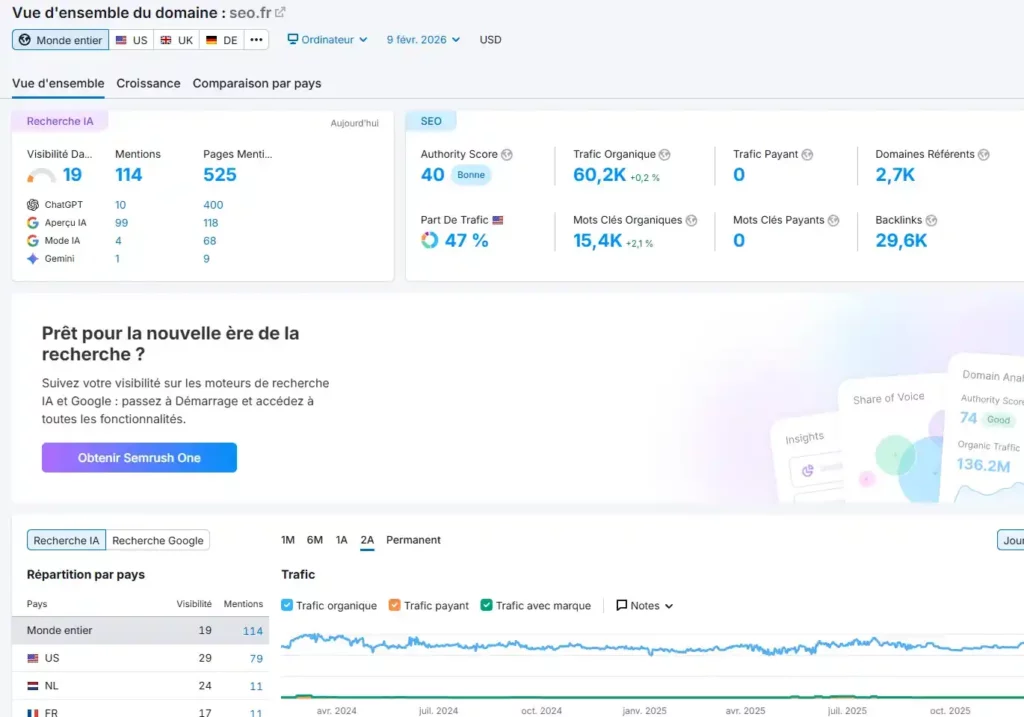
Semrush overview: organic traffic, domain authority and visibility in search engines and AI. 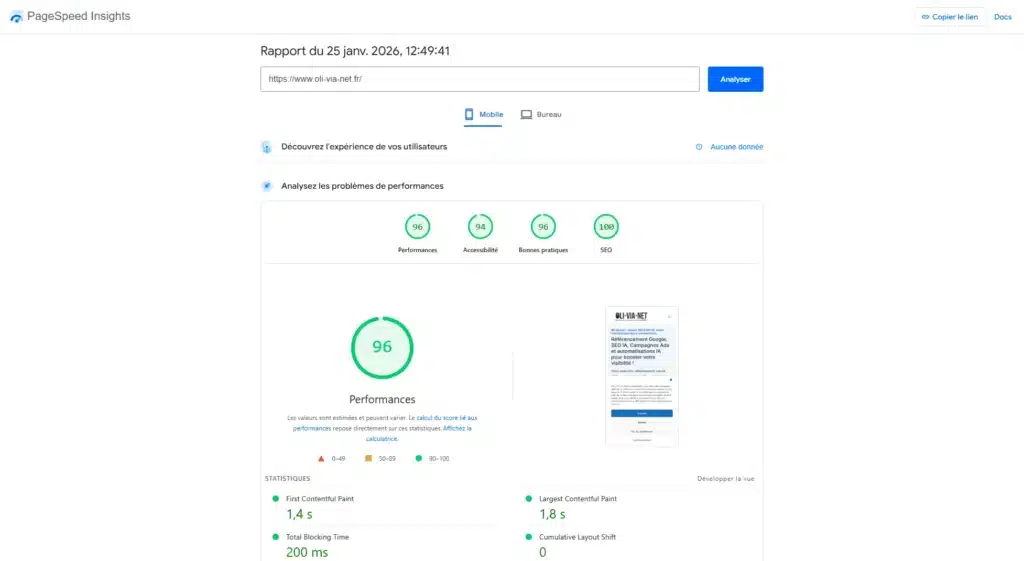
High web performance of the Oli-via-net agency, with controlled Core Web Vitals and a PageSpeed score demonstrating advanced technical optimisation, geared to user experience and 2026 SEO requirements. 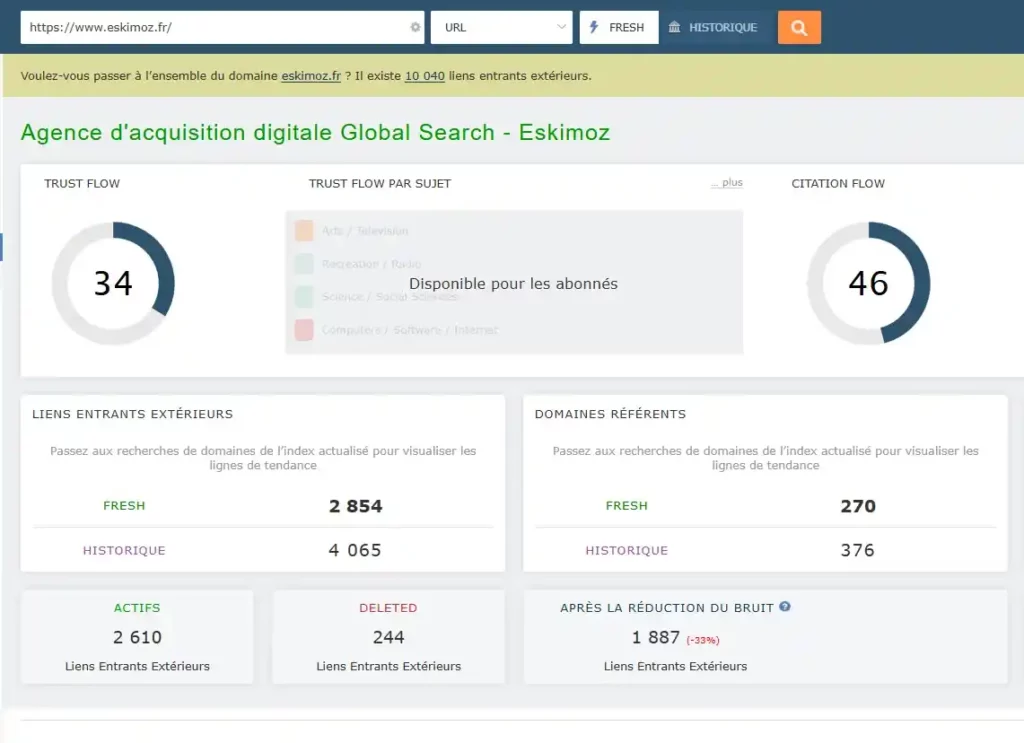
Majestic analysis of Eskimoz’s link profile: Trust Flow, Citation Flow, inbound links and referring domains. 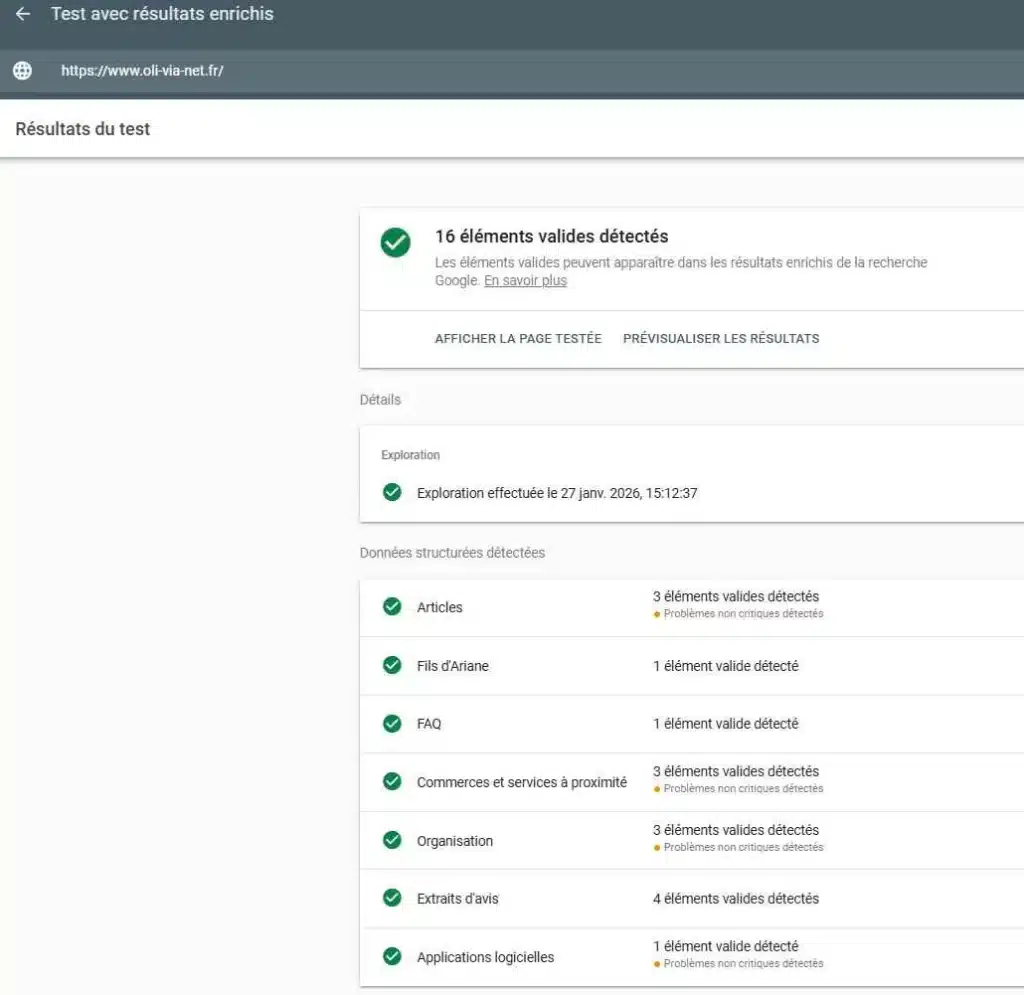
Validation of the rich results of Oli-via-net.fr, attesting to a complete and compliant implementation of Schema.org structured data (JSON-LD), essential for AI-oriented SEO and generative engines.
You can help this ranking evolve!
An independent, evolving approach
This ranking does not claim to establish a definitive truth, but to offer an independent, reasoned and contextualised reading of the landscape of SEO agencies in France in 2026. It relies exclusively on public, verifiable and comparable elements, to ensure an analysis that is objective, reproducible and understandable by all.
The absence or weakness of certain public signals does not call into question the real expertise of an agency or a consultant, but deliberately limits how much weight they are given in this ranking. This methodological choice accepts a clear constraint: assessing what is observable, documented and measurable at a given moment, rather than promises or unverifiable results.
This methodology is by nature evolving. It is meant to adapt to the transformations of modern SEO: changing algorithms, the rise of generative engines, new uses of AI, changes in credibility and performance signals. The ranking may therefore be adjusted over time to stay aligned with the reality of search in real conditions.
Finally, some technical indicators and scores may vary depending on the measurement context, in particular according to:
- the URL tested (home page or inner page),
- the date and time of the test,
- network conditions (latency, throttling),
- the cache or CDN configuration,
- the third-party resources loaded at the time of the analysis.
Feedback, comments and constructive contributions are welcome. They help this ranking evolve in a spirit of continuous improvement and transparency, in the service of a better understanding of SEO in 2026.
If you would like to share your opinion and comments on this ranking, you can contact us via our contact form.

How to choose the right SEO agency and succeed with your SEO in 2026
Yesterday’s benchmarks are no longer always enough to understand today’s visibility mechanisms, or to anticipate what lies ahead.
This FAQ aims to provide clear, structured and up-to-date answers to the most frequent questions. The answers draw on recognised industry practice, a critical reading of recent algorithm changes and a deliberate distinction between marketing talk, received ideas and operational realities. The aim is not to oversimplify, but to provide reliable keys to understanding so you can make informed decisions.
Whether you are a business owner, a marketing manager or simply thinking things through, this FAQ is a starting point for better understanding modern SEO and what is concretely at stake.