
Google Business Profile: what you must plan for from the moment you start your business
A major change is rewriting the rules.
Starting a business in 2026 is therefore no longer just about choosing a name and launching a website. You need to think from the outset about how it will fit with the Google ecosystem. In this article, I explain why, and above all which strategy to adopt.
It is no longer a matter of creating a business and then adapting its Google profile.
You have to do the reverse: think from the outset about a business name that is consistent with your future visibility on Google, then structure your business around that name, making sure you remain credible, consistent and in line with Google’s expectations.
Google has strengthened and automated its control systems, and this is profoundly changing the way businesses must manage their local visibility.
Today, in many sectors, the Google profile generates a significant share of calls, quote requests and in-store visits. It often performs better than a website.
Your business name: an underestimated strategic mistake (and often an irreversible one)
This is the most critical point… and the most often overlooked.
Many businesses try to optimise their Google profile by adding keywords, a city or a description of their activity directly to the name. For years, this approach helped improve local rankings.
The result: more and more Google Business Profiles are being suspended overnight, sometimes with the total loss of the reviews they had built up. For some businesses, this means an immediate collapse in customer acquisition.
That way of working therefore belongs to the past. With automated checks, these practices are now detected and considered non-compliant. Google expects a clear match between the name displayed, the administrative reality and the presence on the ground.
This means your name must be consistent with:
- your registered company name
- your shop sign (if you have one)
- your real presence (physically visible or verifiable)
A real case: Google changes the name automatically
To illustrate this concretely, here is a real case I handled recently.
A bathroom specialist in Paris, trading under the name “Les Bains d’Alexandre”, had a properly optimised Google profile for several years.
Following a report by a competitor or an automatic update, Google changed the profile’s name and replaced it with the company’s legal name, “Décoration Générale”.
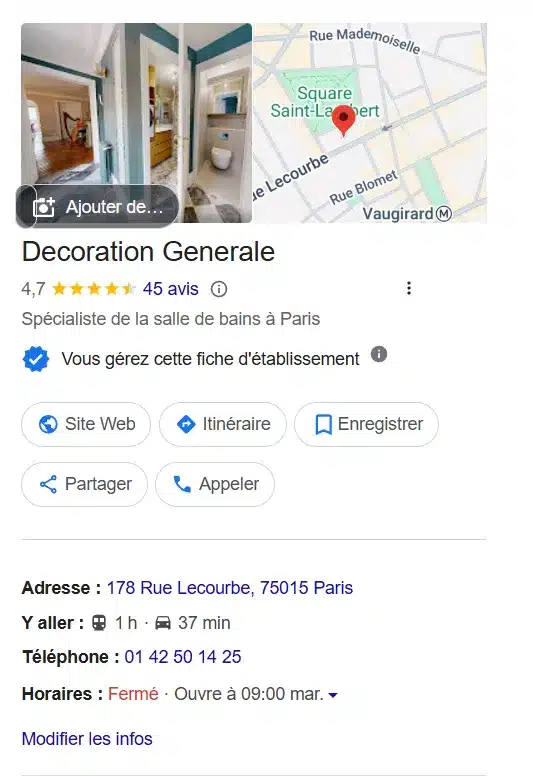
👉 This kind of change is becoming more and more frequent.
Google can cross-reference data from various official databases, including:
- INSEE
- Infogreffe
- Papers
- Société.com
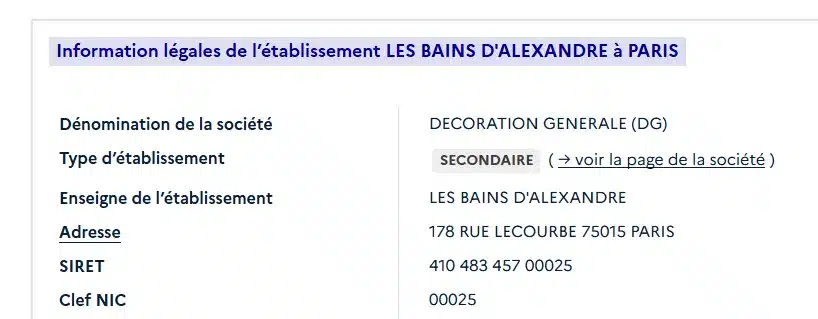
When the name displayed on the profile does not clearly match the administrative information, the system may decide to correct the title automatically.
Why the name was changed
In this specific case, Google considered that:
- the name “Les Bains d’Alexandre” was not sufficiently linked to the official data
- the name “Décoration Générale” was the main reference
The result: the profile was changed without any action by its owner.
How we restored the name

We were able to restore the name “Les Bains d’Alexandre” for two essential reasons.
First, it really is the establishment’s declared shop sign name, which makes it legitimate for display on the profile.
Second, we provided clear visual proof:
a photo of the shopfront showing the “Les Bains d’Alexandre” sign, visible from the street.
👉 This point is decisive.

Google does not rely only on administrative data, but also on the reality on the ground. A visible, verifiable shop sign becomes a strong signal of legitimacy.
What to take away from this case
This case perfectly illustrates the current limits of the system.
If the business had not had:
- a real shop sign
- consistency between its trading name and its activity
- usable visual proof
it would have been very hard to get back to the original name.
In some cases, the only solution is even to change the shop sign’s name administratively so that all the signals line up:
- legal data
- physical presence
- Google profile
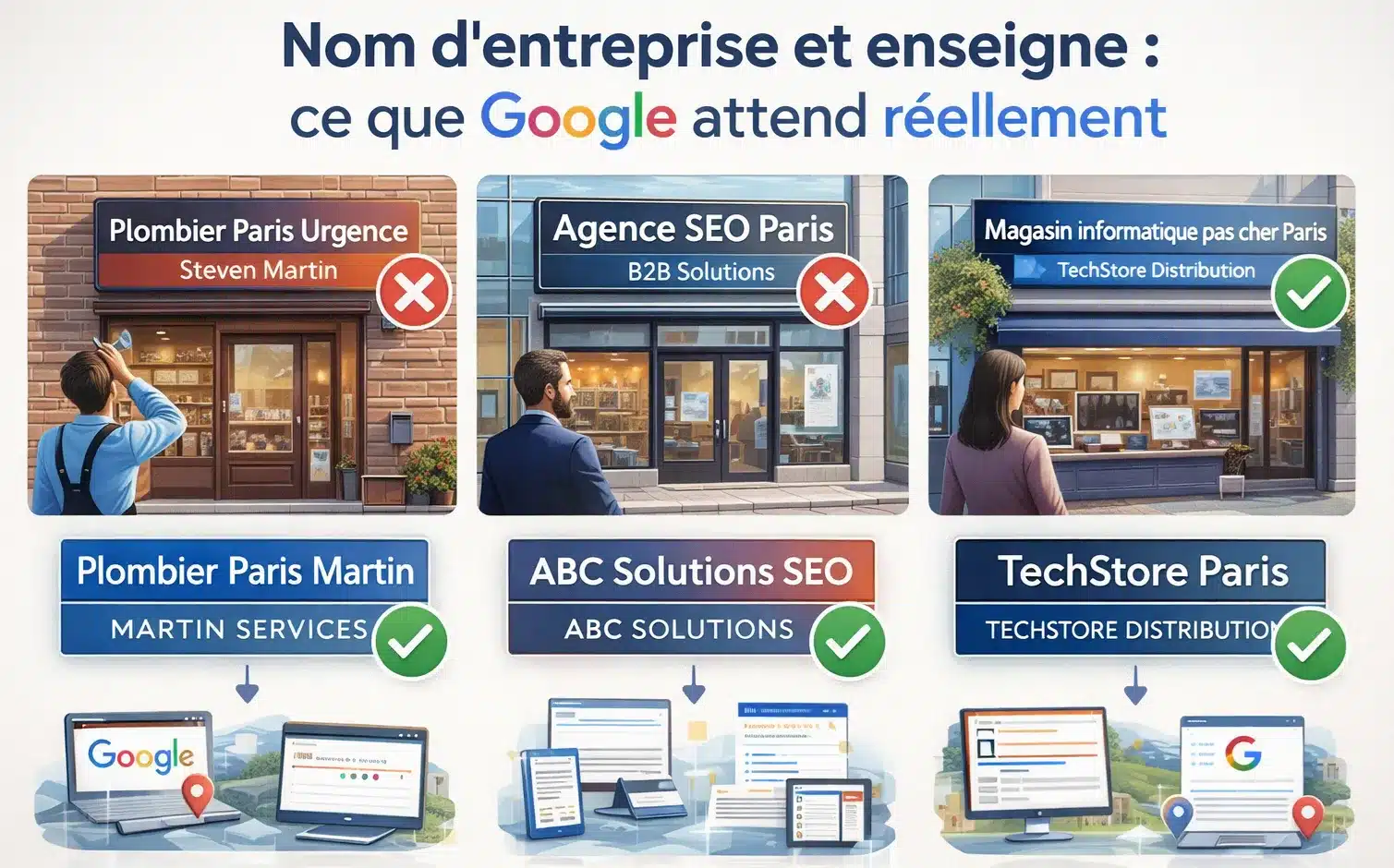
The real strategy therefore consists of planning ahead from the moment the business is created.
Let us take a simple example:
A tradesperson creates a company called “Martin Services” and then tries to appear on Google as “Plombier Paris Urgence” (emergency plumber Paris). This inconsistency becomes a negative signal.
Conversely, a business owner who chooses a shop sign such as “Plombier Paris Martin” from the start aligns:
- their commercial identity
- their Google profile
- their local visibility
The real strategy I recommend, and which seems to me increasingly unavoidable, is to think from the outset about the name you will actually use in your business (shop sign, communication, website…) and to make sure it will be consistent with your future visibility on Google. The aim is to align your registered company name, your shop sign, your presence on the ground and your local visibility from the start. Ideally, the sign displayed on site should be consistent with the name used on your Google profile, without trying to over-optimise or create an artificial gap.
⚠️ An important limit to understand
There is, however, one essential point to bear in mind. Choosing an optimised or even perfectly legal business name in no way guarantees that Google will accept it.
Contrary to a widespread belief, Google does not rely only on administrative data. It applies its own rules, based on its perception of legitimacy and overall consistency.
A name can therefore be legally valid… yet refused, changed or penalised by Google if it is judged non-compliant.
In practice, Google will analyse whether the name is really used on your shop sign, on your website, in your communications and in your wider environment.
That is why the strategy is not to “optimise to the maximum and stuff your business name with keywords”, but to stay in a credible, consistent and verifiable zone.
Google no longer takes you at your word:
As a senior SEO consultant, I have been observing a very clear change in Google’s control systems for several years. We have now entered a logic in which data is cross-referenced on a large scale and a business’s overall consistency is systematically analysed. Algorithms now cross-reference a considerable volume of data:
- official registers (INSEE, Infogreffe, public databases)
- the content of your website
- the information on your Google profile
- your legal notice
- user signals
- visual elements (photos, Street View)
The aim is simple: to check that your business really exists as it is presented.
This implies a fundamental change:
it is no longer possible to build local visibility on an approximation or an “optimised” strategy.
For example, claiming to be based in Paris while operating from Orléans becomes very hard to sustain. Inconsistencies are detected quickly, notably through data correlation.
Google no longer just seeks to index, it seeks to validate the overall credibility of an entity.
Customer reviews: the end of artificial strategies
The same phenomenon applies to reviews. How to avoid negative reviews, or report fake reviews.
For a long time, some businesses tried to influence their reputation by asking friends and family or by generating indirect reviews.
Google can now cross-reference user accounts, their interaction histories, their browsing behaviour and their location data, which lets it identify signals of consistency or, conversely, anomalies.
A review left by a user who has never been in a geographical area consistent with your activity becomes a weak, even suspicious, signal. Likewise, repetitive patterns or close links between accounts can be detected.
What Google is trying to measure is no longer just a volume of reviews, but the consistency between the experience the user describes and the reality observed through their signals.
Physical address: an increasingly checked criterion
Showing an address on Google Maps is a powerful lever, but it is regulated.
To be eligible, a business must be able to welcome customers in real conditions:
- an accessible place
- an identifiable activity
- visible signage
With tools such as Street View, photos or verification videos, Google can check these elements.
Fictitious addresses, registered-office addresses with no real activity and simulated presences are increasingly detected. In time, these practices are set to disappear completely.
Service area: a strategic alternative
For service providers, showing an address is not always relevant. In many cases, it is better to use a service area.
This model lets you define an area of operation consistent with the business’s real activity. It avoids the inconsistencies linked to a non-compliant address while keeping good local visibility.
Google now recommends this approach in many cases, especially for businesses that do not welcome customers on site.
Automated checks: a paradigm shift
The most important change remains automation.
Google now uses advanced analysis systems combining artificial intelligence, image recognition and behavioural analysis. These systems can identify inconsistencies, detect anomalies and automatically trigger checks when suspicious signals are detected.
What is changing is not only the level of scrutiny, but its speed.
Where some practices used to go unnoticed for months, they can now be detected within a few days.
Profile changes: an underestimated risk factor
Another critical point concerns changes.
Regularly changing a profile’s name, category or key information can send negative signals to Google’s control systems.
When a profile starts to be monitored, each additional change raises the level of scrutiny. That is often when suspensions happen.
An effective strategy therefore rests on:
- a solid initial set-up
- consistency over time
- a measured approach to changes
Conclusion
Google Business Profile is no longer just a visibility lever. It is now a system for validating a business’s credibility. Name, address, activity, reviews: everything is analysed, cross-referenced and checked.
Artificial optimisation strategies are gradually disappearing in favour of a model based on consistency and transparency. In this context, businesses that plan ahead from the moment they are created gain a considerable lead. The others expose themselves to blocks, suspensions and a sudden loss of visibility.
The difference is no longer made on technique alone, it is also made on structure.
Sources & references
- Google Business Profile Guidelines (Google, updated 2025–2026)
- Google Search Central – Local SEO & Entity Validation (2025)
- BrightLocal – Local Consumer Review Survey 2025
- Whitespark – Local Ranking Factors 2025
- Statista – Local Search Behavior Europe 2025
- Deloitte – Digital Consumer Trends 2025
- McKinsey – The Future of Local Commerce 2025
Written by
Nicolas Peter, Web Performance, certified Google Ads expert in Paris and Perpignan
Oli-via-net agency
Request your free quote to improve your online reputation.
Is your Google profile not getting enough reviews?
Are a few negative reviews hurting your image?
Or do you want to professionalise the way you handle customer feedback?
We put in place a complete strategy to:
- increase the number of positive reviews,
- keep your ratings on Google & Trustpilot under control,
- improve your reputation and your conversion rate,
- showcase the quality of your service.
We combine automation, editorial support and legal compliance for a solid, lasting reputation.
➡️ Fill in the form opposite and we will get back to you within 24 hours with a personalised proposal.
No commitment.