Google has already announced an update for December. What should you do on your website before then?
On 24 November 2026, Google did something unusual. It announced a core update to its algorithm before launching it.1 The December 2026 update will roll out in December, in every country and every language where Google Search is available.1 The same day, the November update came to an end.4
For a small or medium-sized business, that leaves a few weeks. Here is what we know, what we do not know yet, and what we check on our clients’ websites before December. Nobody can promise what an update will do to a ranking, and that is not what this article is about. The point is not to go through it blind.
What Google announced, and what it does not say
The announcement was published on 24 November at 7:03 am Pacific Time, on the Google Search Status Dashboard.1 It covers two points. First, better understanding and ranking relevant content, including for long and complex questions. Second, improving personalised results for people who have turned personalisation on.1
Google gives neither a date nor a scale. Asked the same day, a spokesperson explained that there was no date yet, that the launch would be announced as usual on the day it starts, and that it was “not imminent”.2
Tool
When should you analyse your figures after an update?
How the calculation works
Google advises waiting at least one full week after the rollout ends before analysing your site in Search Console, then comparing the week after the end with the week before the start. The start and end dates are published on the Google Search Status Dashboard. The pre-filled dates are those of the November 2026 update.
Why Google is giving notice
On the same day, 24 November, Google updated a page of its documentation about how it announces its changes.3 It explains that it gives advance notice when a change requires action from site owners or may move rankings significantly, for example a core update.3
The page also states that, for changes that may noticeably shift the rankings seen by users in the United Kingdom, this notice meets the fair ranking requirements that the UK competition authority, the CMA, imposes on Google.3 The page only mentions the United Kingdom. But the December update applies everywhere, so French websites benefit from the notice too.
November has just ended, do not mix the two up
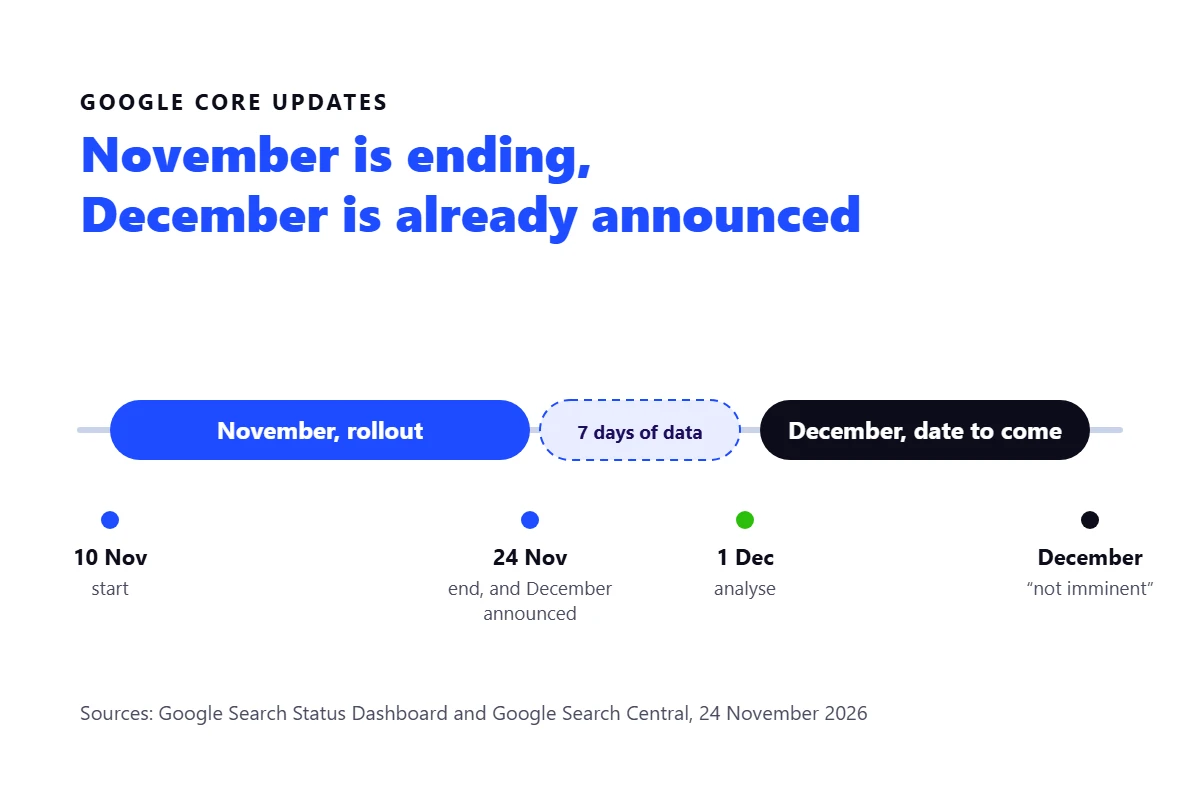
The November 2026 update started on 10 November and ended on 24 November at 6:03 am Pacific Time.4 Google advises waiting at least one full week after a core update ends before analysing your site in Search Console. It then suggests comparing the week after the end with the week before the start.5
For November, the figures can therefore be read from 1 December. If the December update starts soon afterwards, the window will be short. Write down the dates of each rollout now, so you know which one a change should be attributed to.
Not all drops are equal. Google mentions a page that went from 2nd to 4th position, which does not call for a radical change, and a page that went from 4th to 29th, which deserves a closer look. It also advises looking separately at web search, Google Images, videos and Google News.5
Long and complex questions, which pages are affected
Google does not list the pages targeted. In our view, on a small business website, the first ones are those that answer a precise question asked as a full sentence. Price and lead-time pages, service pages that set out conditions, comparisons, FAQs, advice articles. These are also the questions people now ask Google’s AI Mode.
For these pages, Google’s guidance does not change. Look at the site as a whole, objectively, and run the most affected pages through its self-assessment questions. Improve the content in a way that is useful to the reader, for example by rewriting or restructuring it so it is easier to read. Only delete a page as a last resort.5 This is the method we apply in our SEO support.
Personalisation, two people will no longer see the same result
This second strand comes on top of an announcement made the day before. On 23 November, Google said that AI Overviews and AI Mode will tailor their answers to each person’s recent searches, and may draw on connected apps such as Gmail, Calendar and Photos, then Google Wallet, which is starting to roll out.6 Personalisation can be adjusted and turned off at any time in the search settings.6
In practice, a position checked from your own Google account says nothing about what your customer sees. That is why we take our readings in neutral browsing, with no account signed in, and date them. Search Console remains the reference measure, since it aggregates what all users have seen.
What we do for our clients before December
- Date it. We record the start and end of each update, as Google publishes them.
- Keep a baseline. We export Search Console pages and queries before the December launch, so we can compare afterwards.
- Review the pages that answer long questions. We start from queries phrased as full sentences, and check that the page answers them clearly, right from the start.
- Check in neutral browsing. Our position and AI citation checks are made with no account signed in, on fixed dates.
- Change nothing in a rush. Google recommends changes that make sense for users and last over time, not hasty fixes.5
A well-built page has nothing to fear from an announced update, and a fragile page now has a few weeks to be reworked. If you want to know which of your pages to review first, let’s talk.
Frequently asked questions
When will Google’s December 2026 update take place?
Google has only said that it will roll out in December 2026. There is no date yet, and Google will announce the launch on the day it starts.
What does the December 2026 update change?
It aims to better understand and rank relevant content, including for long and complex questions, and to improve personalised results for people who have turned personalisation on.
Is Google’s November 2026 update over?
Yes. Launched on 10 November 2026, it ended on 24 November 2026.
When should you analyse your figures after a core update?
At least one full week after the rollout ends. For the November 2026 update, that means 1 December. Then compare the week after the end with the week before the start.
Why is Google announcing this update in advance?
Google now gives advance notice of changes that may move rankings significantly. For the United Kingdom, this notice meets the fair ranking requirements of the UK competition authority, the CMA.
Should you change your website before the December update?
Not in a rush. Google recommends improvements that are useful to readers and lasting. The right time to review the pages that answer long questions is now, without changing everything.
Our sources
- Google Search Status Dashboard, “December 2026 core update”, 24 November 2026. Read
- Search Engine Roundtable, “Google December 2026 Core Update Preannounced”, 24 November 2026. Read
- Google Search Central, “Stay informed about Search updates”, updated 24 November 2026. Read
- Google Search Status Dashboard, “November 2026 core update”, 10 to 24 November 2026. Read
- Google Search Central, “Google Search’s core updates and your website”, accessed 24 November 2026. Read
- Google, Robby Stein, announcement on personalisation in AI Overviews and AI Mode, 23 November 2026. Read
Free SEO & Digital Marketing Audit
Get a personalised analysis of your website in under 48 hours.
100% free, no commitment. Our aim is to show you how to generate more qualified traffic, more leads and more sales.